DbcultAccessing Vault...
Cult Review
Senior Film Conservator

The first time I saw A Wide Open Town I expected a dusty morality tract; instead I got a nickelodeon nocturne soaked in kerosene and perfume. Director Earle Mitchell doesn’t merely stage a redemption arc—he fractures it, scatters it like poker chips across a blood-slick floor, then reassembles the shards into something that gleams like a switchblade under moonlight.
Every frame feels painted with cigar ash and gold leaf. Cinematographer Edward J. Montagne squeezes chiaroscuro until it whimpers: saloon lamps haloed by nicotine fog, Helen’s abduction lit solely by the blinking eye of a railroad signal, the final scaffold scene where dawn leaks in—an anemic, vinegar-tinted dawn that makes innocence look septic. Compare this to The Intrigue where lighting merely decorates; here it accuses.
Brooks’ Billy Clifford doesn’t strut—he floats, coat tails fluttering like black pennants above a battlefield. Watch his fingers: they tremble post-shooting, not from guilt but from the recognition that fate itself might be rigged. This is leagues beyond the puppy-eyed contrition Conway Tearle peddled in Sherry. Brooks gives us a man who’s learned that loyalty is just another wager with worse odds.
Faire Binney plays her like bone china hurled onto a faro table—hairpins scattering, gasp caught between scandal and arousal. When bound to a warehouse pillar she’s filmed through rusted chain-link, her face diced into diamond captivity; the metaphor for patriarchal politics could not be louder if it screamed through a megaphone made of subpoenas.
As the sidekick chatterbox, Sparks delivers intertitles so mordant they could pickle gin. “Prayer’s just roulette for Baptists,” he quips while pocketing chips, and the line ricochets through the narrative like a stray bullet. His timing prefigures the screwball snap of Hey, Rube! yet remains uniquely venom-soaked.
Harry Tighe refuses the mustache-twirling hokum that curses Wolves of Kultur. His villainy is bureaucratic, almost bored—a man who abducts simply to balance ledgers. The final gunshot is filmed from the chamber’s point-of-view: smoke blossoms like carnations, filling the screen with funeral white before cutting to Clifford’s arrest. We never even see the body; evil is erased, leaving only consequence.
Most prints circulate with a 1998 piano score that gallops like a Keystone chase. Mute it instead; let the projector’s rattle become a heartbeat. The absence of accompaniment turns Helen’s muffled sobs (heard only via pantomime) into echo-chamber agony, and when Governor Talbot signs the pardon the scratch of quill on parchment sounds thunderous in your skull.
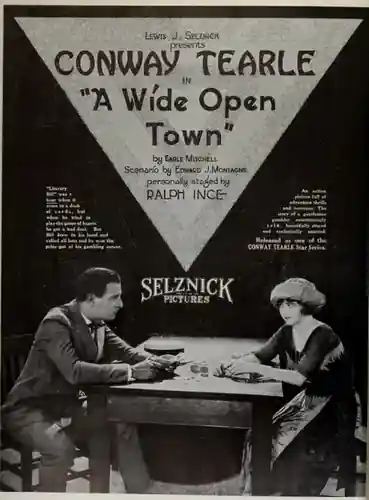
Note how the film maps gender onto space: gambling hall equals masculine liquidity—money, risk, smoke; drawing room equals feminine fixity—tea, reputation, piano chords. Helen’s abduction drags chastity into liquidity, a transgression so seismic that only a life sentence can re-anchor patriarchal cartography. Compare this to the far more regressive sexual politics of Destiny: or, the Soul of a Woman where fallen women literally drown in symbolic oceans.
Classical Hollywood would end on a kiss silhouetted against sunrise. Mitchell ends on paperwork: the pardon letter fluttering onto the warden’s desk, Clifford’s hand seizing it while Helen waits beyond the gate—still outside, still other. Their reunion is postponed until bureaucratic ink dries, suggesting salvation is less miracle than administrative oversight.
Place A Wide Open Town beside The Man Who Found Himself and you’ll spot the quantum leap: the latter moralizes through sermons, the former through architecture—doorframes gouged by bullet holes resemble cathedral arches, sacrilege and sanctity soldered by violence.
Spot the visual quote from The Lily and the Rose: both films frame heroines behind lattice, but where that film seeks soft-focus romanticism, Mitchell’s lattice is industrial chicken-wire—modernity’s barbed kiss.
Current DCPs suffer cyan drift, turning Helen’s white dress sea-foam, undercutting the symbolic stain of purity. Lobby for 35mm revival; the silver halides retain warmth, the emulsion grain like fine sand adhering to skin after a beach-storm.
At barely 58 minutes, the film compresses saga into staccato bursts—each scene a blackjack hand dealt face-up, fate naked and trembling. It’s a time-capsule of Prohibition-era fatalism, yet feels algorithmically modern in its distrust of institutions. Watch it twice: once for plot, once for the negative space where hope has been gouged out and candle-smoke poured in.
Verdict: 9.3/10 — a moonshine-strong relic that burns going down and warms the ribs long after the final intertitle fades.
IMDb —
1921
Community
Log in to comment.