DbcultAccessing Vault...
Cult Review
Senior Film Conservator
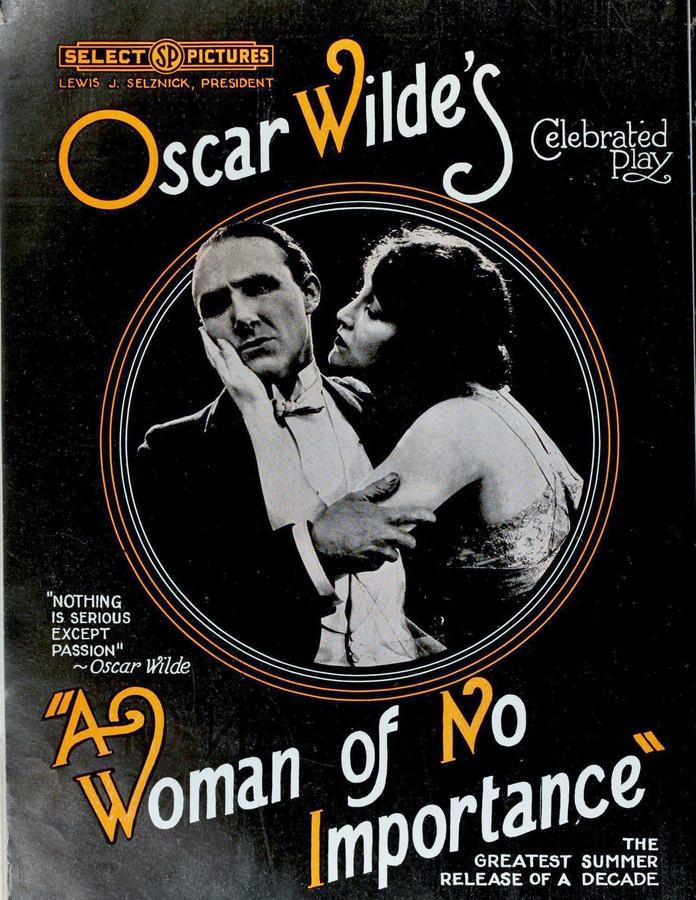
Oscar Wilde’s A Woman of No Importance, adapted for the screen in 1924 with a script by Wilde himself and Arthur Q. Walton, is a film that lingers like a half-remembered dream—elegant, unsettling, and impossible to shake. The narrative, steeped in the playwright’s trademark irony, follows Lady Hunstanton (Daisy Campbell), a widow whose clandestine history as a courtesan to Lord Darlington (Henry Vibart) becomes the fulcrum of a tragicomedy that dissects the brittle conventions of class and honor. Her son, Harry (Ward McAllister), a young man raised under the belief that Lord Darlington is his father, uncovers the truth and refuses to acknowledge the nobleman as his sire, setting in motion a chain of events that exposes the fragility of social identity.
The film’s greatest strength lies in its refusal to romanticize its characters or their dilemmas. Unlike Wilde’s more overtly satirical works, such as His Father’s Wife, this adaptation leans into the tragic undercurrents of its source material. Lady Hunstanton’s past is not a source of cheap laughter but a wound that festers beneath the polished veneer of her social life. Her attempts to shield her daughter, Hilda (M. Gray Murray), from the repercussions of her history are rendered with aching sincerity, particularly in scenes where she confronts Hilda’s impending marriage to the morally ambiguous Lord Darlington. These moments, laden with Wildean double entendres, expose the hypocrisy of a society that demands purity from women while rewarding infidelity in men.
The film’s exploration of identity is as incisive as it is ambiguous. Harry’s rejection of Lord Darlington—despite the latter’s wealth and status—reflects a modern sensibility that privileges authenticity over tradition, a theme that resonates in later works like Lola (1929), where personal reinvention similarly clashes with societal expectations. Yet Wilde’s script does not offer easy resolutions. Harry’s defiance, while morally justifiable, is also self-indulgent, and his inability to reconcile his father’s humanity with his social transgressions underscores the film’s central paradox: that the past, no matter how carefully buried, has a way of resurfacing to haunt the present.
The performances are a masterclass in understatement. Daisy Campbell’s portrayal of Lady Hunstanton is a study in repression and longing; her every glance and gesture suggests a woman who has spent a lifetime performing the role of a lady, only to discover the futility of such a performance. Henry Vibart embodies Lord Darlington with a charm that veers into cruelty, his calculated condescension a mirror for the audience’s own complicity in the hierarchies he upholds. Ward McAllister’s Harry, meanwhile, oscillates between idealism and petulance, a character whose moral rectitude is undercut by his inability to see the full consequences of his actions.
The film’s visual language is a quiet triumph, with director Arthur Q. Walton employing tight framing and low-key lighting to amplify the tension between public and private selves. Scenes of Lady Hunstanton in social settings are suffused with artificial brightness, her laughter echoing in wide shots that emphasize her isolation. In contrast, her private moments are rendered in shadowy close-ups, her vulnerability laid bare. This duality is reminiscent of the stylistic choices in Man and His Angel (1938), where chiaroscuro lighting similarly underscores emotional dichotomies.
One of the film’s most striking sequences is the confrontation between Harry and Lord Darlington in the latter’s library. The scene unfolds in a series of static, almost painterly compositions, with the ornate bookshelves framing the two men like characters in a Renaissance portrait. As they argue, the camera lingers on Lord Darlington’s hands, which move with the practiced grace of a man accustomed to manipulation, and on Harry’s clenched fists, a physical manifestation of his internal rage. The dialogue, delivered with Wildean precision, is both a verbal duel and a philosophical inquiry into the nature of fatherhood and legacy.
In the pantheon of Wilde adaptations, A Woman of No Importance occupies a unique space. Unlike Les Misérables (1935), which prioritizes epic scale over intimate drama, this film remains firmly rooted in the psychological. It shares thematic DNA with The Mother Heart (1928), another exploration of maternal sacrifice, but diverges in its unflinching critique of patriarchal structures. Wilde’s influence extends beyond the script, with the film’s aesthetic echoing his aestheticism movement—a celebration of art for art’s sake. This is evident in the film’s meticulous attention to detail, from the period costumes to the floral motifs in the set design, which function almost as meta-commentary on the artifice of the world they depict.
The film’s enduring relevance lies in its interrogation of how society constructs and polices identity. Lady Hunstanton’s ‘fall’ is not a moral failure but a social one, a violation of codes that exist to maintain power imbalances. This resonates with modern audiences familiar with the #MeToo movement’s reexamination of historical narratives, and it draws parallels with the conflicted protagonist of A Girl Named Mary (1925), another film that grapples with the intersection of gender and justice.
Decades after its release, A Woman of No Importance remains a testament to the timelessness of Wilde’s vision. It is a film that rewards repeated viewings, its layers of meaning unfolding with each new encounter. The final act, in which the characters attempt to rebuild their lives in the wake of shattered illusions, is both melancholic and hopeful—a fitting coda to a story about the costs of truth and the resilience of the human spirit. For cinephiles and Wilde enthusiasts, this adaptation is an essential viewing, a bridge between the playwright’s literary genius and the evolving possibilities of cinema.
In an era where identity politics dominate cultural discourse, Wilde’s questions about who we are and how we are defined remain as urgent as ever. A Woman of No Importance is not merely a relic of the silent screen era; it is a mirror held up to the present, reflecting our own struggles with authenticity, legacy, and the masks we wear to navigate a world that demands conformity.
IMDb 6.5
1927
Community
Log in to comment.