DbcultAccessing Vault...
Cult Review
Senior Film Conservator
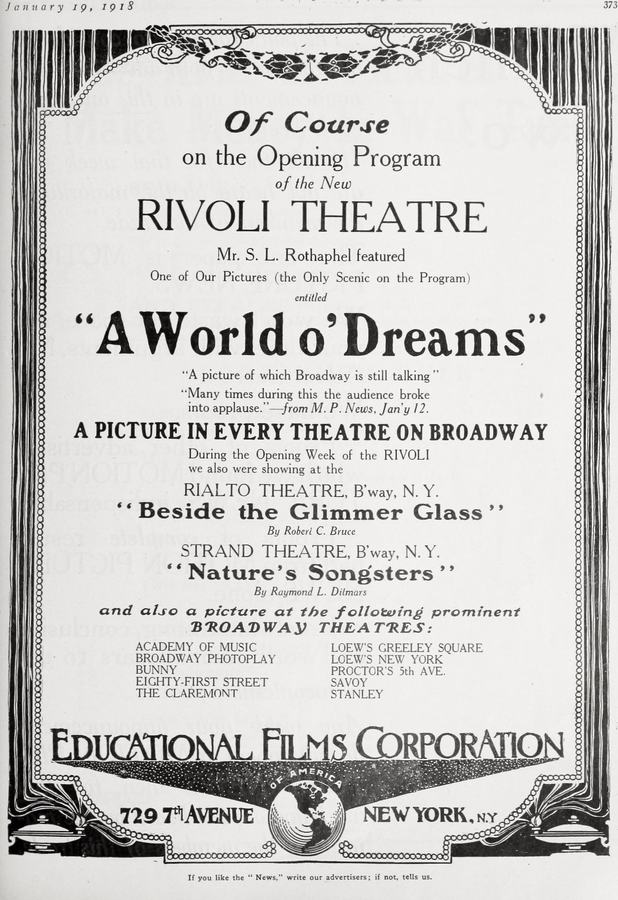
In the annals of early cinema, where pioneers grappled with the nascent language of the moving image, certain works emerge not merely as historical artifacts but as enduring testaments to the medium's profound potential. Robert C. Bruce’s ‘A World of Dreams’ stands as one such luminous example, a cinematic tapestry woven with threads of psychological introspection and visual poetry. Released in an era often characterized by straightforward narratives, Bruce, serving as both its principal writer and lead performer, dared to venture into the uncharted territories of the human mind, crafting an experience that remains startlingly resonant even today.
Bruce’s narrative introduces us to Elias Thorne, a character who, in the hands of a lesser artist, might have been merely a caricature of urban ennui. Thorne is an archivist, a sentinel of dusty records, his waking life a meticulous, almost sterile, procession through a monochrome existence. The film’s opening sequences are a masterclass in visual storytelling, establishing the oppressive regularity of Elias’s world through stark, angular compositions and a deliberate absence of vibrant color. One cannot help but draw parallels to the stark realism found in some European works of the period, perhaps even prefiguring the urban alienation explored in later movements. Yet, it is in the nocturnal realm that Elias truly lives, a realm rendered with an astonishingly imaginative palette for its time. His dreams are a riot of color (implied through tinting and toning in original prints, and vividly imagined by contemporary viewers), a boundless expanse where he sheds his mundane skin to become a heroic explorer, a celebrated artist, or a revered sage. This stark dichotomy forms the bedrock of the film's thematic exploration.
Bruce’s performance as Elias is nothing short of captivating. He navigates the character's dual existence with a nuanced physicality that speaks volumes without uttering a single word. In his waking hours, Elias is stiff, almost brittle, his movements precise and economical, reflecting the rigid structure of his life. In the dream sequences, however, Bruce transforms, embodying a fluidity and expressiveness that is both liberating and profoundly moving. This contrast is not merely a performance trick; it is the very essence of the film's psychological inquiry. How much of ourselves is shaped by the world we inhabit, and how much by the worlds we conjure within?
The true genius of ‘A World of Dreams’ lies in its audacious premise: that the boundary between the conscious and subconscious is not an impermeable wall but a permeable membrane. Elias's vibrant nocturnal adventures begin to bleed, subtly at first, into his waking hours. The film employs innovative visual techniques to depict this encroaching surrealism. Fleeting flashes of color suddenly punctuate the drab urban landscape, almost like momentary glitches in his perceived reality. Ethereal melodies, the soundtrack of his dream-world, begin to echo through the cacophony of the city. Most disturbingly, familiar visages from his subconscious realm—a benevolent mentor, a captivating muse, a menacing adversary—start to manifest in the faces of strangers he encounters daily. This gradual blurring is handled with an exquisite touch, never resorting to cheap jump scares but rather building a pervasive sense of unease and wonder.
This psychological permeability invites comparisons to later, more explicit explorations of altered states of consciousness in cinema. One might even see an early, embryonic form of the surrealism that would later define films like Fantômas: In the Shadow of the Guillotine, albeit with a more internal, less overtly criminal, focus. Bruce’s vision is less about external menace and more about the internal landscape, the potential for one's own mind to become both sanctuary and prison. The film asks profound questions: Is this seepage a symptom of burgeoning madness, a profound truth trying to manifest itself, or simply the human mind's desperate attempt to reconcile its inner desires with external realities?
Technically, ‘A World of Dreams’ is a marvel for its time. Bruce, as writer, clearly envisioned a film that pushed the boundaries of visual storytelling. The use of double exposures, superimpositions, and inventive lighting techniques to depict the dream world are particularly noteworthy. These weren't mere parlor tricks; they were integral to conveying Elias's subjective experience. The city scenes, shot with a stark, almost documentary realism, contrast sharply with the fluidity and fantastical elements of the dream sequences. The editing, too, plays a crucial role, often employing rapid cuts during moments of psychological tension or exhilaration in the dream world, juxtaposed with longer, more deliberate takes in Elias’s waking life. This rhythmic variation contributes significantly to the film’s emotional impact.
Considering the limitations of early cinema, the ambition of 'A World of Dreams' is truly staggering. While films like The Masked Rider and The Sunset Trail excelled in their respective genres of adventure and Westerns, 'A World of Dreams' carved out a niche for psychological drama, demonstrating that cinema could be a canvas for abstract thought and internal conflict, not just external action. It’s a testament to Bruce’s singular vision that the film feels less like a product of its time and more like a timeless exploration of consciousness.
The film’s climax is a masterstroke of dramatic tension and philosophical inquiry. As the line between sleep and wakefulness becomes indistinguishable, Elias is confronted with an agonizing choice. He must decide whether his dream world is merely a fragile refuge, a burgeoning madness threatening to unravel his sanity, or a profound, perhaps even truer, reality trying to manifest itself. This is not a simple good-versus-evil confrontation; it is an internal battle for the very definition of existence. Bruce’s portrayal of Elias at this precipice is heart-wrenching, conveying a man torn between the comfort of the predictable, albeit barren, reality he knows and the chaotic, beautiful, yet terrifying, potential of his inner cosmos.
The resolution, rather than offering a simplistic answer, leans into ambiguity, a daring move for its period. It leaves the audience pondering the nature of reality long after the final frame fades. This open-endedness is a hallmark of truly contemplative cinema, inviting viewers to project their own interpretations onto Elias's ultimate fate. It distinguishes 'A World of Dreams' from more conventional narratives of the time, such as the clear moral boundaries often seen in films like An Innocent Magdalene or the straightforward quests of A Daughter of the West. Bruce was not interested in easy answers but in the enduring questions that define the human condition.
'A World of Dreams' may not possess the widespread recognition of some of its more commercially successful contemporaries, but its artistic merit and pioneering spirit are undeniable. Robert C. Bruce, as both the architect of its narrative and its central figure, crafted a work that transcended the technical limitations of its era to deliver a profoundly psychological and visually inventive experience. It serves as a crucial precursor to later cinematic explorations of dreams, identity, and the fluid nature of reality. One can trace lines from its thematic concerns to much later works that delve into similar territories, showcasing its remarkable foresight.
The film’s examination of escapism, the allure of an idealized inner world versus the demands of a harsh reality, remains eternally relevant. In an increasingly complex world, the human desire to seek refuge or find deeper meaning beyond the immediate often leads us to our own 'worlds of dreams.' Bruce's film reminds us that these inner landscapes, whether fantastical or terrifying, are as real and impactful as any external circumstance. It encourages us to question our perceptions, to embrace the ambiguity of existence, and to recognize the profound power of the human imagination.
In conclusion, 'A World of Dreams' is more than just a silent film; it is a profound cinematic essay on the human psyche, a testament to the pioneering spirit of Robert C. Bruce, and a work that continues to provoke thought and stir the imagination. It’s a vital piece of film history that deserves rediscovery, a dream worth revisiting, and a world ripe for exploration. Its subtle power, its daring themes, and its exquisite execution ensure its place as a truly unique and significant contribution to early cinematic art.
IMDb 5.9
1925
Community
Log in to comment.