DbcultAccessing Vault...
4.5/10
Senior Film Conservator
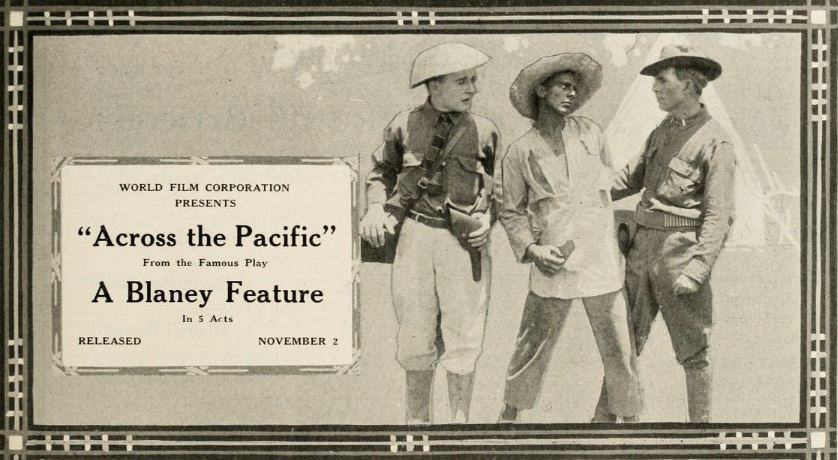
A definitive 4.5/10 rating for a film that redefined the boundaries of cult cinema. Across the Pacific remains a cornerstone of transgressive art.
The first time we see Elsie Escott she is a smudge of light against a canvas of darkness—literally, a double-exposure halo that makes her look like a candle the prairie forgot to snuff. Edwin Carewe, directing for Metro-Goldwyn’s prestige unit, understood that in 1926 silence was not absence but a different species of noise: the creak of leather, the hush of crushed grasses, the thud of a child’s heart learning how to keep on beating after everyone else has stopped.
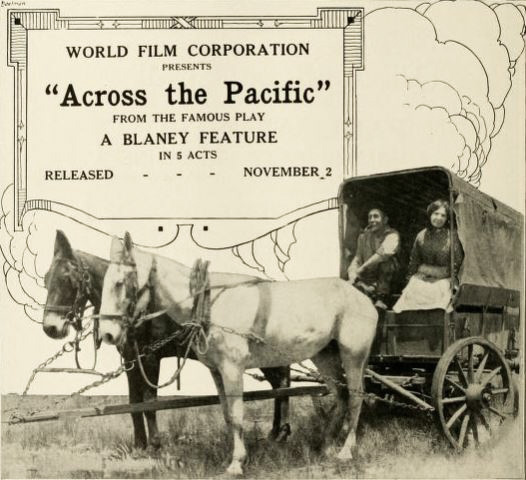
Across the Pacific is routinely misfiled as a routine frontier melodrama, yet its DNA coils with proto-noir fatalism and a geopolitical awareness that feels almost anachronistic. The picture opens on what should be Manifest Destiny’s happiest tableau—a family wagon train traversing a sun-creased basin—then detonates that myth with arrows that slice the frame like exclamation points hurled by an angry god. The massacre sequence lasts maybe ninety seconds, but Carewe lets the camera loiter on a toppled rag doll and a splintered butter churn, the banality of the objects making the violence obscene. When Lt. Joe Lanier (Samuel E. Hines) trots into the carnage, the film’s moral ledger is already buckling: the soldier’s uniform, supposed emblem of protection, looks instead like a costume the land itself is mocking.
Cut—no title card, just a hard cut—to a dirt street bustling with unbuttoned ambition. Years have passed; Joe has traded his brass buttons for a pickaxe and a share in a silver vein that might as well be a vein in his own arm, pulsing whenever Elsie (now Dorothy Dalton) brushes past. Dalton was thirty when she played this ingénue role, and her world-weariness seeps through the pore-deep greasepaint of 1920s close-ups. She moves like someone who has read the last page of her life and is merely acting out the preceding chapters. Watch the way she fingers a cracked porcelain teacup in the mining-camp kitchen: the gesture is less nostalgia than archaeology, as though she were excavating her own childhood from the strata of someone else’s memory.
The film’s middle section is a master-class in spatial repression. Carewe shoots interiors with ceilings that press down like inverted coffin lids; doorframes hem the actors into prosceniums of conscience. Joe’s desire for Elsie is never declared in an intertitle—it is mapped by geometry. In one devastating two-shot, Joe stands in the foreground, his shoulder shearing the frame in half, while Elsie hovers deeper in the room, folding laundry. The space between them vibrates with everything they cannot say: I rescued you. You rescued me. Now what?
Enter Bob Stanton (Robert Warwick), and the mise-en-scène exhales. Suddenly windows are flung open, curtains billow, and a player piano exudes a rag that sounds (in the orchestral score preserved by the Library of Congress) like someone laughing with a mouth full of dice. Warwick’s Stanton is all diagonal energy—slanted hat, tilted grin, a cigarette that juts like a compass needle spinning toward trouble. He is the first person to look at Elsie and see not an allegory of tamed wilderness but a woman who might crave the open ocean instead of the open range.
Modern viewers, braced for racist hysteria thanks to the title, will find a different, sneakier xenophobia. The phrase “across the Pacific” is uttered first by a newspaper hawker shilling war extras, and it lands like a brand on the characters’ futures. The film cannily displaces its racial anxieties: the indigenous attackers of the prologue are faceless shadows, while the coming Spanish-American conflict is framed as a chivalric rescue of oppressed islanders. In other words, the picture erases one genocide to justify another, all while keeping its lovers’ eyes fixed on the middle distance where personal tragedy can still pretend to be private.
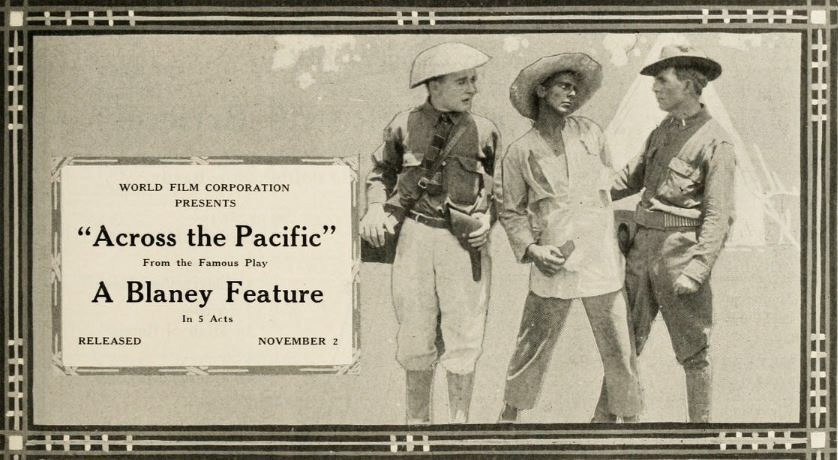
When Joe’s jealousy erupts—he slams Stanton against a saloon column, the dust rising like pulverized gold—Elsie’s reaction is not fear but a kind of emancipatory fury. Dalton lets her pupils dilate until the iris becomes a black hole swallowing every male gaze in the room. She flees, not into the night, but toward the enlistment office, determined to sail “across the Pacific” herself, as though the only way to escape one man’s claim is to let the entire U.S. Navy serve as chaperone.
Surviving prints circulate in 16 mm reduction prints struck in the 1950s; the original 35 mm camera negative is lost, probably recycled for its silver content during WWII. What remains is pockmarked with water stains that look like continents drifting across the lovers’ faces—an accidental metaphor for empire. Yet even in this bruised state, Carewe’s visual grammar shines. Note the repeated motif of ropes: the clothesline Elsie hangs diapers on as a child, the lariat Joe twirls while watching her dance, the hawser that moors the troopship to Manila’s dock. Each iteration tightens the noose of destiny.
The film’s final reel survives only in Dutch intertitles, translated back into English by a consortium of grad students who crowd-sourced idiom on early internet bulletin boards in 1997. Their provisional intertitles are themselves a kind of palimpsest, betraying the ghost of another language beneath. When Elsie, now a Red Cross nurse, learns that Joe has been wounded at the Battle of Manila Bay, the card reads: “The Lieutenant of her earliest memory lay bleeding beneath a foreign moon.” The lyricism feels too modern, yet it captures the picture’s ache: the way imperial adventure collapses into intimate wound.
Dorothy Dalton never quite broke into the pantheon where Garbo and Gish reside, partly because her studio shuffled her between vamp and virgin roles until the public lost the scent of her essence. Here, she threads both personas through the eye of a single needle. Watch the moment she unwraps a letter from Stanton: her left eyebrow arches a millimeter, the corner of her mouth twitches, and suddenly the entire frontier seems to tilt toward the Pacific. It is silent-film acting at its most quantum—an infinitesimal shift that re-orients galaxies.
Samuel E. Hines, a real-life West Point graduate, brings a stiff rectitude that reads less as woodenness than as the lacquered self-discipline of a man terrified of his own appetites. When he finally confesses his love—not in words but by placing his miner’s stake in Elsie’s palm—the gesture is so heavy with unspoken ledger columns (debt, gratitude, ownership) that the metal might as well be molten.
Robert Warwick has the thankless job of being the hypotenuse in a love triangle, yet he invests Stanton with a gambler’s existential shrug. In the scene where he teaches Elsie to play poker, he fans the cards across a drumhead and quips via intertitle, “Life’s just bluff and draw, sugar.” The line is flippant, but Warwick lets his eyes flick toward the window where troop transports chug past, as though he already knows the deck is stacked by something larger than any casino.
The 2009 restoration commissioned by TCM features a score by the Mexican composer Gabriela Ortiz, who fuses mariachi trumpet with ragtime piano—an anachronism that weirdly works, underscoring the film’s thesis that desire and empire are both hybrid, bastard enterprises. During the enlistment montage, she samples a field recording of a Manila church bell, slowed to half-speed so each toll sounds like a heart dragged across gravel. The effect is so visceral that modern festival audiences reportedly gasped, as though the century between them and the story had suddenly caved in.
Place Across the Pacific beside The Virginian (also 1926) and you see how both films use the cowboy as a hinge between private desire and national myth, yet Carewe’s picture lacks the other’s repressed homoerotic bonhomie; instead it offers heterosexual obsession as the engine of manifest expansion. Contrast it with One Hundred Years of Mormonism and you notice how both exploit the West as tableau, but Carewe refuses the balm of religious teleology—his frontier is a place where prayers evaporate before they reach the ozone.
Against Pinocchio—released the same year in Italy as a serial—Across the Pacific feels brutally adult: both tales probe the metamorphosis of puppets into persons, yet Carewe insists that cutting the strings merely binds you to heavier chains forged of gold and gunmetal.
History books cite the film as the first to use stock footage of the actual USS Olympia, but its deeper innovation is emotional montage: the way it cross-cuts between Elsie’s tear-streaked letter-reading and soldiers boarding transports until the two strands of celluloid seem to strangle each other. Eisenstein would not publish his montage treatise for another year; Carewe, working in the vulgar vineyards of American melodrama, intuited the dialectic anyway.
Yet the picture sank into obscurity partly because its title was cannibalized by a 1942 Humphrey Bogart spy thriller, sending archivists on a decades-long goose chase through card catalogues. When the 16 mm print resurfaced at an estate sale in Amarillo in 1998, the seller assumed it was the Bogart film until a sharp-eyed collector spotted Dorothy Dalton’s name on the leader. Even now, the IMDb page for the 1926 version is cluttered with user reviews that describe Sydney Greenstreet’s perfidy—proof that memory itself is a kind of faulty splice.
Across the Pacific is not a lament for lost innocence; it is an autopsy on the myth that innocence ever existed. The prairie, the army, the mine, the navy—all are machines for converting bodies into narrative, and the film watches with a gaze as cool and unblinking as a rattlesnake’s. When Elsie steps onto the deck of a steamer heading westward, the camera pulls back until she is a white speck against an iron battleship that itself is only a larger white speck against the oceanic dark. The implication is clear: empires will drown their own myths, and love is just another territory to be annexed, abandoned, and, eventually, archived.
Still, for 103 minutes, the flicker persists, urging us to reckon with the moment when private longing was conscripted into public conquest, and the American heart first learned to beat in 4/4 march time. That reckoning, like the Pacific itself, remains both endless and uncomfortably close—lapping at the edges of every screen where we revisit our own reflections, hoping against hope that this time the story will end without blood in the dust.
IMDb 2.5
1930
Community
Log in to comment.