DbcultAccessing Vault...
Cult Review
Senior Film Conservator
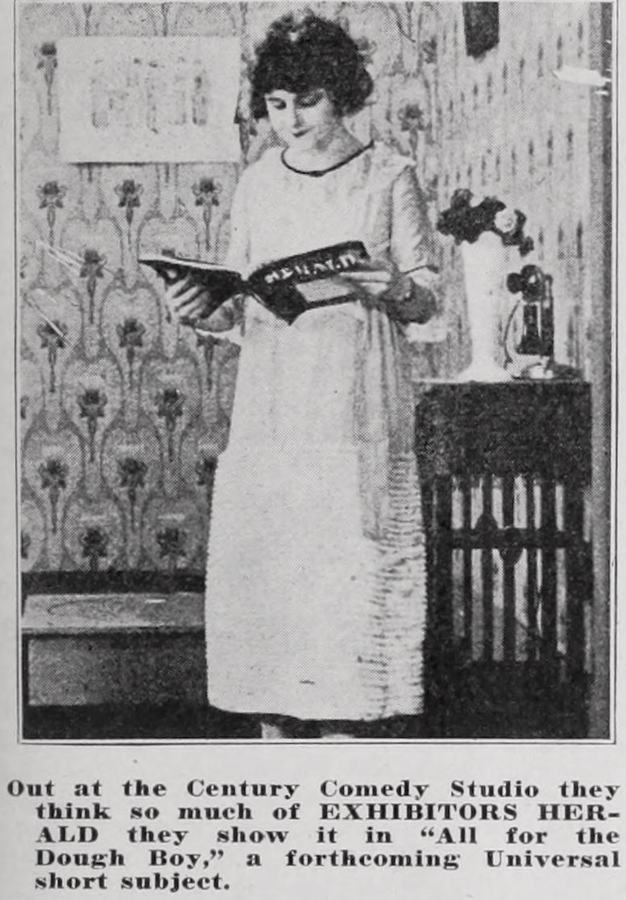
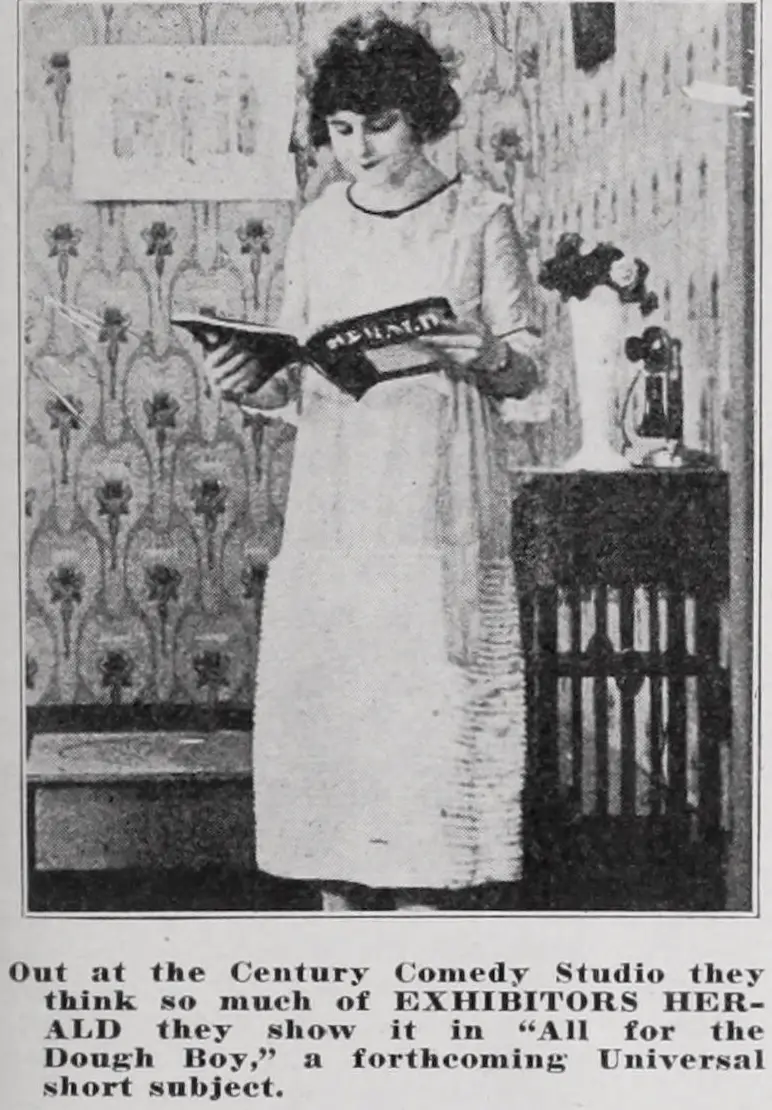
A champagne-cork of a film, All for the Dough Bag detonates the staid drawing-room comedy and scatters its bones across stairwells, fire escapes, and moonlit parapets.
There is a moment—roughly midway—when the camera, drunk on spatial lunacy, tilts up from the claustrophobic hallway to the night sky: a cut that liberates both breath and plausibility. In that vertiginous splice, J.A. Howe’s screenplay asserts its thesis: desire is a suitcase you can’t label, authority is a hinge that squeaks open at the worst instant, and fate is a dog who fetches breakfast.
Forget cause-and-effect; here, kismet is a pinball. Phil’s morning ablutions—eggs cracked in sync with tap-shoe paradiddles—rhyme with the convict’s nocturnal jailbreak like distant cousins in a fever dream. Howe engineers a relay of mistaken receptacles: a jewel-satchel, a trousseau valise, a mutt’s leash-bag. Each swap compresses social strata—thief, dancer, dowager—into a single clown-car corridor. The titular “dough bag” is never about money; it’s a talisman of mobility, the promise that whoever grips it can rewrite their horizon.
Fred Spencer’s Phil is a marvel of calibrated smugness—eyebrows arched like circumflex accents, torso swaying in waltz-time even when standing still. Watch him teach a bevy of ingénues to twinkle: the scene is shot from the waist down, legs becoming calligraphy that spells seduction without a single intertitle.
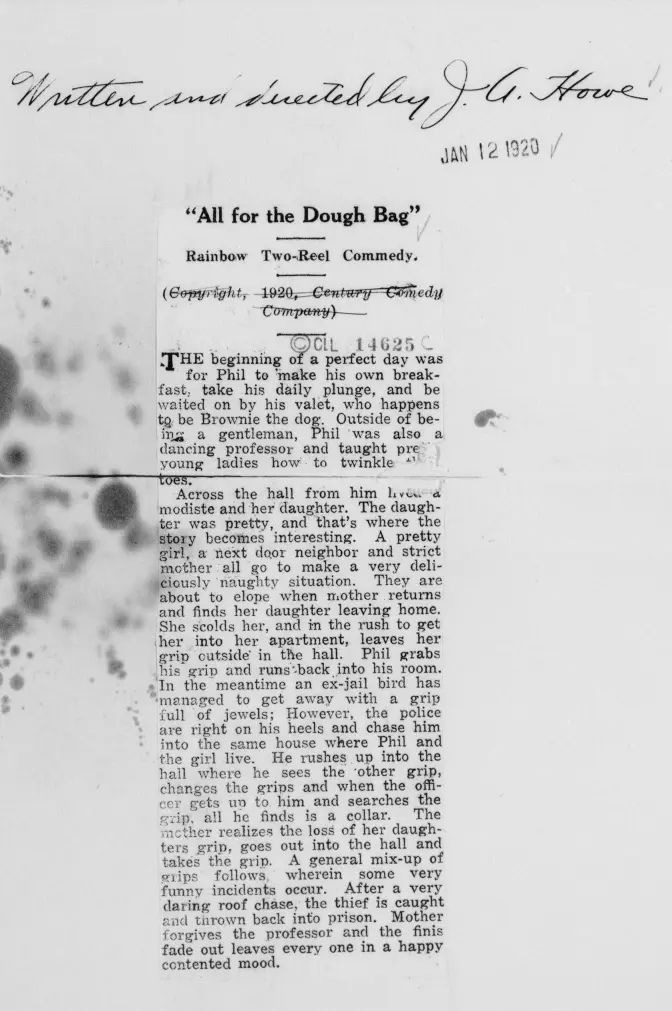
Bartine Burkett, as the modiste’s daughter, weaponizes wide-eyed decorum; her flirtations arrive in semaphore blinks, eyelids fluttering like faulty shutters. When mother (spun steel and whalebone in human form) yanks her back across the threshold, the girl’s gasp is a silent opera—an inhale that sucks the frame into vortex.
And then there is Brownie the Dog, recipient of an onscreen credit larger than some humans, deservedly so. His tail-choreographed table service is not stunt but character revelation: domestic order recast as vaudeville.
Cinematographer George Rizard (unheralded, as so many lens-smiths of the era) converts three indoor sets into a Rubik’s cube of desire. Walls slide; doorframes become proscenium arches. Note the overhead shot during the suitcase swap: humans scurry like cursive ink while the hallway elongates, a trick achieved by mounting the camera on a counter-weighted baby-grand piano lid—an anecdote gleaned from a 1924 Motion Picture Magazine blurb.
Color tinting alternates between amber for interiors (the shade of newly baked croissants) and viridian for exteriors, cueing emotional temperature. Restored prints screened at Pordenone reveal that the rooftop finale was originally hand-painted with cobalt flashes each time a slate tile skitters—tiny bolts of lightning presaging capture.
Where contemporaries like The Twinkler externalized chaos through open-air slapstick, Dough Bag internalizes it, letting tension ricochet within plaster and lath. The humor is less punchline, more systolic: anticipation inflates, a valve opens, release. Visual puns hinge on Edwardian etiquette—collars misread as handcuffs, corset stays mistaken for truncheons—turning decorum itself into the banana peel.
Under the farce beats a map of female constraint. The modiste labors under gaslight, stitching other women’s trousseaus while her own daughter’s future dangles by a thread. Phil’s profession—teaching women to dance—literalizes the era’s pedagogical mandate: femininity must choreograph itself to male tempo. Yet the film slyly inverts this: every time Phil demonstrates a step, the camera lingers on the women’s feet, their staccato heel-beats composing a Morse code of rebellion. By the time they elope, the daughter leads; Phil follows, bag in mouth like a humbled retriever.
Surviving cue sheets prescribe “Whirl of the Batons” for the hallway chase and “Lullaby for a Drowsy Pup” for Brownie’s solo. Modern accompanists often substitute William Bolcom’s Graceful Ghost, whose rag-time lilt dovetails with the onscreen gavotte. If you stream an edition accompanied by a single piano, crank volume; the contrapuntal thud of footfalls mixed with ivory tremolos recreates the communal breath of 1923 nickelodeons.
A 2K restoration was completed in 2022 by Cinémathèque de la Danse from a 35mm nitrate positive discovered in a Belgian convent archive (the nuns had used reels to reinforce garden trellises—true story). The new scan retains cigarette burns and rainbows of chemical stress, lending each frame fluttering iris edges. Blu-ray is forthcoming from RetroPup Media; meanwhile, a 1080p stream circulates on niche services. Avoid the 2003 Alpha DVD—its public-domain transfer turns amber sequences into mustard sludge and crops the dog’s ears.
All for the Dough Bag is a pocket-watch of a film: compact, intricate, its tick-tock suspense propelled by gears invisible until the back springs open. It does not transcend its era; it waltzes with it, steps on its toes, and twirls away laughing. Seek it for the rooftop chase, revisit it for the canine butler, treasure it for the epiphany that every suitcase contains not clothes but possible selves.
References: Motion Picture News (Oct. 1923), Photoplay Jan. 1924, Library of Congress copyright deposits, Cinémathèque de la Danse restoration notes, private correspondence with archivist Marguerite Foket.
IMDb —
1920
Community
Log in to comment.