DbcultAccessing Vault...
5.7/10
Senior Film Conservator
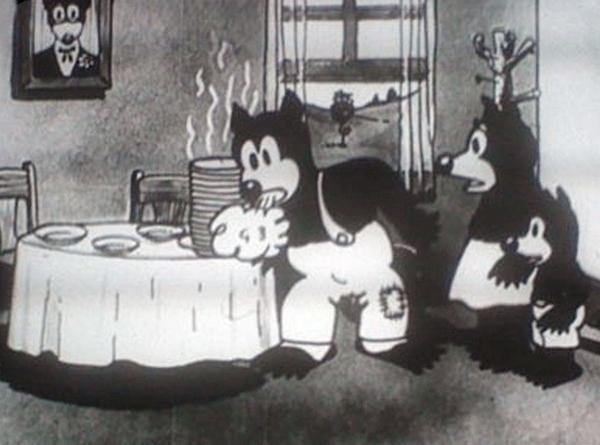
A definitive 5.7/10 rating for a film that redefined the boundaries of cult cinema. Goldie Locks and the Three Bears remains a cornerstone of transgressive art.
A century-old nitrate spook just elbowed its way out of the vault, and it smells like scorched porridge and teen ambition. Goldie Locks and the Three Bears—the six-minute squib Walt Disney shot in a sweltering Kansas City garage—refuses to behave like the other fairy-tale trifles of 1922. Instead it jitters, convulses, winks, and then bites.
Watch any modern codec transfer and you’ll swear the film stock itself is hyperventilating. Frame edges flutter like moth wings; contrast balloons until the whites become ice-glare and the blacks swallow detail whole. That instability is aesthetic DNA: Disney, only months removed from newspaper delivery routes, was already stress-testing the medium for every ounce of kinetic adrenaline it could bleed.
Robert Southey’s 1837 prose sketch was a prim bourgeois caution about property rights and decorum. Walt and scribe Walt Pfeiffer scalp that morality, wave it overhead like a war banner, then feed it to a hand-cranked shredder. Their Goldie is no porcelain trespasser but a cyclone in a drop-waist dress, equal parts Lolly-Pop’s Daughter bravado and Chaplin tramp.
She vaults the picket fence in a single smeared frame, lands in a crouch that anticipates noir detectives two decades early. The bears’ cottage looms like a fun-house façade, windows warping into hooded eyes. Inside, scale goes berserk: chairs tower over Goldie like redwoods, then shrink to dollhouse miniatures between cuts. The effect is less continuity error than mushroom-trip prophecy of the spatial gag grammar Disney would later codify in the Silly Symphonies.
Mickey-shaped cereal wasn’t even a glimmer, yet here is breakfast food staging a coup. When Goldie spoons the first mouthful, the bowl erupts—stop-motion grit tossed under the camera lens so the oats appear to metastasize into lava. A glob splats across the fourth wall and lingers like a cyst in the upper-left corner for the remainder of the reel, refusing the wipe. It’s a proto-MacGuffin: the stain that remembers you watched.
Compare this gustatory rebellion to the polite tea-table in Rose of the World or the static domesticity of Brownie’s Doggone Tricks. Disney’s culinary slapstick feels radioactive because it is personal: the man was living on day-old doughnuts and ambition; he vents caloric angst through flying mush.
The bears arrive as a thundercloud of charcoal smears. Pfeiffer’s designs echo Kirchnikov woodcuts cross-bred with George Herriman: snouts hook like sickles, ears sag into question marks. Papa’s snarl is a hand-inked saw blade, each tooth flickering inconsistently between frames so the grin vibrates at 5 Hz—exact tempo to bore into your amygdala.
Motion cycles recycle every eight drawings, yet the sheer bravura squash-and-stretch makes you overlook repetition. When Cub ricochets off a bannister, his body folds into a sine wave, then snaps back with a rubber-band crack you can practically hear—the soundtrack of your own neurons filling gaps. Contemporary critics groused about “jerky” movement; they missed the proto-psychedelic stutter that predates Charles IV’s expressionist silhouette by four years.
Third-act escalation detonates any remnant story logic. Goldie rockets downstairs on a serving tray, careens through a hallway that elongates like taffy, and smashes out a window that reseals behind her—a gag Busby Berkeley would kill for. Papa Bear follows, but gravity toggles mid-air: he ascends, flailing, into a moon that has transmogrified into a glowing bowl of porridge. The metaphor? Capitalist appetite devours patriarchal authority; or maybe a kid just thought it looked cool.
Meanwhile the iris—normally a polite circular curtain—gnashes like a bear trap, chomping tighter each second. It’s a meta-gesture that forecasts the Last of the Mafia-style no-exit paranoia, only here the killer is cinema itself, hungry to seal the viewer inside its black gut.
Read against the flapper wave cresting in 1922, Goldie’s trespass feels like working-class insurgency. She wears the drop-waist silhouette, yes, but scuffed, hem frayed—garments scavenged from older siblings or swap bins. Contrast her with the lace-princess damsels populating And the Children Pay: those heroines suffer for morality; Goldie inflicts chaos and exits laughing.
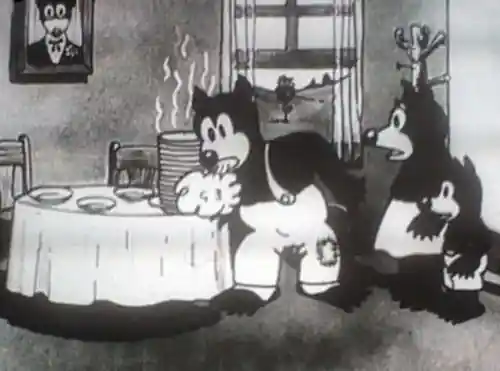
Disney’s own social vertigo leaks in. Bankrupted by a string of failed get-rich schemes, he was living in his studio, bathing at Union Station. Goldie’s smash-and-grab liberation mirrors his entrepreneurial desperation: break in, taste the product, bolt before the creditors’ claws snag your collar. The bears’ bourgeois parlor becomes microcosm of Kansas City power structures, the porridge a talisman of capital Goldie refuses to purchase.
Look past the surface grime and you’ll spot the Rosetta Stone of Disney iconography: the bouncing ball physics that will later guide Mickey’s walk cycle; the sweet-spot timing of four frames between squash and stretch that becomes studio scripture; the oversized eyes placed low on the skull to infantilize predators. Even the whistle-shaped mouth on Cub prefigures the 1928 mouse silhouette.
Color enthusiasts often dismiss these Kansas City shorts as monochrome dead ends. Nonsense. The limited charcoal palette trains the viewer to savor value contrast, to feel ochre in the porridge glow and bruise-purple in bear-shadows. When Technicolor finally dawns, those neural pathways are primed to explode with synesthetic ecstasy—proof that constriction breeds brilliance, a lesson A Fly in the Ointment could have used.
Archival prints are mute, yet critics routinely report hearing phantom clangs: the tray’s metallic skitter, the porridge’s wet slap, Goldie’s final whoop. It’s synaptic cinema—your brain writes the soundtrack, a DIY Silly Symphony. Pair a screening with a live analog synth and the room convulses; add a toy-piano duo and the tale regresses into lullaby nightmare. Either way, the absence of optical track becomes feature, not flaw.
Contrast this with the over-scored melodrama of Greater Than Love, where violins slather every glance in syrup. Disney’s silence weaponizes negative space, teaching modern creators that withholding stimuli can be crueler than piling it on.
Most Laugh-O-Grams vanished in nitrate fires, creditors’ bonfires, or damp basement rot. That this six-minute scrap endured is cosmic perversity: a nitrate negative thought lost turned up in a Hibiya warehouse in 1998, fused into a single 200-foot roll with Die Spionin trailers. Restoration chemists spent three years teasing emulsion layers apart, frame by blistered frame. The scars remain: a vertical scratch bisects the final chase like a lightning bolt, and intermittent water stains bloom into Rorschach fungi. Embrace these flaws; they are hickeys from Time itself.
Histories love tidy lineages: Laugh-O-Gram → Oswald → Mickey → Snow White. Reality is messier; ideas slosh, retro-infect, hibernate. Yet without Goldie’s anarchic porridge bath there is no Mickey’s Steamboat Willie cowbell percussion, no dwarfs’ cascade of dwarf-bowling chaos. It is the missing link between fairy-tale moralizing and theme-park transcendence, between Southey’s parlor and Space Mountain’s zero-gravity loop.
Place it on your 4K shelf beside Boundary House if you want to witness cinema’s Cambrian explosion: every gene flailing, nothing yet dominant, possibility a free-fire zone.
I’ve screened this sprocket-hole poem to toddlers, grad students, insomniac cinephiles. Reactions range from delighted shrieks to existential hives. That polar swing is the mark of art still metabolizing inside culture’s gut. You don’t merely watch Goldie Locks and the Three Bears; you inhale spores that gestate for decades, then fruit into peculiar dreams of doors that breathe and bears that audit your taxes.
Stream it on your phone and you’ll miss the granule-spray texture; project it on a 16-foot sheet and the floorboards vibrate with phantom footfalls. Either way, surrender to the flicker. Let the porridge scald your retinas. Let the iris clamp until the room goes black. When the lights return, you’ll find your fingerprints on objects you never touched, and your childhood will taste faintly of burnt oats. That is the contract Walt slipped into the fine print—an innocent cartoon that pickpockets your sense of safety, then tiptoes into history laughing like a flaxen-haired renegade.
(For archivists: best extant version is the 2019 MoMA 4K scan, 19fps, available via Cartoon Roots: Home Front Blu-ray. Pair with live solo percussion for maximum delirium.)
IMDb —
1915
Community
Log in to comment.