DbcultAccessing Vault...
5.5/10
Senior Film Conservator
A definitive 5.5/10 rating for a film that redefined the boundaries of cult cinema. Amalia remains a cornerstone of transgressive art.
The year 1914: Europe teeters on the precipice of industrial slaughter, while far south of the equator a country still licking the wounds of civil strife decides to invent itself in celluloid. Out of that crucible steps Amalia, a film whose very title carries the perfume of mothballs and gunpowder. It is not merely the first Argentine feature; it is the moment when a continent’s subconscious learned to dream in moving images.
Watch the way cinematographer Eugene Py (a wandering Frenchman with Gaumont in his blood) positions the camera at the threshold of every salon: doorframes become proscenium arches, and every character is both actor and voyeur. The grainy orthochromatic stock renders white satin as a glare of moral blindness; conversely, a black servant’s face dissolves into velvet obscurity, a troubling reminder of the era’s racial hierarchies. Yet within these limitations, Py choreographs bravura long takes—one lasts a full 43 seconds—as a carriage navigates Avenida de Mayo, the lens bobbing like a drunkard, capturing tram bells and the flutter of ostrich-plume hats in real time. Compared to the studio-bound European contemporaries such as La Salome or Chicot the Jester, this on-location verve feels almost documentary.
In the title role, stage diva Dora Huergo shoulders the impossible burden of embodying both virginal martyr and proto-feminist resistor. Her performance is calibrated for the back row of Teatro Colón: brows arched like circumflex accents, hands perennially clasped beneath marble bosom. Yet the close-up—still a novelty—catches micro-tremors at the corner of her mouth, a flutter of self-doubt that no intertitle can articulate. When she spurns Bello’s advances in the shadow of the Recoleta cloisters, the tear that glides down her cheek seems to carry the entire weight of the nation’s Catholic guilt. In 1914, such understated naturalism was years ahead of the arm-flinging hysterics seen in Her Life for Liberty.
Schlieper, a matinée idol with a pencil moustache and carnivorous dimples, plays the villain like a tango instructor who teaches his pupils to dip straight into hell. Note the scene where he unfurls a fan—an audacious gender inversion—covering his smile only to reveal eyes that calculate conquest with algorithmic precision. The costume department drapes him in a calf-skin waistcoat so tight it squeaks when he breathes, an aural detail that the deafening live accompaniment of the day would have amplified into a leitmotif of predation.
While Amalia suffers, a chorus of spinsters and duennas—María Ayerza’s doña Rosa, Josefina Acosta’s sinister nun—whisper rosaries that sound like court indictments. Their black lace mantillas create a living reja, the barred window through which patriarchy surveils desire. In a daring iris shot, the camera shrinks to a keyhole circle, revealing these women knotting a scarlet ribbon: a covert signal that will summon the assassin. It is Argentina’s first cinematic conspiracy enacted entirely by secondary characters, a matriarchal power play that predates the witches of Wildflower by a decade.
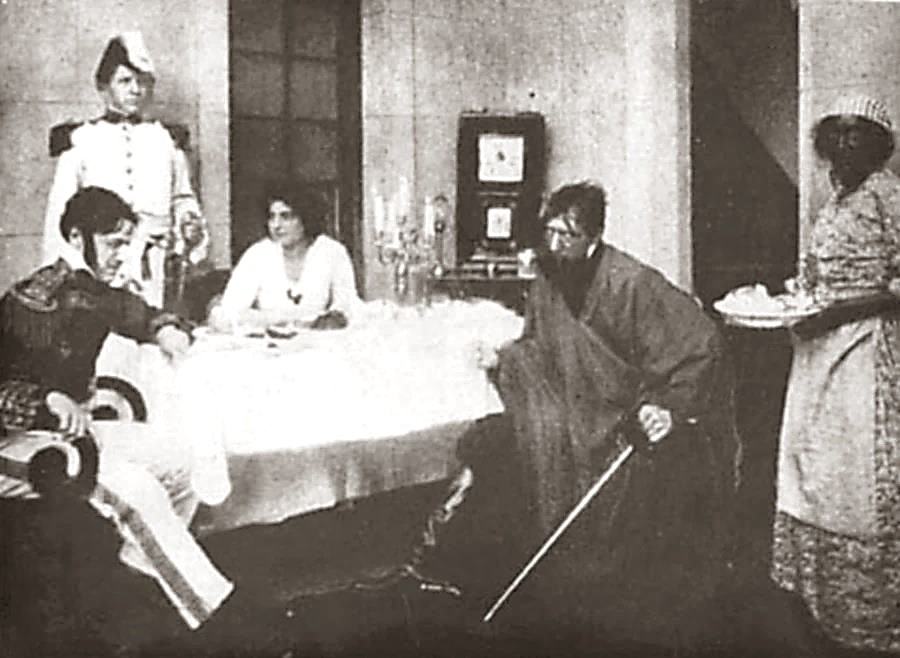
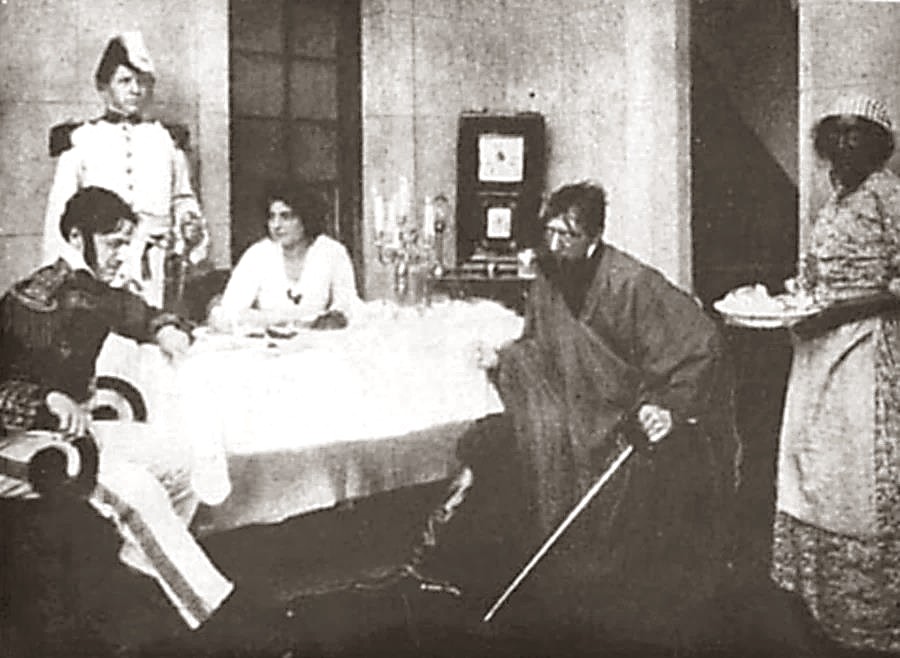
José Mármol’s 1851 novel was a grenade lobbed at the dictatorship of Juan Manuel de Rosas; by 1914, Rosas had become a spectral patriarch haunting every Argentine psyche. Adapting the book was therefore not mere nostalgia but a coded critique of the modern oligarchy. The film’s censors—terrified of inciting fresh uprisings—demanded no fewer than 18 cuts. One excised scene allegedly showed a Federalist soldier bayoneting a child wrapped in the flag; only a single production still survives, its grainy horror rivaling the atrocity photos of later wars. Thus, Amalia exists in two versions: the mutilated 65-minute cut that premiered at the Opera Theater, and a hypothetical 78-minute phantasm that cine-archaeists still hunt in flea-market attics.
Contemporary accounts describe a trio—piano, violin, and bandoneón—who improvised a contrapuntal commentary. When Amalia prays, the bandoneón unleashed a diminished chord that made parishioners clutch their missals; during Bello’s seduction, the violin slid into a habanera whose rhythm syncopated with the flicker of the projector’s shutter at 16 fps, creating a ghostly strobe. Today’s restorations often overlay generic tango recordings, but purists argue for the anarchic spontaneity that once bled music into image.
Place Amalia beside Der fremde Vogel and you witness two hemispheres inventing melodrama: Germany channels Expressionist angles, Argentina opts for Romantic chiaroscuro. Both films obsess over fallen women, yet where the European narrative punishes its heroine with death, the American variant offers a crucifixion-survival arc, a Catholic compromise that leaves room for redemption. Meanwhile, The Girl from Abroad traffics in proto-noir underworld glamour, whereas Amalia’s villainy hides beneath cravats and salaam etiquette, teaching us that Latin American evil wears white gloves.
Look past the principal cast and you’ll spot Lucía de Bruyn’s Afro-Argentine maid, her name absent from early posters. She appears in only three shots—fanning Amalia, receiving a slap, vanishing through a side door—yet her presence condenses the entire racial subconscious of the nation. The camera’s refusal to linger mirrors the historiographical silence on slavery’s role in the River Plate. A single insert of her bare feet on cool terrazzo tiles, cut straight from the negative, survives as a relic of excised conscience.
Every subsequent Argentine melodrama—from Lucrezia Borgia to Camila—owes its rhetorical DNA to this ur-text: the canted angle that signals moral disequilibrium; the sacrificial mother who outlives her usefulness; the city as labyrinth of both desire and damnation. Even the New Wave’s militant documentaries echo Amalia’s dialectic between personal trauma and national history, proving that 1914 was Year Zero not just for Argentine fiction but for its political imagination.
The sole surviving print toured Patagonian towns through 1921, then vanished into a parish basement where a burst pipe reduced 40 percent of the reels to chemical jelly. In 1984, Buenos Aires’ Museo del Cine recovered a 16 mm reduction positive, riddled with fungal blossoms resembling lunar craters. Digital scans at 4K reveal blistered emulsion around every edge; faces swim in a snowstorm of artefacts. Yet these scars testify to the film’s perilous odyssey—every scratch is a battle scar, every missing frame a casualty of indifference.
Today, when algorithms flatten history into bite-sized trivia, Amalia demands we confront the texture of origins. Its silence speaks louder than Dolby Atmos; its chiaroscuro outshines HDR. Watching it is akin to inhaling the dust of your great-grandparents’ letters—an act both archaeological and intimate. The film reminds us that nations are not merely decreed by constitutions but are continuously stitched together in the dark, where shadows dance and forbidden stories flicker to life.
Verdict: A fractured fresco of a continent’s birth-scream, essential for cinephiles, historians, and anyone who suspects that nations, like films, are only as honest as their most haunting frame.
IMDb 6.3
1924
Community
Log in to comment.