DbcultAccessing Vault...
5/10
Senior Film Conservator
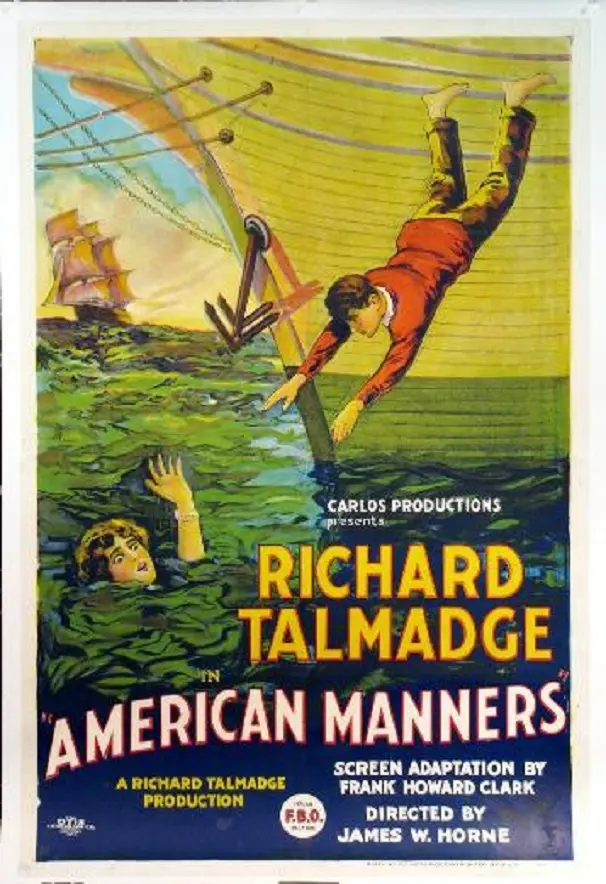
A definitive 5/10 rating for a film that redefined the boundaries of cult cinema. American Manners remains a cornerstone of transgressive art.
There is a specific, electrifying current that runs through the filmography of Richard Talmadge, a current that seems to bypass the cerebral and strike directly at the pulse. Watching American Manners (1924) in a modern context is akin to discovering a lost blueprint for the contemporary action blockbuster, stripped of its digital artifice and left with the raw, sweating reality of human effort. Talmadge, often overshadowed by the larger-than-life shadows of Fairbanks or Keaton, possesses a pugnacious charm that feels uniquely grounded, even when he is literally flying through the air.
The plot of American Manners doesn't waste time with the floral verbosity often found in the intertitles of its contemporaries like The Hoosier Schoolmaster (1924). Instead, writers Joseph Farnham and Frank Howard Clark construct a narrative of lean, muscular efficiency. We meet Roy Thomas at a crossroads where his social standing and his family’s honor are under siege. His father, played with a weary dignity by Mark Fenton, has been framed—a victim of a smuggling ring that operates with the cold precision of a clockwork nightmare. The stakes are personal, visceral, and immediate.
What strikes me most about this film is how it handles the concept of 'manners.' In the 1920s, American cinema was obsessed with the juxtaposition of the 'new money' vigor and 'old world' etiquette. Here, the title feels like a delicious irony. Roy Thomas’s manners aren't found in the drawing-room pleasantries seen in A Man About Town; his manners are the ethics of the fist and the leap. He navigates the social hierarchy not by climbing the ladder, but by jumping over it. It’s a fascinating subversion of the social climber trope, where the protagonist descends into the criminal depths to preserve the integrity of the heights.
To discuss American Manners without dissecting the physical performance of Richard Talmadge would be like discussing a symphony without mentioning the conductor. Talmadge’s Roy Thomas is a whirlwind. Unlike the more deliberate, almost theatrical suffering found in The City of Silent Men, Talmadge approaches his predicament with an optimistic athleticism. There is a sequence involving a chase through a warehouse that remains, a century later, a masterclass in spatial awareness and stunt choreography. He moves with a fluidity that suggests the environment is merely a playground for his escape.
The film shares a certain DNA with The Daredevil, yet it feels more intimate. The smuggling plot serves as the perfect canvas for Talmadge’s stunts because it requires a specific kind of 'invisible' heroism. He isn't performing for a crowd; he is performing for the survival of his family unit. This adds a layer of desperation to his leaps that transcends mere spectacle. When he scales a wall or dives into the harbor, you aren't just seeing a stuntman; you’re seeing a son’s frantic heart expressed through his limbs.
Visually, American Manners flirts with the shadows that would eventually define the noir genre. The docks, the late-night clandestine meetings, the sense of a city that hides its secrets in the fog—it’s all there. The cinematography captures the grit of the smuggling operations with a realism that contrasts sharply with the polished veneer of the Thomas household. This duality is essential. It reminds us that the 'American' experience is often a bifurcated one, caught between the aspiration of the law and the reality of the hustle.
In comparison to the more overtly moralistic The Social Leper, American Manners feels refreshingly amoral in its execution. It doesn't lecture the audience on the evils of smuggling; it focuses on the mechanics of the crime and the mechanics of the recovery. The villains, led by the formidable Pat Harmon, aren't caricatures of evil but are instead presented as obstacles in a grand game of chess. They are the 'smugglers'—a term that in 1924 carried the heavy weight of Prohibition-era anxieties. The film taps into the zeitgeist of a nation that was simultaneously fascinated and repelled by the breaking of the law.
Helen Lynch provides a necessary anchor to the film’s high-flying antics. Her performance is more than just the 'love interest' archetype. There is a shrewdness in her eyes, a sense that she understands the stakes just as well as Roy. Their chemistry provides the film with its few moments of repose, allowing the audience to catch their breath between the action set pieces. While not as overtly comedic as the interactions in The Star Boarder, there is a playful rhythm to their scenes that lightens the overall tension.
The writing by Joseph Farnham is particularly noteworthy. Known for his sharp, often witty intertitles, Farnham manages to infuse the film with a sense of urgency without over-explaining the plot. He trusts the audience to follow the visual cues. This is a far cry from the sometimes convoluted narrative structures of Invisible Ink. In American Manners, the story is told through motion. Every punch thrown, every document stolen, and every narrow escape serves to push the narrative forward toward its inevitable, explosive climax.
When we look at other films of the era, such as the harrowing Auction of Souls, we see a cinema that was deeply concerned with the destruction of the individual. American Manners, by contrast, is a film about the indomitability of the individual. Roy Thomas is not a victim of his circumstances; he is the architect of his own salvation. Even when the odds are stacked against him, there is a sense of inevitability to his success that makes the film a joy to watch. It lacks the existential dread of If, opting instead for a celebratory display of human capability.
The film also manages to avoid the saccharine sentimentality that often plagued mid-20s dramas like Love's Outcast. While the father-son bond is the driving force of the movie, it is handled with a stoic reserve. The emotion is found in the action, not in the dialogue. This 'show, don't tell' philosophy is what keeps American Manners feeling modern. It understands that in a medium defined by silence, the loudest statement you can make is a well-timed leap from a moving vehicle.
The direction (often attributed to the collective efforts of the production team in these Talmadge vehicles) is surprisingly sophisticated. The use of depth of field during the harbor scenes creates a sense of a vast, uncontrollable world. We see Roy as a small figure against the massive ships and the endless water, emphasizing the 'David vs. Goliath' nature of his struggle. This isn't the whimsical, surreal world of How I Became Krazy; this is a world of iron, wood, and consequence.
The editing is equally impressive. The cuts during the fight sequences are sharp, designed to emphasize the impact of each blow. It’s a rhythmic editing style that mirrors the percussive nature of Talmadge’s movements. If you compare this to the more languid pacing of July Days, the difference is staggering. American Manners is a film that is constantly leaning forward, pushing the viewer toward the next thrill.
As the film reaches its crescendo, the resolution of the smuggling plot feels earned. It isn't a deus ex machina that saves the day, but Roy’s persistent, physical refusal to lose. This is the core of the 'American' identity the film seeks to portray—a blend of social responsibility and individualistic fire. It suggests that the true 'American Manners' involve standing up for one's blood, regardless of the physical cost.
In the broader spectrum of 1924 releases, American Manners stands out for its sheer entertainment value. While Pretty Smooth might offer a more polished social comedy, and The Straight Way might offer a more traditional moral arc, American Manners offers the thrill of the chase. It is a film that understands its strengths and plays to them with a relentless, infectious energy.
For those who find silent cinema a bit too 'still,' I challenge you to watch Richard Talmadge in action. He is a reminder that before there were green screens and digital doubles, there were men who risked their necks for a good shot. American Manners is a testament to that era—a time when the only thing more impressive than the story was the man telling it with his body. It’s a gritty, fast-paced, and ultimately rewarding experience that deserves a place in the conversation of great 1920s action cinema. It doesn't just ask for your attention; it grabs it by the collar and takes it for a ride across the rooftops of a forgotten city.
Ultimately, the film leaves us with a question about our own 'manners.' In a world of compromise and moral ambiguity—something explored with much more cynicism in Mark It Paid—how far would we go to protect the people we love? Roy Thomas gives us his answer through a series of death-defying stunts, and in doing so, he defines a hero for the ages. It is a cinematic triumph of the will, dressed in a tuxedo and ready for a fight.
IMDb —
1918
Community
Log in to comment.