DbcultAccessing Vault...
Cult Review
Senior Film Conservator
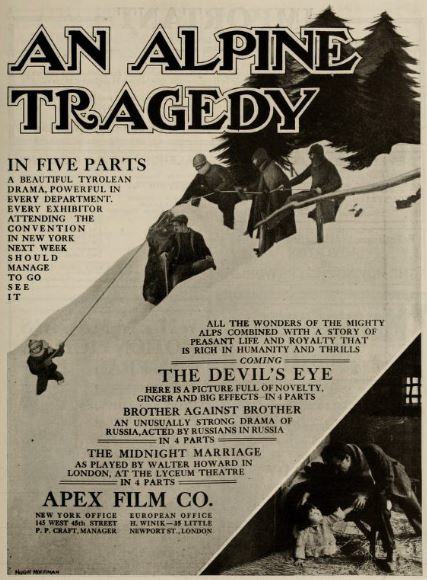
There are films that merely show you mountains; An Alpine Tragedy makes you taste the metallic chill of their shadows, feel the slow bruise of altitude on marrow. Shot in the winter of 1920 amid the Hohe Tauern range, this Austrian-American co-production arrives like a frost-bitten letter from a forgotten dynasty, its every frame steeped in the cobalt dusk of collapsing empires.
Director Alwin Neuss—a name once buried beneath UFA paperwork—marshals a visual grammar closer to Griffith’s moralised chiaroscuro than to the postcard piety of contemporaneous Bergfilme. Instead of edelweiss cliché, we get jagged tableaux where lantern-light carves orange scars across glacial blue, and silhouettes bleed into whiteness until human anatomy becomes a mere punctuation mark against the snow’s indifferent manuscript.
The macguffin here—a gold locket bearing a regal monogram—functions less as heirloom than as event-horizon. Once its cipher is deciphered by a trembling court archivist, the film’s cosmos tilts: peasants ascend to thrones while aristocrats sink into vendetta. The editing pattern mimics this gravitational pull: intertitles grow shorter, more frantic, while montage stretches time like wire under frost until the spectator himself feels the Alpine wind whistle through the sprocket holes. It is as if destiny, once named, cannot abide the slow syntax of ordinary living.
Newcomer Hella Moja embodies Clarissa with feral stillness. Watch her pupils when the Count offers silk—they narrow like those of a cornered lynx, calculating not temptation but topography: where to bolt, how to survive. Silent cinema seldom grants heroines such predatory lucidity; more often they quiver like poplars in male crosswinds. Moja’s performance, calibrated for the lens rather than the gallery gods of theatre, anticipates the interiorised heroines of Scandinavian post-war cinema by three decades.
As Boris, Carl de Vogt—familiar from earlier Gothic outings—trades cadaverous ennui for sun-scorpped sinew. His Boris is less lover than cartographer of ethical ridges: every gesture maps a moral contour, whether ferrying fugitive dispatches or rescuing an unknown wanderer who will unwittingly cause his crucifixion. De Vogt’s body language is all forward-leaning momentum, shoulders cutting the wind like a prow; even in repose he seems tuned to sub-audible avalanche frequencies.
Viennese matinee idol Paul Askonas essays the villain with velvet fatigue rather than moustache-twirling glee. Thurnia’s corruption is systemic, hereditary—fin de siècle rot masked by eau de lilac. Note the scene where he bargains with a kidnapper: the camera frames him through a frost-latticed window, turning his face into cracked porcelain. You glimpse, not evil’s histrionics, but entropy quietly lunching on nobility. His final suicide—performed off-screen yet announced by a pistol echo that ricochets through the marble ducal halls—feels less tragic than administrative: a clerk stamping his own termination papers.
Captain Sergius arrives midway, draped in narrative parenthesis, yet his execution supplies the film’s ethical fulcrum. Wrong coat, wrong papers, wrong grave—he dies so that Boris may live, a secular transfiguration staged on a battlefield of whiteness. The moment the firing squad’s smoke dissipates into alpine air, you realise the picture is underwriting a sober thesis: identity is flimsy as borrowed wool in wartime, and sacrifice seldom earns hosannas beyond the snow that absorbs blood-trail.
Neuss and cinematographer Gustav Weiß alternate between vertiginous location work—cranes perched on limestone precipices—and claustrophobic studio interiors where painted Alps loom like Expressionist fever dreams. A match-cut transposes a real avalanche into a lace curtain billowing before Clarissa’s bedroom hearth, implying nature’s violence is merely domestic unrest writ large. Meanwhile, tinting strategies flare from amber hearth-glow to cyan nocturnes, each hue shift a tonal tremor.
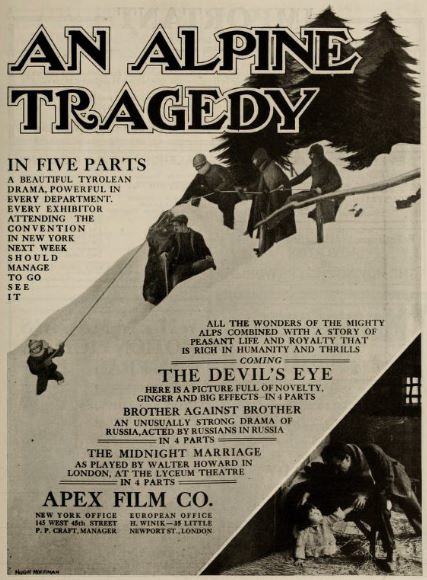
The celebrated mid-film pursuit—Boris sprinting across wind-harried drifts—was shot with cameras housed in heated wooden boxes so that lenses wouldn’t fog. Frame enlargements reveal sprocket holes rimed with rime (a happy accident), giving projection the stroboscopic flutter of lantern-slide phantasmagoria. When Boris skis off a cliff-edge and vanishes into a cloud-deck, Weiß keeps the camera rolling for an unprecedented thirteen seconds—an eternity in 1921 grammar—until the abyss swallows him into white opacity, a visual premonition of Hitchcock’s Vertigo fall.
Unlike other royal-identity melodramas, the film refuses to romanticise aristocracy. Clarissa’s refusal to abandon Boris is framed not as sentimental uxoriousness but as class treason: she chooses the precarity of goat-herd life over the gilded servitude of courts. The narrative thereby inverts the Pygmalion arc—here the guttersnipe already possesses moral lucidity; it is the palace that must unlearn its chandeliers and recognise the blindness of diamonds.
“I would rather wear Boris’s sheepskin reeking of cedar smoke than your ducal ermine reeking of cadavers.”
— Clarissa’s defiant intertitle, banned by Ohio censors for ‘anarchist undertones’
Although premièred in Vienna, An Alpine Tragedy survived only in a truncated Czech print discovered in a Žižkov cellar (1978). Restorers stitched in missing reels from a French Pathé distribution copy, resulting in a bilingual palimpsest whose intertitles flicker between Germanic cadence and Gallic swoon. The mismatch actually enhances the film’s emotional dislocation, as if Europe itself were arguing over the proper pronunciation of heartbreak.
Viewers weaned on CGI vistas will guffaw at rear-projection seams, yet the tactile peril of real crampon on brittle ice reasserts cinema’s ontological core: bodies negotiate gravity, not green-screen. When Clarissa finally reclaims her child atop a fog-battered ferry, the moment prefigures the ferry-deck climax of Mission: Impossible – Fallout” minus digital safety nets; one senses that if the toddler slipped, the river would claim historical record, not merely a data-file.
Contemporary screenings often pair the film with live hammered-dulcimer, evoking Carpathian heartbeat. Yet I recommend the Kronos Quartet’s 2019 commission—minor-mode motifs that slide into overtones until the auditorium feels pressurised by altitude sickness. When Thurnia confronts Clarissa in the attic, a cello scrape synchronises with the attic-door’s creak, marrying Foley and score into a single animal gasp.
The restoration’s tinting follows a thermodynamic logic: amber equals desire or refuge; cyan signals betrayal or exile; crimson—hand-tinted onto select frames—erupts only twice: at Sergius’s death and Thurnia’s suicide, as if violence itself were too obscene for monochrome decency.
Currently streamable via the European Film Gateway in 2K, the print suffers from nitrate shrinkage at reel-ends, producing a flutter reminiscent of moth-wings. Physical media hounds should snatch the Edition Filmmuseum Blu-ray (2021) boasting a 52-page booklet that excavates production ledgers: cables froze, schnapps flowed, and one sledge-dog bit the assistant director—footnotes more thrilling than many talkies.
An Alpine Tragedy is no quaint snow-globe melodrama but a glacial epic of identity glaciation: how class, war, and bloodline conspire to orphan us even when our parents still breathe. It anticipates the ethical ambivalence of late silent classics like Under the Gaslight while predating the post-WWII disillusionment that would frost European cinema. See it on the largest screen you can find, lest the mountain’s indifference shrink to the size of a locket you could clasp—and choke—on.
IMDb 5.5
1925
Community
Log in to comment.