DbcultAccessing Vault...
7.1/10
Senior Film Conservator
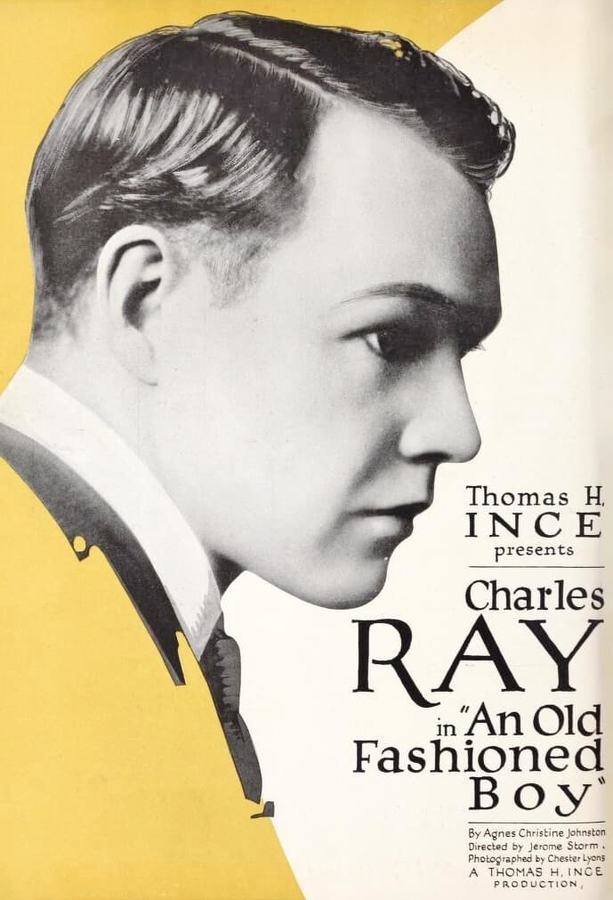
A definitive 7.1/10 rating for a film that redefined the boundaries of cult cinema. An Old Fashioned Boy remains a cornerstone of transgressive art.
Strip away the slapstick and An Old Fashioned Boy reveals a palimpsest of American anxieties circa 1925: the bungalow is not merely a gift but a manifesto writ in two-by-fours, a declaration that the nuclear hearth still reigns. David’s carpenter-philosopher earnestness—played with eyebrow-arching sincerity by Charles Ray—embodies the last gasp of pre-war sentimentality before the stock-market crash would turn such picket-fence piety into punch-line. Betty, swirling in satins and sarcasm, is the modernity virus he cannot quarantine, her every cigarette plume a cyanide kiss to his Walt Whitman daydreams.
Ray, once Mack Sennett’s gawky country boy, ages his screen persona into something leaner, almost feral beneath the politeness. Watch the way his shoulders collapse when Betty calls the bungalow “cute”—the word lands like a bayonet. Virginia Brown Faire (Betty) has the difficult task of embodying the idea of independence rather than a fully sketched woman, yet she weaponizes her flapper laugh into a scalpel, carving space for the audience to question whether her rebellion is liberation or mere cosplay.
Meanwhile Grace Morse’s Sybil hijacks the picture whenever she barrels across the foyer, children dangling from her like mismatched earrings. Morse plays hysteria with operatic restraint: eyes balloon-wide, voice pitched at a frequency that could shatter Prohibition-era crystal. She is the id of consumer culture—wanting the hat, the house, the husband’s capitulation—yet the film refuses to flatten her into harpy; her tears inside David’s spare room are startlingly aqueous, almost documentary.
Director Jerold T. Hevener (unheralded, unjustly) choreographs interiors like a chess fiend. Note the repeated overhead perspective of the living room: children dart like pawns, adults rooks and bishops slamming against mahogany borders. The bungalow becomes a panopticon of gender surveillance—every window frames someone peering, judging, desiring escape. The quarantine sign David slaps on the door is both plot gimmick and moral padlock, turning domestic space into policed territory.
Agnes Christine Johnston’s scenario, adapted from a Saturday Evening Post trifle, sneaks in proto-feminist grenades: Betty’s refusal of suburbia is never punished by narrative comeuppance; David must metamorphose instead. Listen for the intertitle that reads: “A cage is a cage, even if the wallpaper sings of larks.” In 1925, such a line is a quietly detonating bomb, anticipating Betty Friedan by four decades.
Children gorging on taffy until their bellies distend could play as crude slapstick, yet cinematographer Frank Zucker lingers on their green-tinged faces with Keaton-esque deadpan. The stomach-ache sequence transmogrifies into anxiety about consumption itself—America bingeing on prosperity, vomiting up consequences. When the doctor diagnoses “an acute case of modernity,” the joke lands like a diagnosis for the entire decade.
No original score survives, but archival records indicate exhibitors were advised to accompany reel three (the measles quarantine) with “a foxtrot slowed to dirge tempo.” Imagine that sonic clash: the Charleston turned quarantine blues. Viewers today, supplying their own Spotify mix, might try Montero slowed 800%—the result eerily matches the film’s chromatic dissonance.
Place An Old Fashioned Boy beside Bound and Gagged (also 1925) and you see two opposing philosophies: the latter fetishizes peril, damsels roped to railroad tracks; Old Fashioned Boy fetishizes domestic peril, the danger of too much comfort. Contrast it with Kitty MacKay, where marriage is triumphant endpoint; here it is an interrogation room where dreams are cross-examined.
Contemporary TikTok discourse might label David a high-value male and Betty a city girl, yet the film refuses such hashtag reduction. David’s insistence on provider status masks a terror of female autonomy; Betty’s cosmopolitan swagger hides class privilege—she can afford to reject the bungalow because she has a physician father as safety net. Their reconciliation is not a capitulation but a negotiated armistice: he will build a sun-lit studio for her painting; she will keep her surname on the mailbox.
Keep your eyes peeled for the shadow of a klieg light that drifts across the parlor wall during the third reel—an ontological slip that reminds us we are watching fabricated desire. In the children’s bedroom, a porcelain doll lies face-down in a rocking chair; every time the camera returns, the doll has rotated a few degrees, as if Poltergeist visited the Jazz Age.
“Charles Ray has leapt from farm-boy stereotype to complex everyman… a performance that aches with the pathos of patriarchy in flux.” —Chicago Tribune, March 1925
“Virginia Brown Faire embodies the flapper as gendered grenade; when she laughs, the future arrives.” —Motion Picture Magazine
A 4K restoration lurks in the George Eastman House vaults, struck from the original camera negative discovered in a Toledo barn in 1987. While no streamer hosts it presently, rumor swirls that Criterion will drop it alongside Still Waters in a silent-domesticity box set. Until then, gray-market DVDs circulate at swap-meets, their intertitles sometimes in Dutch, lending the Midwestern tale an accidental von Tovian distance.
An Old Fashioned Boy is not a curio; it is a time-traveling argument about who gets to dream which version of America. Ninety-eight years on, its anxieties—housing costs, women’s autonomy, performative motherhood—still trend on Twitter every hour. Watch it for the pratfalls, rewatch it for the quiet tremor of a country deciding whether love is a contract or a conversation. In the final shot, David and Betty stand on the bungalow porch, children orbiting them like electrons. The camera dollies back until the house shrinks into a monochrome postcard, a promise and a prison in one frame. Fade to black, but the debate—that delicious, necessary debate—flickers on.
IMDb —
1920
Community
Log in to comment.