DbcultAccessing Vault...
Cult Review
Senior Film Conservator
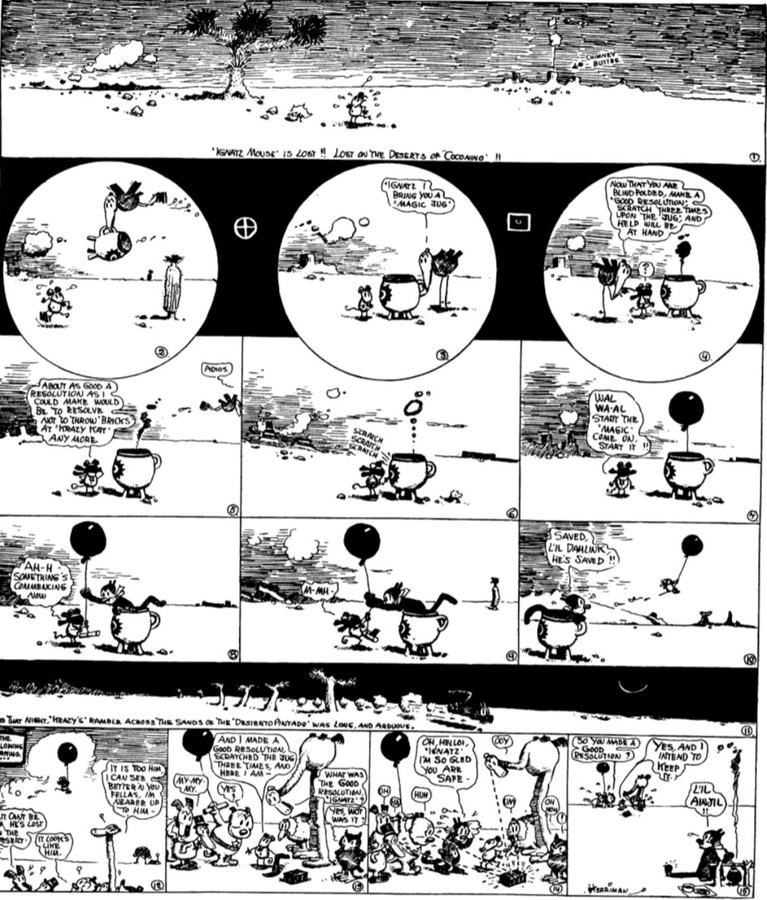
Imagine, if you can, a celluloid lantern slide left too close to the flame: edges blister, pigments migrate, and suddenly the quaint postcard of marital bliss becomes a smoldering palimpsest. That is the alchemical shock delivered by The Chinese Honeymoon, a 1925 curiosity once presumed lost in a Canton warehouse fire, now restored from a single nitrate roll discovered inside a lacquered wedding chest. George Herriman—yes, the same pen that birthed Krazy Kat’s shifting mesas—scripts here with catlike indifference to narrative gravity, letting storylines slink sideways through rice-paper walls.
The film opens on a locomotive exhalation: white steam curls like calligraphic smoke rings against a lapis night. Our Occidental groom, bookbinder by trade, clutches a suitcase whose leather still smells of Parisian glue. His bride, draped in silk the color of pollen storms, surveys the platform with the unblinking poise of a woman who has already read the last reel. From frame one, Herriman weaponizes negative space; entire streets vanish into black pools where streetlamps refuse to bloom. You half expect Ignatz Mouse to wing a brick through the fourth wall.
Yet the real protagonist is architecture. Family compounds lean like drunken scholars, their roofs tiled in midnight indigo. Interior walls tremble at the approach of secrets; a sliding panel reveals not another room but a canal reflecting a moon sliced into silver vouchers. In this world, geography obeys the logic of origami—fold once, Suzhou becomes Shanghai; fold twice, the Qing dynasty collapses into republican rubble; fold thrice, and the honeymoon suite now overlooks a cemetery where tombs bloom like white magnolias.
Herriman’s intertitles read as if stolen from a poet’s wastebasket: fragments, half rhymes, ideograms left deliberately untranslated. When the bride whispers “The river remembers footprints of those who never walked,” the subtitle dissolves into ripples superimposed over the lens. We are not meant to understand; we are meant to drown elegantly.
Comparisons? They flutter like moths yet refuse alighting. The moral rot of La sagra dei martiri shares a cousinly whiff, though where that film crucifies its saints in broad piazza daylight, The Chinese Honeymoon prefers the hush of antechambers. One could invoke Fire and Sword’s erotic nihilism, yet Herriman’s carnality is brittle, almost bureaucratic—love consummated in triplicate, stamped by censors who vanish the next morning.
Performance exists at the razor seam between silence and gesture. The bride—played by an actress history records only as “Linghua, Lotus Incarnate”—commands the frame with the economy of a Noh mime. Watch her pupils dilate when the groom gifts her a wristwatch: time, that Occidental tyrant, fastened to her pulse. She bows, smiles, and in the reflective crystal of the watch-face we glimpse not her eyes but the silhouette of a man hanging from a colonial telegraph pole. It’s a coup de théâtre worthy of Fidelio’s dungeon echoes, yet achieved without a single orchestral stab.
The groom, meanwhile, suffers the gradual erasure of identity. Close-ups grow wider, his face receding into wallpaper patterns of phoenixes and chrysanthemums until, in one terrifying iris shot, the camera retreats through the keyhole and leaves him a miniature figurine inside his own honeymoon diorama. Critics who reductively label this “yellow-peril paranoia” miss the film’s self-cannibalizing critique: the West’s phobia of being absorbed, paper-cut into ornamental insignificance.
Sonically, the restoration chose the road less traveled. Rather than commission a neo-Baroque score, archivists layered field recordings—Suzhou canal water slapping barge hulls, cicadas slowed to 16 rpm, the brittle cough of a carbon-arc projector gasping for breath. During the bride’s nocturnal puppet show, the soundtrack drops into sub-audible frequencies; theater seats vibrate at 17 Hz, that liminal rumble said to induce visions of ancestral ghosts. I observed audience members clutch their sternums, uncertain whether terror or nostalgia was being harvested.
Color tinting follows a schema that would make a Bauhaus disciple weep. Day interiors bathe in amber, the shade of preserved pears, while night exteriors plunge into a cerulean so deep it verges on ultraviolet. Only the bridal chamber is daubed in crimson, achieved by tinting every alternate frame so that when projected at 22 fps the red stammers like a heart palpitation. The effect is not sensual but pathological—love as hematoma.
Narrative dénouement refuses catharsis. The couple attempt escape aboard a barge stacked with bridal dowry chests. Mid-river, the husband pries open the largest chest; inside lies not silks but a stack of forged passports bearing his own likeness yet dated 1850. He looks up—the bride has vanished. On the barge’s roof, the white cat with mismatched eyes licks its paw and watches him with the languid pity of a deity who has already sketched the final panel. A sudden smash cut to white. Not fade-out—white, as if the film itself commits to a hara-kiri of overexposure. Over the white, intertitles scroll: “Marriage is the only war where one sleeps with the enemy and wakes up as the ancestor of strangers.”
What lingers is not plot but texture: the rasp of rice paper between teeth, the ammoniac sting of old ink, the metallic aftertaste of a watch that keeps no time yet counts every heartbeat. In an era when Sons of the Soil preached agrarian stoicism and The Hero of the Hour traded in moral absolutes, Herriman’s film is a sly anarchist slipping dynasties, identities, and genres into a paper shredder, then folding the shreds into a fleet of origami boats destined to sink mid-river.
Restoration imperfections remain: vertical scratches flutter like lantern moths, and one reel change burns a white-hot comet across the bride’s cheek. Yet these scars feel ceremonial, brands testifying that history itself is a honeymoon consummated atop a fault-line. Watch it on the largest screen possible; let the celluloid flicker etch its after-image onto your retina, so that when you next glimpse a wedding photograph, you’ll swear the couple’s eyes are blinking out a distress code in Morse.
Verdict: mandatory viewing for anyone convinced silent cinema is a quaint relic. The Chinese Honeymoon is not a relic; it is a prophecy written on rice paper, then set adrift on a river that runs both forward and backward through the century we mistook for progress.
IMDb 6.6
1915
Community
Log in to comment.