DbcultAccessing Vault...
Cult Review
Senior Film Conservator
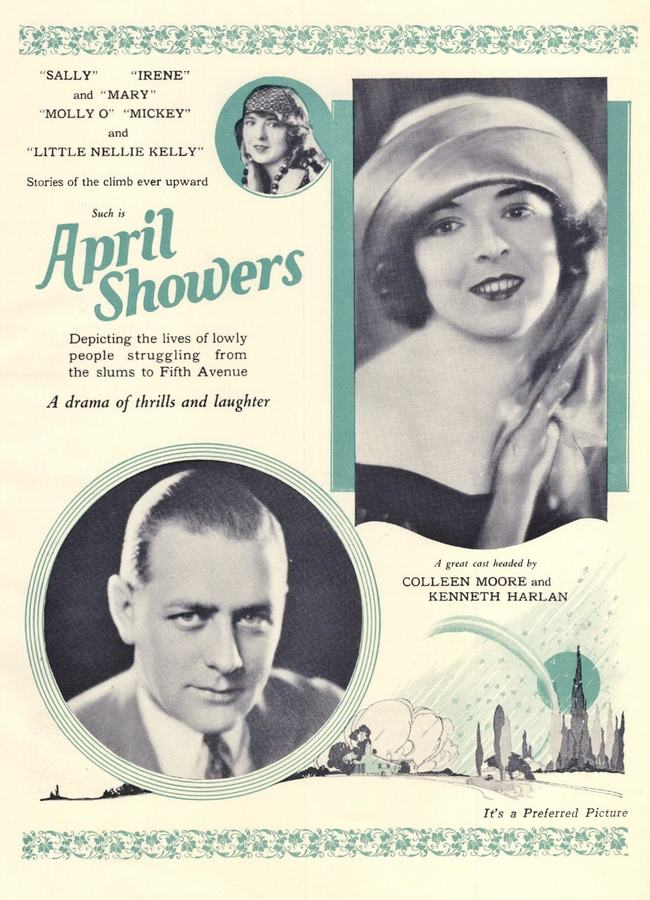
The 1920s cinematic landscape was often a battlefield where the burgeoning middle-class aspirations of a post-war America clashed violently with the gritty reality of the urban immigrant experience. April Showers (1923), directed with a keen eye for social nuance, stands as a quintessential artifact of this era. It is not merely a melodrama; it is a sprawling meditation on the weight of expectation and the fragile nature of proletarian honor. The film leverages the trope of the 'policeman’s son' to explore whether virtue is an inherited trait or a hard-won victory against the gravity of the slums.
Danny O'Rourke, portrayed with a stoic vulnerability by Jack Byron, is a protagonist defined by absence. His father’s heroic death in the line of duty is the silent antagonist of the film, a ghost that demands Danny’s total submission to the law. This thematic preoccupation with legacy is a recurring motif in silent cinema, often seen in works like The Happy Warrior, where the physical and moral struggles of the youth are inextricably linked to the sins or successes of the preceding generation. Danny’s journey toward the police force is depicted not as a career choice, but as a religious pilgrimage, one fraught with the possibility of excommunication through failure.
The narrative brilliance of writers Louis D. Lighton and Hope Loring shines in the way they juxtapose Danny’s internal pressure with the external allure of the neighborhood. The 'court' where Maggie Muldoon (the luminous Colleen Moore) resides is a microcosm of communal intimacy and claustrophobia. Moore, even in this early role, exhibits the kinetic charm that would soon make her a flapper icon, yet here she is grounded, providing the emotional ballast Danny requires as he navigates the treacherous waters of his own inadequacy.
One of the most sophisticated elements of April Showers is its critique of 'slumming'—the practice of wealthy socialites intervening in the lives of the poor for their own moral gratification. Miriam Welton’s neighborhood clubhouse is a monument to this disconnect. While she intends to 'give happiness,' her efforts are met with a justifiable skepticism. The film suggests that charity without empathy is merely a form of soft colonization. Unlike the more earnest depictions of social reform found in Puritan Passions, April Showers treats Miriam’s intervention as a catalyst for chaos.
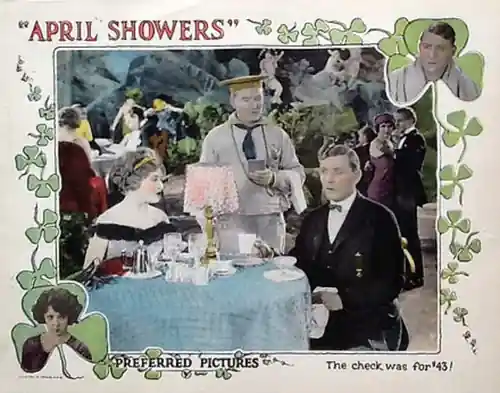
The gift of the hat to Shannon O'Rourke is a masterclass in symbolic storytelling. In the visual language of silent film, a single garment can represent the entire spectrum of human desire. For Shannon, the hat is a portal to a world where she is noticed, a world of masculine attention and aesthetic validation. However, this taste of the 'high life' creates a void that her socioeconomic reality cannot fill. Her descent into theft is not portrayed as a moral failing of the soul, but as a systemic inevitability. The film argues that when you show a starving person a feast they can never afford, you are not being kind; you are being cruel. This thematic depth elevates the movie far above the standard 'crook' dramas of the time, such as Lights of New York.
The climax of the film hinges on a prize fight that serves as a visceral metaphor for Danny’s life. When he fails his examination—a failure that feels like a betrayal of his father’s memory—he is forced to monetize his own suffering to save his sister. The boxing sequences are shot with a raw, unvarnished energy that anticipates the gritty realism of later noir films. Danny isn't a skilled fighter; he is a man being pulverized by the weight of his responsibilities. The sea blue (#0E7490) tones of the night scenes contrast sharply with the dark orange (#C2410C) heat of the boxing arena, creating a visual tension that mirrors Danny's internal state.
There is a profound irony in the resolution of the plot. Danny is 'badly beaten' in the ring, yet he is saved by a clerical error. This pivot from physical struggle to bureaucratic correction is a fascinating commentary on the nature of success in the modern world. It suggests that while Danny’s willingness to bleed for his family is noble, his actual salvation comes from the very system he sought to join. This nuance prevents the film from feeling like a simple 'pull yourself up by your bootstraps' narrative. Instead, it acknowledges the role of chance and systemic fallibility, a theme also explored in the contemporary piece The Fringe of Society.
While the film is ostensibly about Danny’s journey, it is Colleen Moore’s Maggie who provides the spiritual center. Her performance is a study in restraint. In an era where silent acting often drifted into the histrionic, Moore utilizes subtle shifts in expression to convey a lifetime of shared history with Danny. Her presence in the 'court' scenes provides a warmth that contrasts with the cold, sterile environment of Miriam’s clubhouse. The romance between Danny and Maggie is not one of grand gestures, but of mutual survival. It is the type of relationship found in The Brief Debut of Tildy, where love is a quiet necessity rather than a loud luxury.
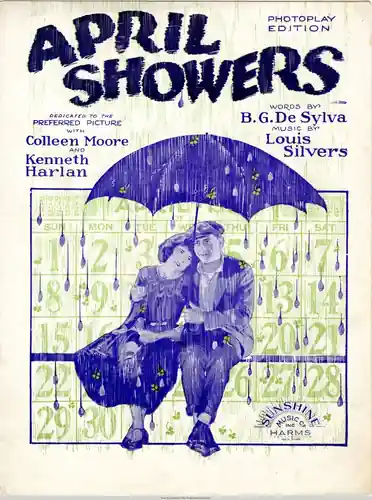
The cinematography deserves special mention for its use of light and shadow to demarcate class boundaries. The O'Rourke household is often bathed in a soft, diffused light that suggests a fading sanctity, while the world of Miriam Welton is sharp, high-contrast, and ultimately hollow. This visual dichotomy reinforces the film’s central thesis: that the 'happiness' Miriam seeks to provide is a synthetic substitute for the genuine communal bonds of the tenement dwellers. The use of yellow (#EAB308) accents in the set design of the clubhouse highlights its artificiality, a jarring intrusion into the naturalistic palette of the neighborhood.
As we look back at April Showers from a century’s distance, its relevance remains startlingly intact. The issues it grapples with—the ethics of charity, the pressure of familial legacy, and the desperation of the working class—are perennial. It avoids the easy sentimentality of films like Over the Garden Wall, opting instead for a more complex exploration of what it means to be a 'good man' in a world that demands a thousand dollars for a sister’s dignity. The film’s conclusion, while ostensibly a 'happy ending,' is tempered by the bruises on Danny’s face. He has won his badge and his girl, but the cost of that victory is etched into his skin.
In the broader context of 1923 cinema, which saw everything from the epic scale of Eretz Yisrael Hameshukhreret to the localized drama of On the Fighting Line, April Showers holds its own as a deeply humanistic work. It doesn’t preach; it observes. It doesn’t offer easy solutions; it offers a reflection of a struggle that continues to this day. The 'showers' of the title are both the tears of the marginalized and the cleansing rain that allows for a new beginning. For any student of silent film or social history, this is a mandatory viewing, a piece of celluloid that captures the heartbeat of an era in transition.
April Showers is a robust, emotionally resonant drama that utilizes the specificities of the Irish-American experience to speak to universal themes of sacrifice and redemption. With stellar performances and a script that refuses to patronize its characters, it remains a high-water mark for the 1923 season. It is a film that understands that sometimes, to become a hero like your father, you first have to be willing to lose everything in a dirt-floor ring.
IMDb 3.3
1923
Community
Log in to comment.