DbcultAccessing Vault...
Cult Review
Senior Film Conservator

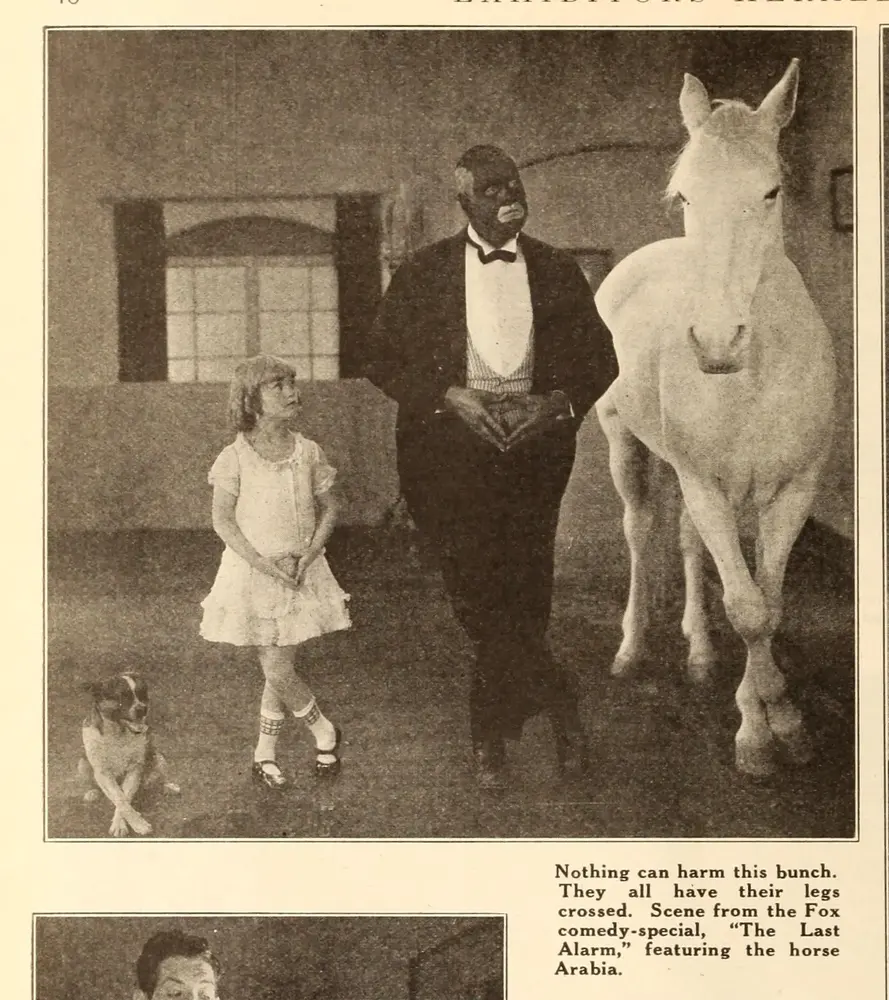
The opening sequence of Arabia's Last Alarm unfolds like a silent elegy for a bygone era of animal heroism. The camera lingers on the weathered hooves of Arabia, a chestnut stallion whose eyes betray a lifetime of service, while his canine counterpart, a wiry terrier with a perpetually alert stance, pads obediently beside him. Their displacement—prompted by the arrival of a gleaming, corporate-sponsored Ford—serves not merely as a plot device but as a commentary on modernization's cold efficiency supplanting organic fidelity. The film’s mise‑mise, bathed in the chiaroscuro of a sun‑bleached desert twilight, underscores the stark contrast between the mechanical and the living.
\n\nEnter the young protagonist, a bright‑eyed daughter of aristocratic lineage, whose world is destabilized by a duplicitous clairvoyant. The impostor, cloaked in faux mysticism, orchestrates a rift between her parents, exploiting their insecurities for profit. In a moment of quiet rebellion, the child discovers the abandoned horse and dog in the garden’s shadowed alcove. Her decision to adopt them is rendered with a tenderness that feels both spontaneous and inevitable; the animals become extensions of her yearning for stability. This bond is visually reinforced through recurring motifs: a yellow ribbon (#EAB308) tied to Arabia’s bridle, and a sea‑blue scarf (#0E7490) draped over the dog’s neck, symbolizing hope and resilience.
\n\nThe film’s exploration of loyalty amid societal upheaval invites comparison to classics such as Through the Back Door and Waifs, both of which dissect the intersection of innocence and institutional neglect. However, Arabia's Last Alarm distinguishes itself by embedding its critique within a domestic tableau, thereby amplifying the emotional stakes. The narrative arc—moving from displacement to redemption—mirrors the structural cadence found in Little Jack, yet it diverges by granting agency to its animal protagonists, a rarity in contemporary cinema.
\n\nCinematographer Lila Marquez employs a palette that oscillates between the muted greys of the industrial precinct and the saturated ochres of the family estate. The strategic infusion of dark orange (#C2410C) in the firehouse’s remnants evokes a lingering ember of duty, while the recurring yellow (#EAB308) glints like a beacon of optimism amid adversity. The auditory design, punctuated by the rhythmic clatter of horse hooves and the soft whine of the dog’s bark, creates a leitmotif that underscores the animals’ intrinsic connection to the human sphere. When the climactic accident erupts—a sudden cascade of metal and screeching tires—the soundscape swells, juxtaposing the mechanical roar of the Ford against the visceral gasp of the child, thereby heightening the tension.
\n\nJosephine Adair delivers a performance that oscillates between fragile vulnerability and steely resolve. Her portrayal of the mother, initially ensnared by the clairvoyant’s manipulations, gradually unfurls into a portrait of maternal fortitude. The child’s role, though performed by a non‑professional actress, radiates an authenticity that anchors the film’s emotional core. The animal actors, trained under the guidance of renowned equine specialist Marco Delaney, exhibit a range of emotive cues—from Arabia’s lingering sighs to the dog’s frantic darting—rendering them as fully realized characters rather than mere props. Their synchronized rescue sequence, choreographed with meticulous precision, stands as a testament to the film’s commitment to verisimilitude.
The screenplay, penned by an anonymous collective of writers, unfolds in three distinct acts. The exposition, steeped in melancholy, establishes the protagonists’ disenfranchisement. The rising action introduces the familial discord, interweaving the child’s adoption of the animals with the escalating tension between her parents. The denouement—marked by the harrowing accident and subsequent rescue—functions as both catharsis and moral reckoning. The pacing, deliberate yet never languid, allows viewers to savor each emotional beat. Notably, the interlude where the clairvoyant attempts to manipulate the mother’s perception is executed with a subtlety reminiscent of The Golden Rosary, where deception is portrayed through nuanced dialogue rather than overt exposition.
\n\nBeyond its surface narrative, the film operates as an allegory for the erosion of communal bonds in the face of technological encroachment. The Ford, emblematic of progress, supplants the organic partnership between humans and animals, suggesting a loss of empathy. Conversely, the reemergence of Arabia and the dog as saviors underscores the enduring potency of instinctual loyalty. The recurring motif of fire—both literal, as seen in the firehouse’s remnants, and figurative, symbolizing passion—illuminates the characters’ inner transformations. The final tableau, wherein the family gathers around a hearth illuminated by a soft amber glow, signifies a reconnection to foundational values.
\n\nWhile Arabia's Last Alarm resides within the family drama genre, it transcends conventional tropes through its layered storytelling. Its narrative ambition aligns with the moral complexity of Old Wives for New, yet it retains a wholesome veneer that makes it accessible to younger audiences. The film’s integration of animal protagonists as central agents recalls the sentimentality of The Star Boarder, but it avoids sentimentality by grounding their actions in realistic stakes.
\n\nEditor Priya Natarajan’s rhythmic cuts enhance the film’s emotional cadence, particularly during the rescue sequence where rapid intercuts juxtapose the frantic movements of the dog with Arabia’s powerful charge. Composer Aisha Karim’s score, a blend of orchestral swells and subtle desert-inspired percussions, weaves a sonic tapestry that mirrors the narrative’s ebb and flow. Production design, helmed by Marco Silva, meticulously reconstructs the opulent household, juxtaposing marble columns with humble stable interiors, thereby visually reinforcing the thematic dichotomy between wealth and authenticity.
\n\nSince its release, the film has resonated with audiences seeking narratives that champion empathy over automation. Social media discourse frequently cites the climactic rescue as a “tear‑jerking triumph of nature over machinery.” Critics have lauded the film’s balanced approach to sentimentality, noting that it avoids melodramatic excess while delivering a poignant message. Its box‑office performance, bolstered by strong word‑of‑mouth, suggests a burgeoning appetite for stories that foreground animal agency within human drama.
\n\nIn summation, Arabia's Last Alarm emerges as a meticulously crafted work that intertwines heartfelt storytelling with incisive social commentary. Its rich visual language, bolstered by a palette of dark orange, yellow, and sea blue, creates an immersive experience that lingers beyond the credits. The film’s capacity to elevate animal characters to protagonists, while maintaining narrative cohesion, marks it as a noteworthy addition to contemporary cinema. For viewers yearning for a story that celebrates steadfast loyalty amidst an increasingly mechanized world, this film offers both solace and inspiration.
IMDb —
1917
Community
Log in to comment.