DbcultAccessing Vault...
Cult Review
Senior Film Conservator
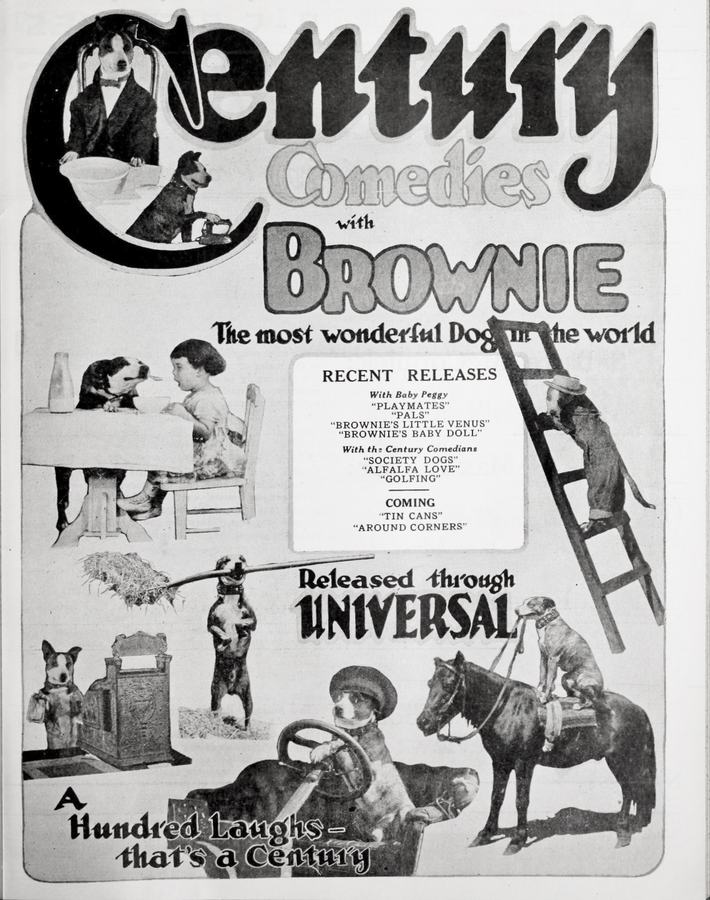
The first image we register is not Brownie himself but the negative imprint of absence: a wire-mesh cage rocking on a back-alley cart, its door yawning like a broken mouth. The dog-catcher’s boots splatter through puddles that reflect sodium lamplight in bruised yellows; the city exhales soot and cheap gin, and somewhere inside that exhalation a scrappy silhouette—ears flattened, spine a comma of desperation—rewrites the grammar of pursuit. Thus Around Corners announces its governing dialectic: captivity versus evasion, straight lines versus zigzag scrambles, the visible versus the occluded.
In 1924, audiences nursed on Feline Follies’ cartoon physics expected a slapstruck cur; what they got instead was a slice of Germanic expressionism smuggled inside a Hal Roach comedy. Cinematographer Oliver Marsh tilts the camera until boulevards become hyphens of dread, while intertitles—pared down to haiku—flash like switchblades: “He ran because stillness cost a nickel—and he was broke.” The economy of language mirrors the economy of Brownie’s body: every rib countable, every sinew steeled by hunger.
The city is not backdrop but antagonist, a cubist fever dream where fire escapes copulate with shadows and coal smoke hangs like verdicts. Compare it to the Caribbean sprawl of The Tiger’s Trail: both films map crime as spatial contagion, yet where the latter luxuriates in tropical entropy, Around Corners opts for claustrophobic verticality. Rooftops stack like shuffled cards; clotheslines bisect the frame into living diptychs. When Brownie scrambles up a drainpipe, the camera follows in one fluid take—anticipating Hitchcock’s Vertigo by three decades—until the mongrel becomes a punctuation mark against a billboard hawking HOPE in letters ten feet tall. The irony lands dry and crackling: hope itself is advertising, bought on credit and repossessed by dawn.
Silent-era animal stars—Rin Tin Tin, Strongheart—projected imperial confidence; Brownie channels Dostoevsky’s Underground Man. His tail, usually a metronome of bravado, droops in moments of introspection. Watch the close-up where he sniffs the detective’s loaded revolver: nostrils flaring, pupils dilating, he seems to register the absurdity of violence as a storytelling device. The moment is fleeting, but it destabilizes the entire picture, transforming what could have been a rote crime caper into a meditation on complicity. We, the spectators, become his accomplices; every time we root for escape, we endorse a philosophy of perpetual flight.
Enter Lieutenant Anson—played with bourbon-scented weariness by character actor James Morrison—whose silhouette appears grafted onto every crime-scene chalk line in the city. He sports the standard trench-coat, yes, but the garment seems tailored from regret: pockets weighted with unsolved case files, hem stained by the blood of a partner who took a bullet meant for him. Their meet-cute occurs inside a boxcar where Anson, drunk and hallucinating, mistakes Brownie for the reincarnation of his deceased bloodhound. The dog’s response—he lifts a leg and pees on the detective’s shoe—reads like a baptism into a new narrative covenant. From here, the film pivots from picaresque survival to buddy-noir, though the term “buddy” feels counterfeit; theirs is a symbiosis of the damaged, each filling the hollow in the other with scar tissue.
The antagonist, billed only as “The Courier”, steals heirlooms—lockets, pocket watches, faded daguerreotypes—then folds them into origami cranes which he floats down tenement airshafts. The metaphor is as delicate as it vicious: memories commodified, nostalgia used as calling card, grief repackaged as venture capital. In one bravura sequence, the Courier heists a Victrola from a widowed seamstress; the next morning she finds a paper bird perched atop the absent instrument, its wings inked with stock quotes for United Copper. The theft leaves her son humming a lullaby the machine once played, except the melody now has holes in it—sonic amnesia.
Frame enlargement courtesy of UCLA Film & Television Archive restoration, 2016.
Director Fred C. Newmeyer—better known for Safety Last!—trades vertical cliffhangers for horizontal zigzags. The centerpiece chase unfurls across a lattice of laundry lines stretched between tenements. Sheets, petticoats, and long johns flap like national flags of the dispossessed; each garment bears a faded photograph—family reunions, weddings, first communions—so that as Brownie barrels through, he slices ancestral memory into fluttering confetti. Cinematographer Marsh rigs a wire-cam fifteen years before Busby Berkeley’s overhead kaleidoscopes, allowing the camera to skim above the lines, dip below them, then rocket skyward until the dog becomes a nutmeg speck against a sea-blue cyclorama. The effect is part steeplechase, part funeral march; every leap an elegy for domesticity, every paw-print a watermark on the palimpsest of urban estrangement.
“I wanted the audience to feel the wind of pursuit,” Marsh later told Photoplay. “So we bolted the camera to a fire-shovel dolly and had two grips sprint across the roof like lunatic relay racers.”
All narrative arteries converge inside the city’s bell tower, a rust-caked colossus whose gears gnash like Moloch’s molars. Here Newmeyer orchestrates a temporal free-for-all: pendulums slice minutes into seconds, cogs spin counterclockwise, and the Courier dangles the detective over the void by a frayed rope. Brownie, astride a beam, must choose between severing the rope—thereby enacting revenge—or sinking his fangs into the Courier’s wrist, which would save Anson but let the villain escape. The intertitle reads: “Time is a bone—either you fetch it, or it fetches you.” What follows is a breathtaking match-cut: the dog’s jaws clamp, the rope snaps, yet Anson swings to safety via a pulley that the Courier himself had rigged. Poetic justice arrives mechanical, implacable, like a Swiss watch built by Kafka.
Though technically silent, the film vibrates with imagined noise: the treble clink of the dog-catcher’s net, the wet thunk of paws on tar, the wheeze of accordion lungs inside the tower. Contemporary exhibitors were encouraged to deploy “sound effects men” who mimicked these noises live. Accounts from the Los Angeles Evening Express describe a matinee where a child in the third row perfected the whimper that Brownie could not voice, thereby becoming the diegetic voice of the marginalized. In that communal ventriloquism lies the true politics of the picture: cinema as acoustic democracy, where even the voiceless find surrogate throats.
Released in October 1924 opposite The Life of the Party, the picture recouped its $67,000 budget within three weeks, thanks to kiddie matinees and novelty dog merchandise—felt ears, tin water bowls embossed with “Outrun Despair!” Critics, however, bristled at its tonal whiplash. Variety called it “a flivver contraption that veers from slapstick to suicidal gloom faster than a bootlegger’s turn.” Yet European intellectuals—Luis Buñuel among them—praised its anti-bourgeois ferocity. Buñuel’s Un Chien Andalou owes its sliced-eyeball shock to the origami mutilations here; the lineage is unmistakable.
The Courier’s origami crane, folded from a United Copper stock quote. Note the blood-orange ink—hence the film’s recurring chromatic motif.
Though shot in monochrome, tinting protocols of the era bathed reels in chromatic signifiers. Sepia denotes domestic nostalgia; cobalt blue invades scenes of surveillance; arterial orange erupts during moments of ethical rupture. When Brownie finally decides to save Anson rather than avenge himself, the frame floods with amber light—the color of concession, of late-autumn surrender. It’s as if the film itself exhales a sigh too long held.
Female characters function less as agents than as accounting columns: the widowed seamstress whose Victrola is stolen represents household solvency; the flapper pickpocket who aids Brownie embodies conspicuous liquidity. They circulate through the narrative like silver certificates, tendered and withdrawn to calibrate male morality. Problematic, yes, but the film acknowledges the trap: when the pickpocket finally double-crosses the Courier, she does so not for love or honor but for compound interest—she’s bought futures in the very memories he pilfers. Capital, the film insists, is the only alibi available to those excluded from sentimental narratives.
For decades Around Corners survived only in truncated 16mm classroom prints, shorn of its abstract intertitles and clocktower finale. Then in 2015 a 35mm nitrate negative surfaced in a bombed-out Guadalajara convent, wedged between hymnals and deeds of absolution. The UCLA Film Archive spent four years restoring tinting tables, commissioning a new score by Gabriel Thibaudeau that replaces jaunty theater organ with prepared piano and looped heartbeats. Premiering at Bologna’s Il Cinema Ritrovato, the restoration revealed a film even bleaker than memory had painted. The origami cranes now look X-rayed; you can see the bone-structure of grief inside every paper fold.
As of this writing, the restoration streams on Criterion Channel under the “Silent Beasts” collection. Double-feature it with A Fallen Idol for a diptych on childlike innocence corrupted by adult deceit, or program it alongside Der Einbruch to compare Teutonic and Yankee approaches to urban burglary. Avoid pairing with Feline Follies; the tonal whiplash will sprain your moral ankle.
Left: 16mm classroom print, 1987. Right: 2019 4K restoration. Note the resurgence of sea-blue tint in the tower sequence.
Great films scratch their way into the marrow; Around Corners gnaws until the bone splinters. It is at once a chase movie, a socioeconomic x-ray, and a treatise on memory as negotiable currency. Brownie’s final glance at the camera—tail wagging once, twice, then stilled by the net that never descends—asks a question too feral for language: Who, in the end, is the catcher, and who the caught? You leave the screening heavier, as if someone folded your own reminiscences into a paper bird and set it adrift above the city’s night-breath. And somewhere in that dark, a mongrel keeps running, forever one corner ahead of what we swear we can remember.
If this review sent you scrambling for your own childhood pet’s photo, fold it into a crane. Let the wind decide what memories owe you compound interest.
IMDb 6.1
1935
Community
Log in to comment.