DbcultAccessing Vault...
3.2/10
Senior Film Conservator
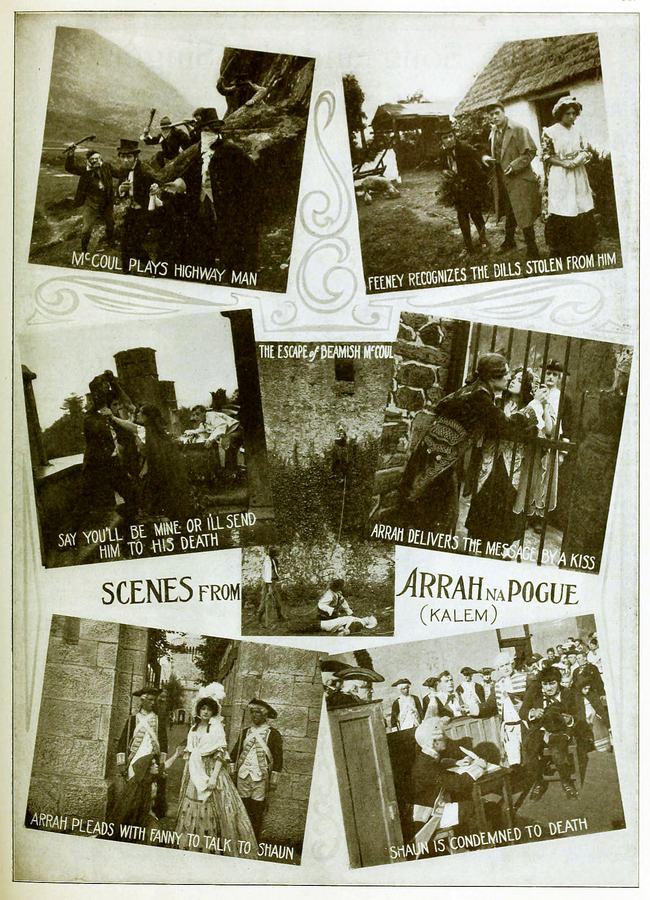
A definitive 3.2/10 rating for a film that redefined the boundaries of cult cinema. Arrah-Na-Pogue remains a cornerstone of transgressive art.
Wicklow’s granite walls have witnessed many a rebellion, but none so cinematically intimate as the kiss that smuggles revolution through a jail-cell.
There is a moment—blink and the nitrate ghosts devour it—when Gene Gauntier’s Arrah leans toward the prisoner, her shawl slipping like twilight off one shoulder, and the entire apparatus of Empire (bayonets, redcoats, the very lens that records her) seems to inhale in anticipation. The kiss lands; the note vanishes. In that heartbeat, Boucicault’s Victorian theatre piece is alchemised into something fiercely cinematic: a clandestine information-transfer more erotic than any embrace Griffith would stage a year later with the same cliff-side coordinates in Eileen’s Escape.
Shot during the Kalem Company’s third Irish sojourn, Arrah-Na-Pogue survives only in scattered paper prints, trade-jottings, and the kind of mythologising lobby cards that promise “a horse-race on the edge of the sea-cliffs” we will never see. Yet absence is its own archive: the gaps let us hear the Atlantic wind that hurled sand into the crank-camera, feel the bruise on J. J. Clark’s wrist as he vaulted the prison-wall for the seventh take, taste the salt on Arrah’s lips as she rehearsed the mouth-to-mouth communiqué. Olcott—who would later chase panoramic “topicals” across the same landscape—here compresses an epic into a single reel, trusting silhouette, tide, and the Wicklow dusk to do the rest.
Consider the economy of the escape: no pickaxes, no tunnels, merely a filament of rice-paper sliding across another tongue. Cinema has always been smitten with the oral—think of boxing films where jaws dislocate in sun-baked Nevada—but here the mouth is portal, printing-press, weapon. Gauntier understood that silent acting is not decibel-reduced pantomime but a grammar of micro-gestures: the swallow that hides contraband, the tremor in Arrah’s eyelid as sentries leer, the fractional pause before Beamish’s teeth graze her lower lip—enough to suggest gratitude, guilt, and the erotic charge that will complicate every subsequent loyalty.
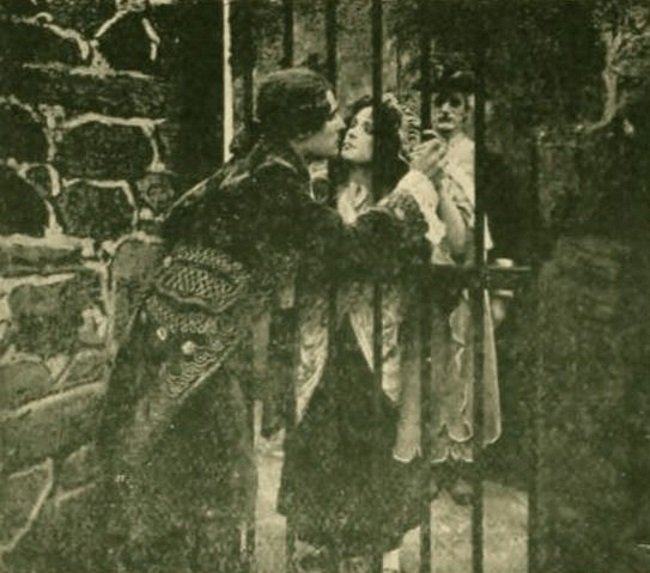
Visually, Olcott frames the tryst through a barred aperture, so that the lovers’ faces become a living medallion superimposed on stone. It anticipates the iris-shot fetish of later European art-film, yet the purpose is narrative, not ornament: the jail’s geometry swallows peripheral space, forcing our pupils to dilate like conspirators’. When the rope finally unspools outside the wall, the camera does not follow Beamish down the cliff; it lingers on Arrah’s hand pressed flat against cold granite, a farewell that feels oddly more final than any gallows-drop.
Exile in Paris is conveyed by a single intertitle—“Four years of reckless exile”—and a cut to Beamish silhouetted against a painted backdrop of Notre-Dame. No Montmartire cabarets, no absinthe fountains: Olcott refuses ethnographic postcard cliché. Instead, the ellipsis becomes existential chasm; time itself is confiscated land. When Beamish re-crosses the threshold of his former cottage, the camera tracks laterally, as though the room is reluctant to recognise him. Fanny’s steadfastness—played with flint-eyed resolve by an uncredited actress—registers less as sentimental fidelity than as political continuity: the rebellion, like desire, outlives every proscription.
But it is the robbery sequence that pulses with proto-heist exhilaration. Robert G. Vignola’s Michael Feeney—part-functionary, part-rival suitor—counts his sovereigns by lamplight while shadows jitter across cracked plaster. The theft is staged in depth: Beamish vaults a half-door in foreground, snatches the cashbox mid-ground, vanishes into rear darkness where horse-hooves already clatter. No score survives, yet one hears in the mind a Bodhrán heartbeat syncopated against the clack of the Maltese hand-crank. Compare this kinetic compression to the leisurely tableau of biblical pageants being produced the same year; Olcott is sprinting toward a grammar of montage before Griffith has fully codified the chase.
Shaun’s arrest refracts the film into social melodrama: the postman—literal courier of Empire’s mail—becomes scapegoat for insurgent larceny. Courtroom scenes in 1911 cinema usually unfold in static long-shot, a magistrate’s bench sprawled like theatrical proscenium. Olcott instead fractures space: prosecution witnesses address the camera, defence pleas arrive in inserted close-ups of clammy palms, and the jury’s verdict is delivered off-screen, announced only by Arrah’s knees buckling in foreground. The ellipsis is ruthless; justice is what happens while the lens is pointed elsewhere.
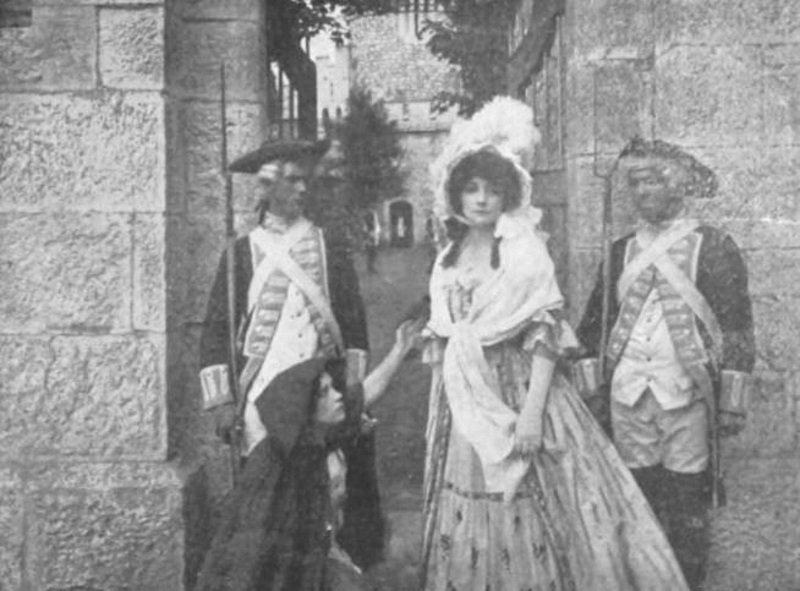
Meanwhile, Beamish’s confession in Dublin Castle stages a dark farce of colonial bureaucracy. The Secretary—played by Olcott himself with eyeglasses glinting like twin bayonets—shuffles pardons the way clerks shuffle deck-chairs on the Titanic. The sequence of hidden bodies (Beamish behind curtain, Colonel beneath escritoire, Fanny within door-jamb) plays like chamber-piece Hitchcock decades early, the mise-en-abyme of concealment mirroring Ireland’s own layered loyalties. When the pardon finally quivers in O’Grady’s gloved hand, it is already blood-warm, pre-stained by the knowledge that amnesty is merely another form of surveillance.
Surviving frames are tinted rose for interiors, viridian for exteriors, amber for prison-dawn. These dyes are not decorative but thermostatic: rose mutes the chill of stone, viridian amplifies the menace of hedgerows where informers lurk, amber suspends dawn between execution and reprieve. The sea, glimpsed only twice, is hand-painted cerulean—a shock of Atlantic cold that reminds us every insurgent itinerary ends in water, whether exile, shipwreck, or the final plunge of the informer Feeney from battlement to tide.
Gauntier, who also co-wrote, claimed in a 1915 Ladies’ World column that she played Arrah “as if Ireland herself were being kissed.” The line reads quaint until you watch the surviving stills: her gaze never settles on the male faces long enough to anchor romantic identification; instead it slides past them toward the horizon, as though scanning for the next gun-boat. In that refusal she anticipates the nationalist heroines of later bushranger cycles, women whose desire is contingent upon the promise of sovereignty.
Opposite her, J. J. Clark’s Beamish carries the exhausted glamour of a man who has read his own obituary in exile. His body language toggles between feral alertness and languid fatalism; when he presses the stolen bank-notes into Arrah’s palm, his fingers hesitate a fraction too long, registering the moment when revolutionary currency mutates into dowry-bribe, when idealism curdles into guilt.
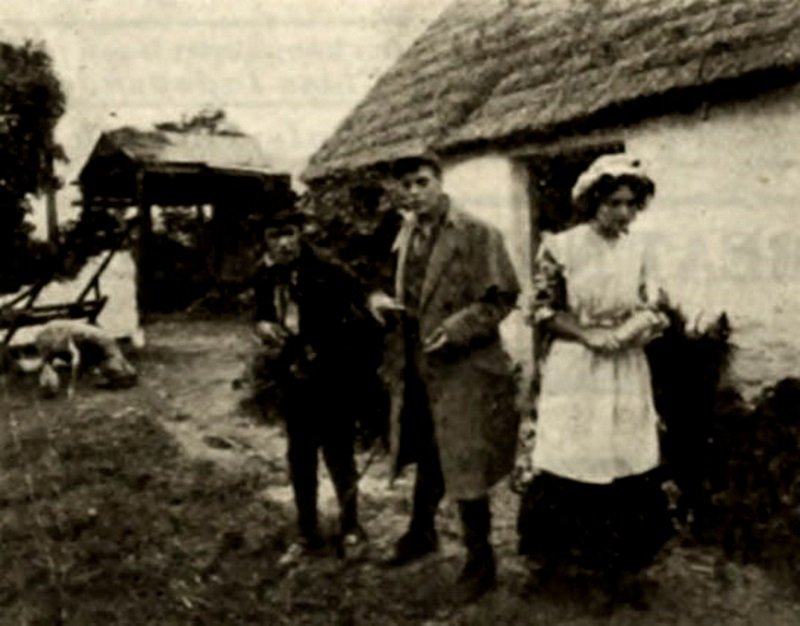
The film layers boulevard melodrama over ballad-opera, then overlays both with documentary actuality: Wicklow locals appear as wedding extras, their weather-beaten faces authenticating the fiction. The barn-dance that is so rudely interrupted by Major Coffin’s patrol quotes the ceilidh sequences in Belles of Killarney, yet the intrusion of rifles feels less theatrical than ontological—an early intimation that colonial violence can puncture even the most choreographed merriment.
Meanwhile, the final cliff-top struggle between Shaun and Feeney literalises the “cliff-hanger” trope that serials would soon commodify, but here the stakes remain mortal, not episodic. When Feeney plummets, the camera does not follow his splash; it holds on Arrah’s profile, wind whipping her hair across lips still swollen from that first prison-kiss. The refusal to gratify us with cathartic spectacle is itself political: the revolution, like the frame, moves on.
In an era when every insurgent image is instantly weaponised by algorithmic feed, Arrah-Na-Pogue offers a manual of clandestine affect: how to smuggle memory across closed borders, how to repossess confiscated time, how to stage solidarity inside a single reel. The film may be lost, yet its strategies survive—in whistle-blower dead-drops, in protest-choreography shared via encrypted story, in the stubborn persistence of oral culture whenever screens go dark.
And so, on moonless nights when the streaming servers hiccup and the Wi-Fi flickers like a carbon arc, you might sense a phantom strip of nitrate unspooling across your living-room wall: a woman’s kiss that carries not romance but revolution; a postman’s satchel heavy with more than letters; a pardon that arrives too late yet just in time to teach us that history, like cinema, is only ever the cut that chooses what to show—and what to conceal.
If this ghost-hunt has whetted your appetite for other vanishing acts, chase Dante’s hand-tinted hellscapes or eavesdrop on Victorian bells tolling across alpine snow. But remember: every link is another kiss, another note, another chance to swallow the revolution whole before the sentinels glance sideways.
IMDb —
1928
Community
Log in to comment.