DbcultAccessing Vault...
Cult Review
Senior Film Conservator
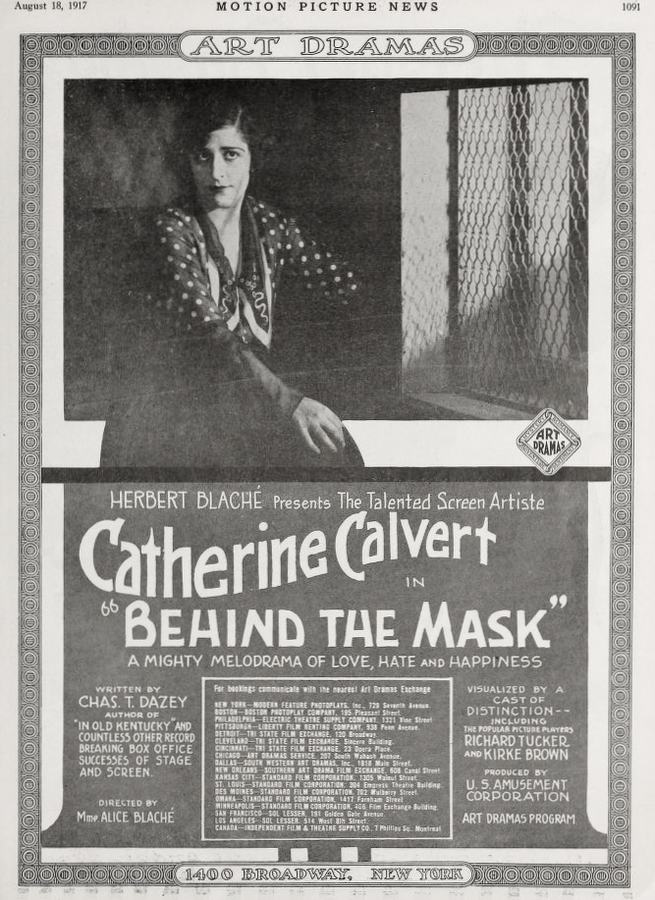
The first time we see Margaret Stanton she is a silhouette against her father’s coffin, the air thick with funeral lilies and the metallic stench of insolvency. Director Fred Rath withholds her face, letting the camera linger on black-gloved fingers shredding a bankruptcy notice—an overture of annihilation that reverberates through every reel of Behind the Mask. By the time the final iris-in closes on her tear-stained but radiant gaze, we have traveled from candle-lit boardrooms to Swiss sanitariums, from ballrooms where chandeliers drip like frozen chandeliers of blood to nurseries where a newborn’s cry splits the screen like a redeeming thunderclap.
Rath and cinematographer Charles Halton shoot Harrold’s offices like a cathedral of Mammon: vertical shadows of venetian bars cage the financier’s face, converting every close-up into a mug-shot of the soul. When Margaret—now employed under an alias—first steps across that threshold, the threshold itself is a diagonal slash of light, a visual metaphor for the moral precipice she straddles. Contrast this with the pastoral interludes at Strathmore’s estate, where the grayscale blooms into pearlescent whites and misty grays, a limbo of almost-heaven before the next knife-twist.
Flora Nason navigates these tonal shifts with feline precision. In early scenes her eyes perform a semaphore of grief: eyebrows arched like circumflex accents above hollow pupils. Later, as she begins her seduction of Strathmore, those same eyes acquire a predatory languor—half-shut, glinting beneath the brim of a feathered hat. Watch the way she removes her glove in the carriage scene: one finger at a time, a striptease of etiquette that leaves Kirke Brown’s Strathmore visibly swallowing his gallant composure.
What elevates the film above contemporaries like Chained to the Past or The Love Thief is its refusal to grant the audience moral footholds. Margaret’s scheme is not a romantic caper but a leveraged buyout of the heart: she purchases Strathmore’s affections with counterfeit tenderness, then divests him in a public display of humiliation. The wedding scene—shot through a veil of organza so that faces blur into ghostly smudges—plays less like a celebration than a notarized foreclosure.
Yet the film’s most subversive stroke arrives post-separation. Strathmore’s pursuit is not the usual stalwart-lover chase but a slow, anonymous philanthropy: he funds her confinement, pays surgeons in Vienna, all while wearing the drab coat of a charity worker. The power dynamic flips; the jilted husband becomes the clandestine benefactor, rewriting the revenge ledger into an unexpected covenant of grace. When Margaret’s bandages are unwrapped and she recognizes the timbre of his whispered endearments, the recognition lands like a second Fall—in reverse, a sunrise in Eden.
Charles Dungan’s Mark Harrold is capitalism’s Grand Inquisitor: every smile a lien, every handshake a mortgage. He eschews the moustache-twirling villainy of silent-era stereotypes; instead he radiates the chill rationality of a balance sheet. In the pivotal moment when he learns Helen’s fiancé has been lured away, his only reaction is a microscopic tightening of the jaw—yet the intertitle card reads merely “One must safeguard investments.” The understatement scalds more than any tirade.
Catherine Calvert’s Helen, by contrast, is a porcelain doll whose cracks appear only in long shot: note how her shoulders lift a millimeter when Strathmore’s letters cease, a tremor the camera catches just before the ballroom doors swing shut. The performance is a masterclass in peripheral anguish, a reminder that even collateral damage possesses a heartbeat.
Written by Charles T. Dazey—who gave us the equally caustic Children of Eve—the screenplay weaponizes marriage as both social escalator and guillotine. Helen’s ambition to wed aristocracy is not mere snobbery but corporate strategy: the merger of new-world liquidity with old-world branding. Margaret’s counter-maneuver, therefore, is hostile acquisition, a boardroom coup executed in boudoirs and ballrooms.
Yet the film refuses to crown either woman victor. The final tableau—Margaret cradling her infant while Strathmore’s shadow stretches across the nursery floor—suggests motherhood as a new share offering, a public offering of vulnerability. The cycle of exploitation mutates, but never vanishes.
Masks appear long before the title card: Harrold’s office safe features a sculpted façade of Comedy and Tragedy; during Margaret’s first dinner with Helen, a lacquered wall-clock is flanked by porcelain masks whose eyes have been painted over. The motif crescendos when Margaret, now sightless, runs her fingers across her own reflection in a tarnished hand-mirror—an image of self-estrangement that out-Lynchs Lynch.
Blindness here is not narrative punishment but epistemological reboot. Deprived of sight, Margaret learns to parse sincerity through vocal cadence, to feel the tremor of a pulse rather than the artifice of a gaze. When her vision is restored, the camera racks focus from her iris to Strathmore’s face, a rack-focus that feels like a moral re-focusing: she sees, therefore she repents.
Place it beside Arsene Lupin and you notice both films fetishize disguise, yet Lupin’s trickery is celebratory whereas Rath’s is penitential. Pair it with Thou Art the Man and you detect a shared Calvinist dread: both narratives posit that every sin is logged in a celestial ledger, payable with compound interest. The difference is that Behind the Mask allows redemption to accrue not through divine grace but through human mercy—scarred, reluctant, and utterly terrestrial.
Surviving prints lack the original score, yet the absence amplifies the film’s percussive intertitles—each card a cymbal crash. Listen (yes, listen) to the hush that follows Margaret’s written confession: the projector’s mechanical heartbeat, the shuffle of audience feet, the intake of breath as viewers confront their own complicity in her vendetta. Silence becomes the film’s unseen orchestra, tuning moral strings.
Modern viewers conditioned to the therapeutic arc of twenty-first-century melodrama may bridle at the film’s refusal to pathologize revenge. Margaret is never infantilized as “trauma victim”; her cruelty is autonomous, exhilarating, and ultimately reversible. The closing reconciliation does not feel like studio-imposed moral glue but like the exhausted aftermath of trench warfare: both parties limp away with limbs intact yet souls amputated.
In an age when algorithmic feeds flatten nuance into outrage, Behind the Mask offers the radical suggestion that identity itself is a negotiable security, that love can be short-sold, that forgiveness may arrive wearing the drab coat of a stranger. It is, in short, the first great Wall-Street-Noir—three decades before the term existed, and a century before our own era of ghosted texts and venomous subtweets.
Seek it out in whichever archive still shelters its frayed reels; watch it in a room lit only by the projector’s guttering halo. When the final image fades—a close-up of Margaret’s eyes reflecting the ghost of her husband’s silhouette—you may find yourself checking your own reflection, wondering which mask you donned this morning, and whether you still possess the courage to peel it away.
IMDb 6.7
1921
Community
Log in to comment.