DbcultAccessing Vault...
4.2/10
Senior Film Conservator
A definitive 4.2/10 rating for a film that redefined the boundaries of cult cinema. Assigned to His Wife remains a cornerstone of transgressive art.
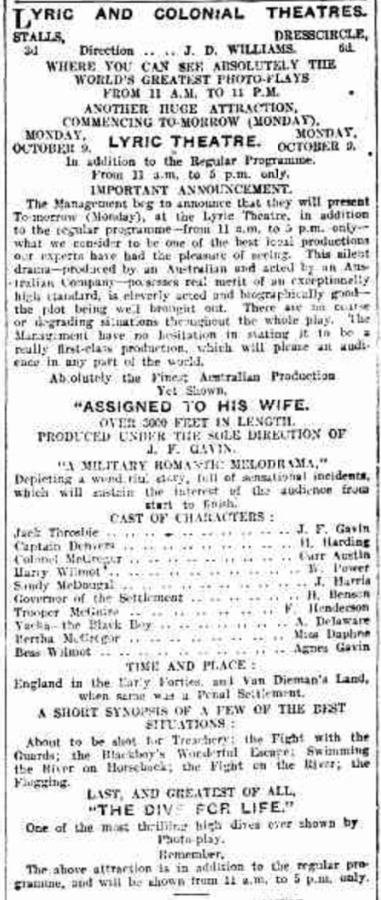
The year 1911 remains a seminal epoch in the annals of global cinematography, yet few works possess the singular, biting irony of the Gavin family's production, Assigned to His Wife. As the medium was still shedding its theatrical chrysalis, this Australian gem emerged not merely as entertainment, but as a sophisticated critique of social hierarchies and the capricious nature of colonial justice.
To understand the weight of this film, one must first acknowledge the formidable presence of Agnes Gavin. In an era where the cinematic apparatus was largely a masculine playground, Gavin’s role as both writer and lead actress provided a perspective that was as refreshing as it was radical. Unlike the raw, kinetic energy found in The Story of the Kelly Gang, Gavin’s work here is a surgical dissection of the domestic sphere. She leverages the historical reality of the 'assignment system' to create a narrative tension that feels remarkably modern.
The plot revolves around a central paradox: a man, cast out by his homeland and branded a criminal, finds himself in a land where his only path to survival is through the grace of the woman he once called wife—now his legal superior. This isn't just a story of survival; it is a story of renegotiated intimacy. The camera captures the subtle shifts in power with a static but intentional gaze, forcing the audience to sit with the discomfort of a husband kneeling before his wife in a role of servitude.
Technically, Assigned to His Wife operates within the constraints of its time, yet it manages to transcend them through atmospheric storytelling. While international epics like Dante's Inferno were pushing the boundaries of special effects and grandiose set pieces, the Gavins focused on the visceral reality of the Australian landscape and the intimacy of the interior set. The lighting, though rudimentary, often casts long shadows that mirror the moral ambiguity of the characters.
The acting style of Jack Gavin and Agnes Gavin avoids the hyperbolic gesticulations common in early silents. There is a restrained pathos in Jack Gavin’s performance—a man stripped of his agency, yet retaining a flicker of his former dignity. This performance stands in stark contrast to the more overtly theatrical portrayals seen in films like The Life of Moses, which relied heavily on religious iconography and broad strokes. Here, the drama is found in the silence between the characters, in the exchange of glances that speak of a shared past and an uncertain, legally-defined future.
When placed alongside other 1911 releases, such as the Danish thriller A Victim of the Mormons, the cultural specificity of Assigned to His Wife becomes even more pronounced. While the former focuses on the sensationalism of foreign cults, the Gavins’ film is deeply rooted in the soil of the Antipodes. It contributes to a burgeoning national identity that was obsessed with the figure of the convict and the bushranger—themes also explored in Robbery Under Arms.
However, Assigned to His Wife is arguably more subversive than the bushranger films. While the bushranger is an outlaw who defies the state from the outside, the protagonist of this film is trapped inside the state’s logic. He is a victim of the law, yet the law is what reunites him with his family. This duality is the film's greatest strength. It captures the 'cultural cringe' and the defiant spirit of early Australia with equal measure.
One cannot ignore the gender dynamics at play. Agnes Gavin’s character is not a damsel in distress; she is the administrator of her husband’s fate. In 1911, this was a potent image. The film suggests that within the rigid structures of the British Empire, there were pockets of space where traditional gender roles could be inverted, even if only through the lens of penal servitude. This thematic depth puts it on par with the psychological explorations found in Jane Eyre (1910), though with a distinctly more gritty, colonial flavor.
The pacing of the film is deliberate. It allows the audience to witness the mundane tasks of convict life—the wood-chopping, the cleaning, the subservience—which serves to heighten the emotional impact of the eventual climax. It is a slow-burn melodrama that prioritizes character development over cheap thrills, a rarity for the era.
Sadly, like many films from this period, Assigned to His Wife has suffered the ravages of time. Nitrate rot and neglect have claimed much of our early cinematic heritage. Yet, the fragments and historical accounts that remain paint a picture of a work that was ahead of its time. It serves as a bridge between the primitive 'actualities' of the late 19th century and the sophisticated feature-length dramas that would follow.
In the context of the Gavin family's filmography, which includes a wide range of subjects from historical dramas to contemporary comedies, this film stands as their most intellectually rigorous. It lacks the populist appeal of their later works but gains a lasting significance through its willingness to engage with the dark heart of the Australian origin story.
To watch—or study—Assigned to His Wife today is to engage with the ghosts of a lost world. It reminds us that cinema, even in its infancy, was a powerful tool for social commentary. It challenges the notion that early films were merely 'moving pictures' without substance. The complexity of the characters, the irony of the premise, and the bold direction of the Gavins make this an essential piece of the cinematic puzzle.
While audiences in 1911 might have seen it as a compelling 'convict drama,' a modern viewer can see it as a proto-feminist text, a critique of the carceral state, and a testament to the enduring power of the human spirit. It is a film that refuses to be forgotten, a flicker of light from the past that continues to illuminate the complexities of our shared history. For those interested in the evolution of storytelling, this film is a mandatory stop on the journey through the history of the silver screen.
Rating: A Foundational Pillar of Australian Narrative Film
A masterclass in early 20th-century irony and domestic tension.
IMDb —
1917
Community
Log in to comment.