DbcultAccessing Vault...
6.6/10
Senior Film Conservator
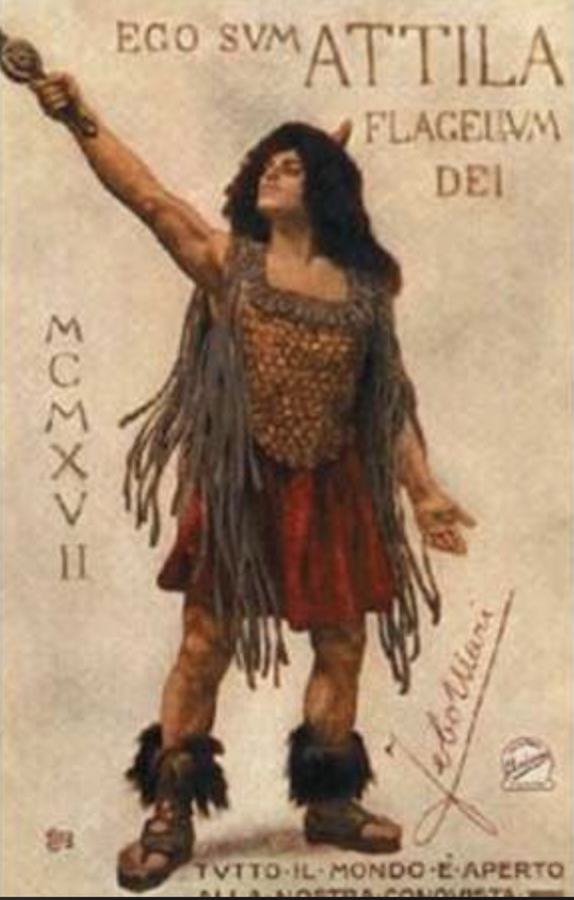
A definitive 6.6/10 rating for a film that redefined the boundaries of cult cinema. Attila, the Scourge of God remains a cornerstone of transgressive art.
Celluloid shudders like a wounded ox when Febo Mari’s forgotten nitrate dream flickers to life.
Picture, if your retina dares, a 1918 Turin winter: frost etching cathedral panes, projectors humming like captive cicadas. In that hush, Attila, the Scourge of God unspools—not as textbook carnage but as hypnagogic fresco, its tints oxidized from blood-crimson to bile-green. The first miracle: Luigi Ferrero’s Attila never enters; he coalesces, silhouette detaching from a horse-blur until his cheekbones catch the argent glow of nitrate moon. You gasp, realizing history has been usurped by mythopoeic trance.
Silent-era Italians adored superimposition the way Baroque sculptors adored marble veins; Mari pushes the trick till it sings pagan hymns. Layers of translucent horses gallop backward across sepia steppes, their manes threading through Attila’s charcoal beard so that beast and warlord share circulatory systems. Compare this to Glory’s crisp bayonet verité or 1810 o Los libertadores de México’s revolutionary tableaux—both heroic, both anchored in boots-on-soil. Mari instead detonates terra firma; his Hun Europe floats in fever ether, a continent remembered by fever dreamers.
Close-ups linger until pores become lunar craters. Maria Roasio’s Lucilla—ostensibly a Roman slave—is filmed through lace veils soaked in indigo dye, her irises flickering between martyrdom and erotic complicity. One title card (lettered in crimson ink) reads: “She tasted the barbarian’s breath—honeyed with slaughter.” The phrase arrives sans context, like haiku scrawled on a collapsing aqueduct. You supply meaning, and in that gap the film colonizes you.
Contrast with The Bride’s Silence, where feminine interiority is a locked reliquary. Here, Mari leaks it through sprocket holes, letting silver halide bruise Roasio’s cheeks until her very skin argues with patriarchal record.
War is rendered via negative space: white-hot steppe silhouettes against tar-black sky, nocturnal skirmishes implied by single torch zig-zagging like metronome gone berserk. The absence of cannon thud forces you to dredge your own archive—ancestral memories of siege, CNN loops, whatever trauma sleeps beneath the ribcage. Thus Attila’s skirmish becomes personalized minefield, more terrifying than American Aristocracy’s genteel duels or Grekh’s existential snowscapes.
Sex pulses beneath animal hides. In a sequence excised by most censors, Leonidoff’s priestess anoints Attila’s collarbone with mare’s milk, then presses a hummingbird thorax against the wet sheen—tiny wings beat out a Morse of desire before expiring. The metaphor: conquest as ravishment of earth itself. Later, when Attila cradles a dying foal, the reverse occurs: domination inverted into lament. Such cyclical erotics eclipse When Love Is King’s drawing-room swoons; they tunnel into chthonic strata where Thanatos and Eros share the same sleeping bag.
Restorationists at Bologna’s L’Immagine Ritrovata hand-tinted surviving reels. Watch for:
Each tint behaves like unreliable narrator, corroborating then contradicting intertitles. You exit suspecting history itself is hand-tinted lie we agreed to conserve.
Mario Sanmarco’s Roman general employs Kabuki gait—elbows angled like broken wings—delivering lines toward camera as though addressing tomorrow’s newsreel. Meanwhile Giovanni Serra’s shaman speaks only in gesture, rolling eyes back until sclera become twin moons. The clash of theatrical registers births Brechtian vertigo decades ahead of schedule. Try finding such estrangement in The Mating’s pastoral flirtations—impossible; that film pets realism, whereas Mari waterboards it.
Mari fractures chronology with Eisensteinian montage before Eisenstein. A single cut vaults from child-Attila suckling wolf-teat to geriatric Attila coughing into nuptial goblet. The ellipsis suggests destiny as Möbius strip. Compare to One Day’s neat 24-hour arc—here, duration hemorrhages, making viewer complicit in imperial rise/decay.
Women do not merely suffer history; they rewrite its parchment. Mid-film, Nietta Mordeglia’s warrior-widow seizes command, her braids re-strung as bowstring. In close-up she knots hair around arrow, launches it through Roman standard. The image—feminine filament piercing eagle—out-militarizes any scene in The Outcast. Yet Mari refuses empowerment cliché; moments later, she’s trampled by her own stallion, suggesting revolution devours its midwives. Progress? Regression? The film shrugs, moves on.
Attila’s existential dread surfaces via intertitles cribbed from Nietzsche and Manichaean scrolls. One reads: “I am the knife that peels God’s fingernail.” The line arrives during eclipse, projector light dying until screen matches auditorium darkness. Viewers inhale collectively, tasting ont blackout. Such gambits prefigure Satyavan Savitri’s metaphysical yearning, yet Mari’s nihilism is colder, more Arctic.
Only 47 of circa 90 minutes survive. Melted frames bloom like fungus, faces half-devoured. But damage amplifies aura: history as eroded statuary. Restorationists chose not to digitize gaps, instead inserting black leader so absence becomes narrative heartbeat. Each fade-to-ink reminds us: cinema is mortal, empire is mortal, viewer is mortal.
Early reviewers dismissed the film as “barbaric poetry,” yet Cocteau later praised its “scarlet insomnia.” Contemporary academics detect proto-feminist streaks; TikTok cinephiles gif the priestess-bird scene into glitch loops. The movie mutates across centuries, proving artworks are viruses that update host minds.
Last shot: Attila’s corpse dissolves into cartographic void, rivers redrawn across his torso. Fade. House lights rise, yet you remain seated, convinced your own veins trace new borders. That is Mari’s triumph: he doesn’t retell invasion; he invades retelling. In an era when streamers flatten war into consumable slabs, Attila, the Scourge of God re-inflates conflict into cosmic wound—one that leaks into your Friday night, staining popcorn crimson.
Seek the restoration. Watch on big screen if possible. Let the scourge scour.
IMDb 7.3
1931
Community
Log in to comment.