DbcultAccessing Vault...
7/10
Senior Film Conservator
A definitive 7/10 rating for a film that redefined the boundaries of cult cinema. Avatar remains a cornerstone of transgressive art.
In the vast, often overlooked archives of early cinema, there exists a cinematic artifact bearing a title that, in the modern lexicon, conjures images of vibrant blue humanoids and sprawling alien ecosystems. Yet, long before Pandora graced the silver screen, there was another “Avatar” – a 1916 Italian silent film, a haunting adaptation of Théophile Gautier’s eponymous novel. This cinematic journey plunges us not into a fantastical future, but into the suffocating grip of unrequited love, spiritual intervention, and the profound tragedy of identity in a bygone era. It's a film that demands a re-evaluation, not just as a historical curiosity, but as a potent exploration of human frailty and the perilous allure of the mystical.
The narrative unfurls with a delicate yet palpable sense of impending doom, centering on Ottavio de Saville, a young man whose spirit is progressively consumed by an all-encompassing, debilitating passion. His object of desire is Madame Prascovie Labinska, a woman of impeccable virtue and unwavering devotion to her husband, the Polish Count Olaf Labinski. Prascovie is a figure of almost saintly purity, her marital vows an impenetrable shield against Ottavio’s burgeoning obsession. This isn't merely infatuation; it's a consuming fire that threatens to incinerate Ottavio from within, manifesting as a profound physical and mental deterioration. His existence becomes a living testament to the destructive power of a love that can neither be reciprocated nor extinguished, a plight not dissimilar to the emotional torment found in the character studies of films like The Outcast, where societal norms and personal desires clash with devastating consequences.
As Ottavio’s health spirals, his concerned inner circle – a collection of relatives and friends – finds themselves increasingly desperate. Conventional remedies prove futile against a malady rooted in the soul. Their last, most audacious hope arrives in the form of Doctor Balthazar, a man whose recent sojourn in the distant, enigmatic lands of India has transformed him. Balthazar returns not merely with medical knowledge, but with an esoteric understanding of Brahmanic secrets, an initiation into the ancient art of spiritual transmigration. It is here that Gautier’s original concept of the "avatar" takes its sinister, fascinating form: not a physical embodiment of a deity, but the perilous swapping of souls, a spiritual invasion designed to cure one man's despair by implanting him into another's life. This concept, chilling in its audacity, immediately sets the film apart from mundane romantic tragedies, elevating it into the realm of the supernatural and philosophical, echoing the Faustian bargains and existential dilemmas explored in works like The Magic Skin, where extraordinary powers come with extraordinary, often unforeseen, costs.
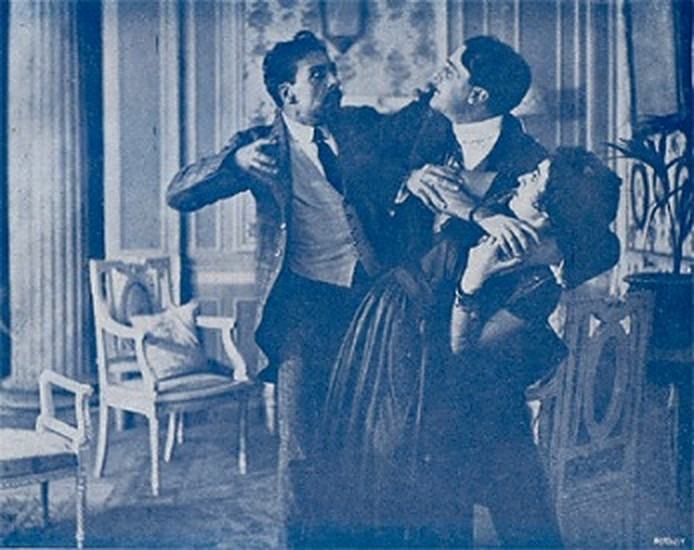
The genius of this adaptation lies in its ability to translate the psychological intensity of Gautier’s prose into the visual language of silent cinema. The actors, particularly Andrea Habay as Ottavio, must convey the slow erosion of a man’s will and sanity through gesture, expression, and the subtle nuances of body language. One can almost feel the weight of his unfulfilled longing, the shadows deepening beneath his eyes, the slumped posture of a soul in torment. Soava Gallone, portraying Madame Prascovie Labinska, embodies the epitome of chaste beauty and unwavering resolve, her every movement communicating an innate dignity and an unyielding commitment to her marital vows. Her performance is a delicate balance of compassion for Ottavio’s suffering and an immutable loyalty to her husband, making her not a cold figure, but one bound by an honor code that is both admirable and, for Ottavio, tragically insurmountable. Amleto Novelli, as Count Olaf Labinski, must project an aura of unsuspecting authority, a man whose domestic tranquility is about to be shattered by forces beyond his comprehension, a silent sentinel before the coming storm. Augusto Mastripietri, as Doctor Balthazar, carries the weight of exotic knowledge and moral ambiguity, his gaze hinting at the profound, perhaps dangerous, secrets he now wields.
The film’s visual style, typical of the era, would have relied heavily on dramatic lighting, stark contrasts, and expressive close-ups to convey the interiority of its characters. The set designs, though perhaps not as lavish as later epics, would have meticulously recreated the opulent, yet often suffocating, interiors of aristocratic European society, providing a stark backdrop to the raw human emotions unfolding. Imagine the flickering lamplight casting long, ominous shadows as Balthazar explains his radical procedure, or the delicate, lace-draped drawing-rooms where Prascovie’s unwavering fidelity silently rebuffs Ottavio’s desperate overtures. These visual cues, coupled with the emotive power of the actors, are crucial in a medium devoid of spoken dialogue, demanding a heightened sense of theatricality and symbolic representation. The contrast between the mundane European setting and the exotic, almost mystical, origins of Balthazar's knowledge would have been a powerful visual and thematic juxtaposition, akin to the cultural clashes explored in films like The Arab.
At its heart, “Avatar” is a profound meditation on identity. What happens when the very essence of a person is transplanted? Does the soul retain its original affections, or does it conform to its new vessel? Gautier’s novel, and by extension this film, delves into the terrifying implications of such a spiritual usurpation. Ottavio’s love for Prascovie is so absolute that he is willing to sacrifice his very self, his own corporeal form, for a chance at proximity, at possession. This isn't merely a tale of tragic romance; it's a philosophical thriller wrapped in a gothic sensibility, questioning the boundaries of selfhood and the ethics of manipulating the fundamental fabric of existence. The film asks us to consider: if love drives one to such extremes, what remains of the lover? And what happens to the invaded, the unwitting host of another’s desire? It’s a moral labyrinth, where the lines between victim and perpetrator become blurred, and the pursuit of happiness morphs into an act of profound spiritual violation.
The silent era, often underestimated in its narrative complexity, excelled at exploring such grand, operatic themes. Without the crutch of dialogue, filmmakers were forced to rely on pure visual storytelling, on the power of the human face and body to convey the most intricate emotions. The dramatic tension in “Avatar” would have been meticulously built through sustained gazes, agonizingly slow reveals, and the dramatic staging of confrontations. The intertitles, far from being mere plot exposition, would have served as poetic pronouncements, guiding the audience through the emotional and philosophical undercurrents of the narrative, much like the thoughtful interjections in Conscience, where moral dilemmas are laid bare. One can imagine an intertitle proclaiming, “A soul possessed by love, now possessed by another,” underscoring the film’s central conceit with stark eloquence.
The enduring power of Gautier’s story lies in its timeless exploration of obsession and its consequences. While the magical elements provide the narrative engine, the emotional core resonates with anyone who has grappled with unrequited love or the desperate desire for what cannot be had. The film serves as a cautionary tale, demonstrating how the pursuit of an ideal, when taken to its most extreme, can lead to self-annihilation and the destruction of others. It’s a testament to the fact that sometimes, the most profound forms of love can also be the most destructive, twisting altruism into a perverse form of selfishness. This complex interplay of noble sentiment and dangerous action gives the film a psychological depth that transcends its supernatural premise, making it relevant far beyond its specific historical and cultural context.
Furthermore, the character of Doctor Balthazar introduces a fascinating element of the exotic and the ethically dubious. His return from India, imbued with "Brahman secrets," positions him as an outsider, a figure operating beyond the conventional moral and scientific boundaries of European society. He is both a potential savior and a dangerous manipulator, his motives perhaps altruistic in intent, but potentially disastrous in execution. This portrayal of Eastern mysticism as a powerful, yet potentially corrupting, force was a common trope in early 20th-century Western literature and cinema, often reflecting a fascination mixed with apprehension. However, in “Avatar,” it serves a crucial narrative function, providing the mechanism for the central conflict and pushing the boundaries of what is dramatically possible within the story’s framework. His presence lends an air of profound otherworldliness, a clash of cultures and philosophies that adds another layer of intrigue to the already complex plot.
One must also consider the societal context of the early 20th century. The strictures placed upon women, particularly married women like Prascovie, meant that her fidelity was not just a personal virtue but a societal expectation. Her unwavering loyalty to Count Olaf is therefore not merely a character trait but a reflection of the prevailing moral code. Ottavio’s pursuit, therefore, is not just a romantic endeavor but an assault on established social order, making his desperation all the more transgressive. The film, in its silent grandeur, subtly critiques these societal pressures, showing how rigid codes of conduct can lead to immense suffering for those whose desires fall outside the accepted norms. This social commentary, often implicit, adds a layer of realism to the fantastical premise, grounding the supernatural events in a recognizable human struggle. The tragic implications of such social constraints are also palpable in films like Nearly a Lady, where women navigate complex societal expectations.
The film’s legacy, unfortunately, often gets overshadowed by its modern namesake. However, for those willing to delve into the rich tapestry of silent cinema, the 1916 “Avatar” offers a unique and compelling experience. It stands as a testament to the artistic ambition of early filmmakers, their willingness to tackle complex philosophical and emotional themes without the aid of spoken dialogue or advanced special effects. Its power lies in its raw emotional intensity, its reliance on the expressive capabilities of the human form, and its bold exploration of the spiritual and psychological boundaries of identity. It’s a film that demands close attention, rewarding the viewer with a narrative that is both deeply unsettling and profoundly thought-provoking. It’s a reminder that true cinematic artistry often lies not in technological spectacle, but in the timeless resonance of human stories.
The careful pacing of a silent film, often slower than contemporary cinema, allows for a deeper immersion into the characters' emotional states. Each gesture, each lingering shot, becomes pregnant with meaning. The audience is invited to become an active participant, interpreting the unspoken words, feeling the unspoken pangs of despair and hope. This active engagement is a hallmark of silent film viewing, and “Avatar” would have leveraged this beautifully, drawing viewers into Ottavio’s psychological torment and Prascovie’s moral fortitude. The climactic moments, particularly those involving Balthazar’s intervention, would have been built with meticulous suspense, the dramatic tension ratcheted up through visual cues and the sheer weight of the narrative's implications. The film, in its quiet intensity, would have made a powerful argument for the enduring capabilities of a medium that often gets dismissed as rudimentary.
In an era where cinema was still finding its voice, films like “Avatar” pushed the boundaries of what was possible, adapting complex literary works and exploring sophisticated themes. It showcases the versatility of the medium, proving that even without sound, a film could provoke deep philosophical questions and evoke powerful emotional responses. The tragic arc of Ottavio, the unyielding virtue of Prascovie, and the dangerous wisdom of Balthazar combine to create a narrative tapestry that is rich in symbolism and human drama. It’s a film that, once discovered, leaves an indelible mark, urging us to reflect on the nature of love, sacrifice, and the very essence of what makes us who we are. It’s a poignant reminder that some of the most profound stories are those that delve into the ethereal, the spiritual, and the terrifyingly human. This exploration of complex human relationships and psychological states, even within a fantastical framework, aligns it with the deeper character studies seen in films like The Woman of Mystery, where hidden depths and motivations drive the narrative.
Ultimately, the 1916 “Avatar” is more than just a historical curiosity; it is a profound piece of cinematic art that deserves to be rediscovered and appreciated for its timeless themes and its masterful silent storytelling. It offers a window into the narrative sophistication and artistic ambition of early Italian cinema, demonstrating how a compelling story, strong performances, and evocative visuals could transcend the limitations of the medium. It challenges viewers to look beyond superficial similarities with modern blockbusters and to appreciate the depth and nuance of a different kind of “Avatar” – one that explores the inner landscapes of the human soul rather than the outer reaches of an alien world. Its enduring legacy lies in its courageous foray into the complex interplay of human desire and spiritual intervention, a narrative that remains as potent and unsettling today as it was over a century ago.

IMDb —
1935
Community
Log in to comment.