DbcultAccessing Vault...
Cult Review
Senior Film Conservator
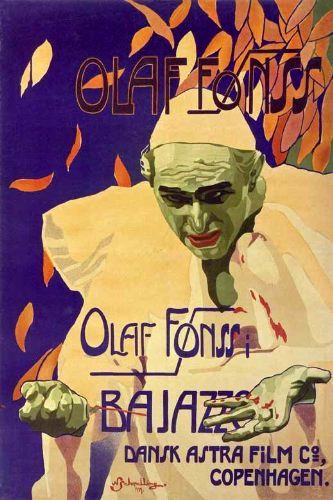
There are films you watch and films that watch you—Bajadser belongs to the latter, a 1919 Danish fever-dream carved from whale-bone and tallow, still squirming a century later. Director Fritz Magnussen, armed with Ruggero Leoncavallo’s blood-soaked libretto, strips the Pagliacci myth to its marrow yet lets it inhale the briny sighs of the Kattegat, transmuting clownish caricature into Norse saga.
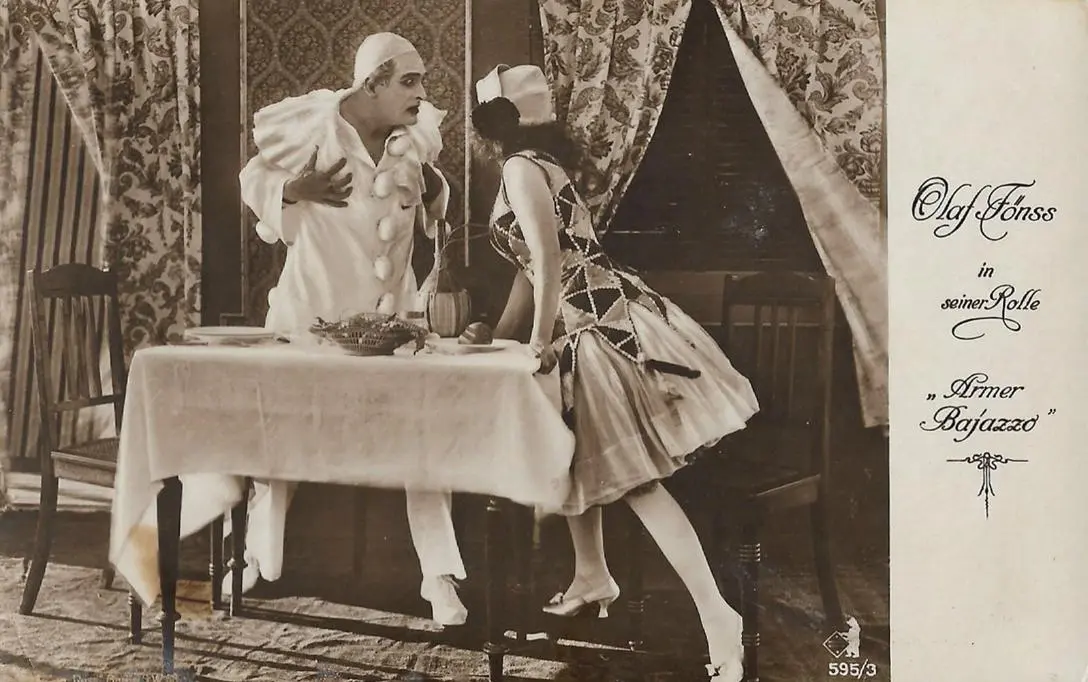
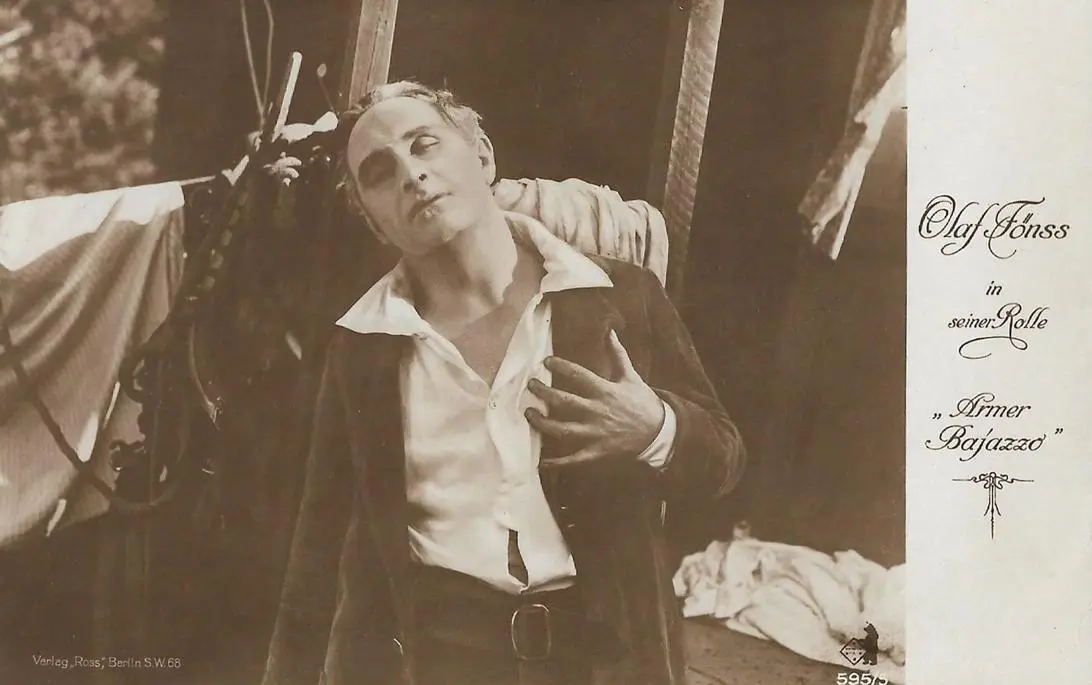
From the first iris-in, the camera ogles a fjord so charcoal-black it might swallow the whole Nordic pantheon. Against this obsidian canvas, a ramshackle troupe erects a stage that looks salvaged from a shipwreck, every splinter exhaling saltpeter and grief. Philip Bech lumbers forth as Canio—no corpulent tenor but a sinewy scarecrow whose grin splits his face like a poorly healed axe-wound. Bech’s gait is a spasmodic waltz, half Punchinello, half penitent flagellant, and when he lifts his eyes they are twin fjords of uncried tears.
The plot—ostensibly the oldest triangle in Christendom—mutates under Magnussen’s glacial gaze. Canio’s wife Nedda (Aase Winsnes, equal parts snowfire and sulphur) itches against marital captivity like a lynx in a herring barrel. She flirts with Silvio, Cajus Winding’s smouldering rag-dealer, whose sideburns alone deserve a Salome-style aria. Their dalliance unfolds not in sun-dappled groves but amid fish-gut strewn docks, where gulls shriek Greek-chorus commentary and the wind slaps cheeks until they blister crimson.
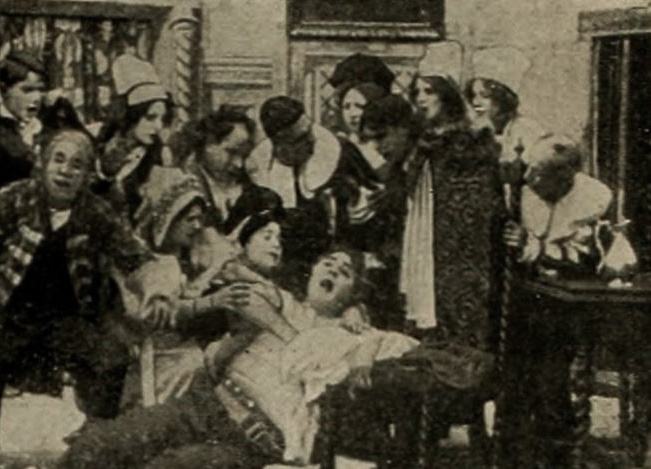
Magnussen’s stroke of genius is to frame the entire infidelity as a matryoshka: inside the travelling show sits a toy theatre, within which the actors rehearse the very cuckoldry festering backstage. Thus when Canio finally snaps—swapping a balsa knife for a fish-gutter’s steel—the boundary between life and performance liquefies like lard in a skillet. Blood spatters the footlights; the villagers, initially whooping for entertainment, recoil as if reality itself has been flayed alive. The moment is staged in a single, merciless tableau: Bech’s profile gilded by kerosene flare, Winsnes’ mouth an O of astonishment, the blade descending in silhouette—an icon of cruelty worthy of Caravaggio.
Silent cinema rarely aches this audibly; every intertitle feels like a cracked rib.
But Bajadser refuses to wallow in Grand Guignol. The true terror lies in its quietude—the hush between drumbeats when the accordion exhales, the snowflakes that drift through the torn canvas roof and melt on the corpse’s cheek like tepid tears. Cinematographer Angelo Bruun (also doubling as a Pierrot-faced mime) lenses the tundra in bleached monochrome, so whites sear and blacks swallow light. Depth is forged not through tinting but via layers of gauze and cigarette smoke; figures loom and dissolve as though sculpted from breath on a winter pane.
Compare this austerity with Nearly a King’s flamboyant caper or Daphne and the Pirate’s swashbuckling Technicolor fantasy, and you’ll grasp why Danish critics of 1919 dubbed the film “a frostbitten psalm.” Even Home, released the same year, pampers the spectator with pastoral balm, whereas Bajadser offers no such comfort—only the chill of existential hollowness.
Performances bristle with astringent nuance. Bech modulates from buffoon to berserker without a single title card of exposition; the tremor in his gloved hand when he caresses Nedda’s cheek foreshadows the impending butchery. Winsnes, meanwhile, pirouettes on razor’s edge between flirtation and panic—watch her eyes dart to the doorframe where Silvio lingers, pupils dilated like a cornered hare. In one unbroken take she binds her hair with a scrap of bunting; the gesture feels so private one instinctively averts one’s gaze, as though trespassing on a sacrament.
Supporting players orbit like icy moons. Torben Meyer’s tight-lipped bookkeeper tallies coins with monkish devotion, each chink a countdown to catastrophe. Gudrun Bruun Stephensen, wordless as the troupe’s sylph-like ballerina, embodies conscience itself—her final tableau, kneeling in the sawdust beside the slain lovers, is a Pietà stripped of redemption. Even the child actors (Hugo Bruun, Ellen Dall) evince feral authenticity; their snowball fight outside the booth plays like a danse macabre once you realize they’re rehearsing the imminent bloodsport.
Composer-conductor Ruggero Leoncavallo originally intended his score as a Neapolitan screamer; Magnussen repurposes its leitmotifs into sparse, funereal piano plinks, performed on a detuned parlour grand. The result evokes Satie more than verismo—each note hangs like a frost-laden twig, ready to snap. Exhibition houses reportedly provided audience members with woollen blankets; patrons left shivering, uncertain whether from cold or dread.
Yet for all its Nordic asceticism, the film pulses with subterranean sensuality. Silvio’s courting of Nedda unfolds amid tar barrels and hemp nets, yet every glance drips ichor. Their single kiss—captured in chiaroscuro silhouette—lasts three seconds on my stopwatch, yet feels as languorous as opium. The censors, prudish even by Danish standards, snipped several frames, alleging “unseemly undulation.” Those missing metres survive only in legend, like excised verses of a skaldic saga.
Editing is modernity masquerading as antique. Magnissen cross-cuts between the villagers’ torchlit procession and the lovers’ tryst, building a contrapuntal crescendo that anticipates Eisenstein by half a decade. The climactic knife-thrust lands precisely at the moment the town band strikes up a jaunty polonaise—irony sharp enough to shave bone. Such audacious montage places Bajadser closer to The Border Wireless’ rhythmic tension than to contemporaneous chamber ditties like A Bunch of Keys.
Scholars often pigeonhole 1919 as the year post-war cinema regressed into escapist fluff; Bajadser belies that truism. Its nihilism is prophetic—less a comfort blanket than a shroud. Consider the final shot: dawn’s pewter light seeping across the stage, now deserted save for a lone gull pecking at a bloodied harlequin sleeve. No moral, no epilogue, no iris-out. Just the wind, the waves, and the viewer left to marinate in culpability.
Restoration efforts remain sporadic. A 2008 nitrate print surfaced in a Helsingør attic, riddled with mould blooms resembling lunar maps. Digital scans reveal hairline cracks dancing like static across Bech’s cheekbones—blemishes that somehow deepen the verisimilitude. The Danish Film Institute schedules annual winter screenings in an abandoned herring warehouse, heaters deactivated to honour the film’s frigid spirit. Audience members huddle in sealskin coats, breath fogging the air, experiencing cinema as endurance art.
Why resuscitate this glacial relic? Because Bajadser reminds us that the earliest moving pictures could be as pitiless as life itself, long before Hays-code piety neutered narrative. Because its depiction of toxic masculinity and commodified femininity feels ripped from today’s headlines—cancel culture, incel rage, #MeToo reckonings. Because, quite simply, it hurts to watch, and hurt is the sharpest whetstone of empathy.
So seek it out, should fate grant you a Scandinavian sojourn. Sit on the splintered bench, let the Baltic frost nibble your fingertips, and witness celluloid bleed. You’ll exit quivering, yet paradoxically scorched—as if something glacial has thawed inside your ribcage and left a rust-coloured stain.
And when you queue for latte to thaw your bones, reflect that you’ve survived a rite more primal than narrative: the moment when masks slip, knives glint, and love reveals its serrated edge. Few silents dare that candour; Bajadser wields it like a scalpel, carving initials on your ventricle you’ll trace for life.
In the pantheon of Nordic nightmares—Dreyer’s Day of Wrath, Sjöström’s The Phantom Carriage—Magnussen’s opus deserves exaltation. Not because it consoles, but because it condemns: the possessive gaze, the audience’s complicity, the whole carnival of human cruelty. And as the lights rise and you stumble back into the crystalline afternoon, you’ll swear the fjord itself is chuckling—low, guttural, infinitely amused.

IMDb 6.1
1925
Community
Log in to comment.