DbcultAccessing Vault...
Cult Review
Senior Film Conservator
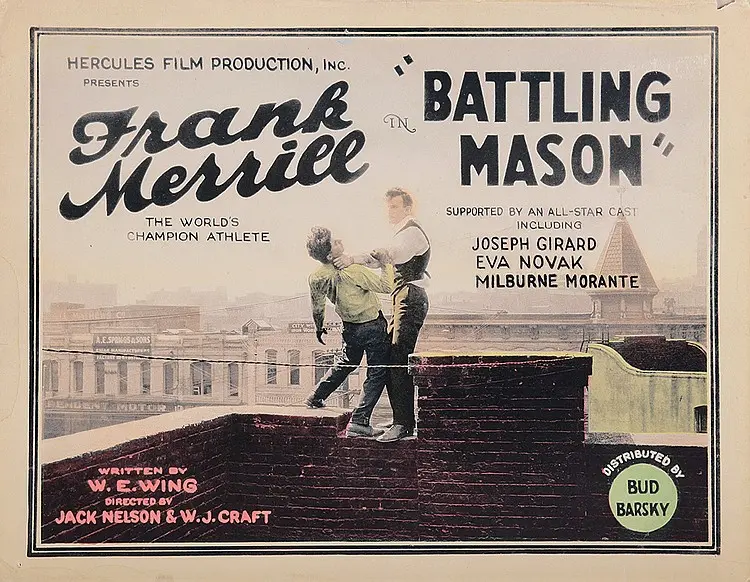
There's a certain magic to silent cinema, a unique ability to convey profound human drama through gesture, expression, and the rhythmic pulse of intertitles. Among the myriad forgotten gems of that era, William E. Wing's *Battling Mason* (1924) emerges not just as a historical curiosity but as a surprisingly incisive character study, one that resonates with timeless themes of integrity, public image, and the true definition of strength. It's a film that asks us to look beyond the surface, to question what we perceive as courage, and to consider the profound weight of self-imposed vows. In an age dominated by bombast and spectacle, *Battling Mason* offers a quieter, yet no less impactful, exploration of a man caught between his nature and his ambition.
Central to the film’s compelling narrative is Frank Merrill, cast as Mason. Merrill, known for his athletic prowess and often seen in roles demanding physical exertion, brings an inherent authenticity to the character of a man who 'loves a good fight.' This casting choice is nothing short of brilliant, as it immediately establishes Mason’s baseline character. We implicitly understand his predisposition for conflict, his visceral reaction to provocation. Yet, the film swiftly pulls the rug from under this expectation. Mason, driven by political aspirations, makes a radical commitment: absolute non-violence. This isn't merely a plot device; it's the very crucible in which Mason's character is forged anew. Merrill’s portrayal isn't about grand speeches or overt declarations; it's in the subtle clenching of his jaw, the restrained tension in his posture, the flicker of internal struggle in his eyes when faced with egregious insults or physical threats. His performance masterfully conveys the immense self-control required to suppress a deeply ingrained instinct, transforming what could have been a simple narrative into a complex psychological portrait.
The irony here is palpable: a man named 'Battling Mason' must cease battling to achieve his goals. This paradox forms the narrative's spine, forcing Mason — and by extension, the audience — to re-evaluate what true strength entails. Is it the ability to dominate physically, or the fortitude to resist one's baser impulses in pursuit of a higher principle? Merrill’s silent performance, relying on a physicality that is simultaneously powerful and restrained, allows this internal conflict to play out with remarkable clarity. It’s a testament to the evocative power of silent acting, where every gesture, every nuance of facial expression, carries the weight of unspoken dialogue.
Mason's journey into public office isn't just a backdrop; it's the very engine of his transformation. The political arena, with its relentless scrutiny and demand for carefully curated images, forces him into an uncomfortable compromise with his true self. His vow of non-violence, while pragmatic for his campaign, isolates him from those who value a more traditional, aggressive form of masculinity. This is most keenly felt in his relationship with his wealthy uncle, a man whose erroneous belief in Mason's newfound 'weakness' drives a significant wedge between them. The uncle, representing a segment of society that equates physical might with moral fiber, cannot comprehend Mason's strategic pacifism. He sees only a lack of courage, a betrayal of character, rather than an extraordinary act of discipline. This misunderstanding highlights a timeless societal dilemma: how often do we judge others based on superficial actions, failing to grasp the deeper motivations or the immense internal battles being waged? The film subtly critiques this superficiality, inviting us to empathize with Mason's difficult position.
While Merrill anchors the film, the supporting cast provides essential texture. Eva Novak, a prominent figure in silent cinema, likely brings a crucial emotional dimension to the narrative, perhaps as a love interest whose faith in Mason is tested, or as a moral compass. Dick Sutherland, often cast as villains or intimidating figures, would undoubtedly contribute to the sense of external threat or provocation that Mason so stoically endures. Milburn Morante, Joseph W. Girard, and William Elmer round out an ensemble that, through their collective performances, build the world around Mason, solidifying the stakes of his political campaign and the personal cost of his unwavering commitment. Silent film acting demanded a particular kind of expressive skill, and these performers, through exaggerated gestures and emotive facial work, ensure the audience remains deeply invested in the unfolding drama.
William E. Wing’s screenplay for *Battling Mason* is a masterclass in building tension through constraint. It’s easy to write a story where the hero unleashes his fury; it’s far more challenging, and ultimately more rewarding, to craft a narrative where the hero’s strength lies in his refusal to do so. Wing understands this fundamental principle. He continually places Mason in situations designed to test his resolve, piling on provocations that would break a lesser man. The narrative doesn't shy away from depicting the visceral difficulty of Mason's vow, allowing the audience to feel the mounting pressure alongside him. This calculated escalation of conflict, where the true 'battles' are internal and psychological, makes for an incredibly engaging experience. The pacing, typical of the era, allows moments to breathe, letting the audience absorb the emotional weight of each decision and reaction. Wing’s script, without the benefit of spoken dialogue, relies heavily on visual cues and the dramatic impact of the intertitles to convey character motivation and plot progression, a skill he demonstrates with remarkable proficiency.
Watching *Battling Mason* today is a powerful reminder of the sophisticated visual language developed by silent filmmakers. Every shot, every camera angle, every set design choice was intentional, designed to communicate without words. The film likely uses stark contrasts between the grimy, working-class environments where Mason might typically engage in physical altercations and the polished, often deceptive, world of political campaigning. Lighting would have been employed to underscore emotional states, perhaps casting Mason in shadow during moments of doubt or highlighting his face with a stark clarity when his resolve is tested. The intertitles, far from being mere dialogue substitutes, serve as narrative anchors, revealing crucial plot points, internal monologues, and thematic declarations. The sheer physicality of silent acting, particularly from someone like Merrill, is paramount. His body language, his facial expressions, the way he carries himself – all become primary vehicles for emotion and character development. It’s a form of storytelling that demands active engagement from the viewer, an interpretation of visual cues that, once mastered, offers a deeply immersive experience.
*Battling Mason* delves into a constellation of themes that remain profoundly relevant today. At its core is the question of identity: can a man fundamentally change who he is, or merely suppress his true nature for external gain? Mason's struggle isn't just about winning an election; it's about defining himself, about grappling with the expectations of others versus his own internal compass. This leads directly to the theme of integrity. Does Mason compromise his integrity by adopting a persona that contradicts his innate inclinations, or does he demonstrate a higher form of integrity by adhering to a chosen moral code, however difficult? The film subtly argues for the latter, suggesting that true strength lies not in never falling, but in rising each time one is tempted to fall.
Moreover, the film is a fascinating commentary on the public self versus the private self. In the political arena, image is everything. Mason must present a calm, composed, non-violent front, even as his internal world seethes with suppressed aggression. This tension between outward appearance and inner reality is a universal human experience, amplified in the public eye. The film asks us to consider the sacrifices individuals make to conform to societal expectations or to achieve their ambitions, and whether those sacrifices ultimately define or diminish them. It touches on the very nature of heroism – is it the dramatic act of violence, or the quiet, enduring act of restraint? In an era grappling with shifting notions of masculinity and civic duty, *Battling Mason* offered a nuanced perspective, challenging its audience to look beyond superficial displays of power and recognize the profound courage in self-mastery. The film’s exploration of these ideas predates much of modern psychological drama, yet it handles them with a sophistication that belies its age, making it a compelling watch for anyone interested in the human condition.
*Battling Mason* doesn't exist in a vacuum; its themes and narrative choices resonate with other films of its era, highlighting common societal concerns and storytelling trends. One might draw parallels with a film like The Faith Healer (1921), which also grappled with public perception versus personal truth, albeit through a spiritual lens. In both films, protagonists face skepticism and misunderstanding from a world quick to judge based on appearances rather than deeper convictions. The internal struggle to maintain one's chosen path against external pressure is a shared thematic thread. Similarly, the dilemmas faced by characters in Once to Every Woman (1920) or Alarm Clock Andy (1920) often involve significant life choices, societal expectations, and the arduous process of personal transformation. While the specific contexts differ, the underlying narrative of an individual striving to redefine themselves or adhere to a difficult principle, often at great personal cost, is a powerful and recurrent motif in early 20th-century cinema. These comparisons underscore *Battling Mason*'s contribution to a broader cinematic conversation about character, morality, and the complex interplay between individual will and societal forces.
In conclusion, *Battling Mason* stands as more than just a relic of the silent era; it is a thoughtful, engaging piece of cinema that offers a surprisingly modern take on the challenges of political life and personal integrity. Frank Merrill's understated yet powerful performance as Mason, coupled with William E. Wing's intelligent screenplay, creates a narrative that transcends its historical context. It’s a film that reminds us that the most significant battles are often fought not with fists, but within the confines of one's own conscience, and that true strength can manifest in the most unexpected forms. It challenges viewers to consider the profound implications of public image, the enduring value of self-control, and the often-misunderstood nature of honor. For those willing to engage with the unique artistry of silent film, *Battling Mason* offers a rich and rewarding experience, a testament to the enduring power of compelling storytelling regardless of its technological framework.
IMDb —
1922
Community
Log in to comment.