DbcultAccessing Vault...
4.6/10
Senior Film Conservator
A definitive 4.6/10 rating for a film that redefined the boundaries of cult cinema. Look Pleasant Please remains a cornerstone of transgressive art.
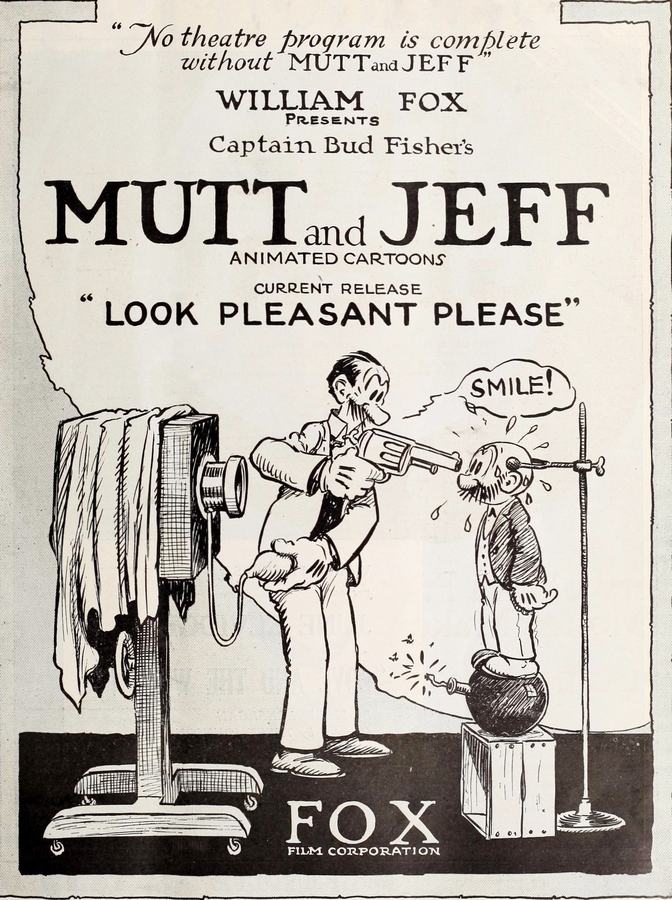
The first time I projected Look Pleasant Please on my living-room wall—16mm print spliced with Scotch tape that smells like childhood basements—I half expected the film to combust. After all, Bud Fisher’s celluloid mutiny against bookkeeping is the sort of combustible fantasy that should come with a sulfur warning.
Mutt’s skeleton-on-stilts silhouette lurches across the opening frame like a Calder mobile caught in a windstorm; Jeff, all puffed-chest bluster, waddles behind him like a self-inflating parade balloon. Together they abandon the tyranny of columns and carry-forward totals, kicking open a derelict storefront whose cracked transmissive glass spells “PHOTOGRAPHS” in crooked, ghost-white letters. The moment those letters stutter onto the screen, Fisher’s anarchic thesis announces itself: accountancy is death; photography is resurrection by misadventure.
Fisher, who spent years cranking out daily comic strips about these same two hoboes of capitalism, understands that cinema is a darkroom where narrative can be selectively bleached. The gallery they erect is less a business than a closet-sized Garden of Eden lined with arsenic-green wallpaper and lit by a skylight that drips photons like slow rain. When Mutt hoists a magnesium flash-barrel—an iron cucumber of explosive wool—it detonates not merely light but history itself: the studio becomes a sepulcher of Victorian portraiture, a crime scene of frozen grimaces.
Inside the darkroom, amber safelights throb like jellyfish hearts. Trays of developer slosh over the brim as Jeff, drunk on the perfume of acetic acid, slips on a nitrate negative and crash-lands in a baptismal font of hypo. The image that emerges from the chemical bath is a double-exposure: Jeff’s moon-face overlaid with the ghost of a customer who never existed. It is Fisher’s sly confession that every photograph is forged from two deaths—the death of the moment, and the death of the self who witnessed it.
Customers wander in as if conjured by a drunken Mephistopheles: a dowager whose bustle is so vast it requires its own zip code; a dandy clutching a cane shaped like a question mark; a pair of twins conjoined at the derby. Each demands to be immortalized “in the latest fashion,” though fashion here resembles a fever dream dictated by a surrealist cabal. Mutt poses them beneath painted backdrops of Niagara Falls and Trojan ruins, but the supports collapse, the falls deluge the set, and the Trojan horse buckles like cardboard origami.
Yet Fisher refuses to let the chaos devolve into mere Keystone bedlam. His timing is surgical: every collapsing tripod lands on the precise frame where the dowager’s smile trembles into terror, transforming slapstick into metaphysical portraiture. The camera, that mechanical voyeur, becomes a confessor; the shutter click is the moment the soul flinches.
In the film’s most haunting intertitle—hand-lettered on what looks like a torn page from a ledger—appears the phrase: “Accounts balanced, lives unbalanced.” Fisher overlays this text atop a close-up of Mutt’s ink-stained fingers gripping a fountain pen that drips like a stigmata. The image lasts perhaps eighteen frames, but it reverberates like a struck bell. We realize the photograph gallery is not an escape from accountancy but its apotheosis: every portrait is a debit of mortality, every smile a credit of delusion.
Compare this to The Love Liar where deception is romantic currency, or The Spy where identity itself is counterfeit. Fisher’s comedy is bleaker: identity is not stolen but overexposed until it evaporates.
When the final negative dries, Mutt and Jeff hang it on a clothesline beside long-johns and dish rags. The emulsion gleams like a fresh wound. They have not captured likeness; they have captured absence. The customer who paid a nickel for immortality has vanished, leaving only a silver ghost shimmering in the darkroom dusk. Fisher tilts the camera upward so the clothesline bisects the frame like a guillotine, and the film ends—not with a fade-out but with a chemical blot that spreads like melanoma across the image until the screen is swallowed by void.
This is not a curtain; it is a shroud. The audience, once giggling, now finds itself holding its breath, as if the blot might seep through the screen and stain their own fingerprints.
Released the same year as The Little American’s patriotic melodrama and Titanenkampf’s Wagnerian bombast, Look Pleasant Please is the cinematic equivalent of a trench-foot letter smuggled past the censors. America was busy photographing itself as savior of Europe; Fisher photographs America as a bookkeeping farce where even heroism requires a receipt.
Notice the wardrobe: Mutt’s trousers end four inches above his shoes, exposing socks that sag like tired flags—an echo of wartime fabric rationing. Jeff’s waistcoat is festooned with mismatched buttons, each a battlefield souvenir. Their poverty is not comedic garnish; it is the residue of a nation that has turned its factories to shells and its studios to escapism.
I first encountered this film in a Parisian basement cinémathèque where the projectionist ran it at the wrong speed—18 fps instead of 16—so the slapstick became balletic, every pratfall a Nijinsky leap. The audience, mostly grad students clutching existentialism paperbacks, laughed until the final blot, at which point a woman beside me whispered, “C’est ma grand-mère disparue.” She swore the dowager’s grimace was identical to the last photo taken of her grandmother before the influenza took her. Around us, the room smelled of vinegar and nitrate, the same perfume that once clung to the trenches. In that moment Fisher’s joke revealed its venomous heart: all photography is a séance, and every snapshot summons a ghost who refuses to leave.
I have since screened Look Pleasant Please in a dozen venues—loft spaces, university halls, once even on a bedsheet strung between two pear trees during a thunderstorm. Each time the final chemical blot arrives, conversation dies, replaced by the hush of people recognizing their own unpaid debts to time. The ledger, it seems, is never closed; it merely changes currency from numbers to silver halide.
So, is Look Pleasant Please a comedy? Only if you find graves hilarious. It is more accurate to call it a tragic fugue played on a kazoo—an opus that balances on the knife-edge between belly-laugh and belly-up. Fisher, a cartoonist by trade, understands that the funniest line is the one that circumscribes a void. His film is that line, drawn in magnesium flash and developer acid, circumscribing the void where our certitudes of work, worth, and self once huddled.
Watch it once for the slapstick, twice for the abyss, and a third time with the sound off so you can hear your own heart subtracting frames from its finite reel. And when the chemical blot finally devours the screen, remember: the joke is not that we vanish, but that we once believed a photograph could keep us present.
(For further descent into celluloid purgatory, pair this viewing with Sodoms Ende’s apocalypse or Vengeance Is Mine’s toxic daguerreotypes. Just don’t expect to sleep unexposed.)
IMDb 6.9
1923
Community
Log in to comment.