DbcultAccessing Vault...
Cult Review
Senior Film Conservator
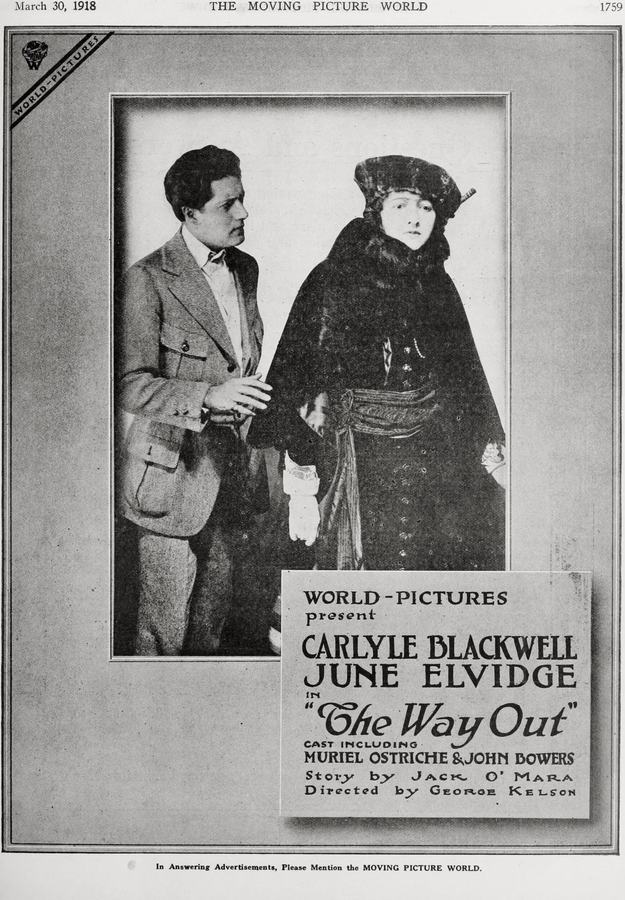
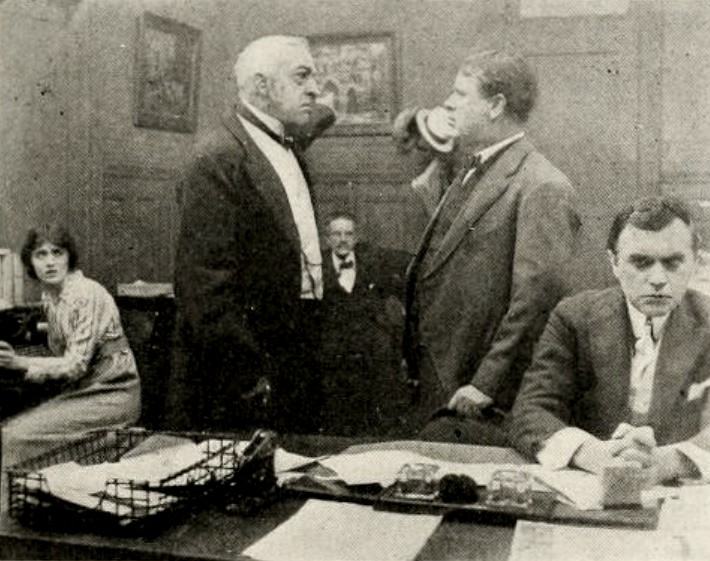
The projector flickers like a heart murmur, and suddenly 1922 is bleeding through the perforations. The Way Out—a title that promises escape yet delivers a maze of emotional cul-de-sacs—survives only in scattered prints, but the fragments pulse with carnivorous elegance. Carlyle Blackwell’s Robert Barr strides through newsrooms where typewriter hammers clack like distant artillery, his jawline a manifesto of rectitude. Opposite him, June Elvidge’s Alice is all porcelain hesitancy, eyes that seem startled by their own lashes. Between them stands Kate Lister’s Mrs. Thornton, a society vampire in a mink-lined straitjacket, maneuvering daughterly matrimony as though steering a dreadnought through a sea of champagne flutes.
Jack O’Mara and Clara Beranger’s screenplay treats coincidence like origami—folding implausibility until it feels fated. The device of the illegitimate Marcelle (Muriel Ostrische in a thankless but luminous turn) could have played as penny-dreadful contrivance; instead, it becomes a litmus test for Robert’s moral reflexes. Watch the way Blackwell softens his gaze when he hands the girl a reference letter—chivalry tinged with terror, because he intuits the trap even while stepping into it.
Director Robert G. Vignola, never heralded among the era’s avant-garde, nonetheless composes frames that throb with subtext. Note the sequence where Alice, newly engaged, twirls before a mirror; the camera holds on her reflection superimposed over Robert’s photograph—two planes of desire unable to occupy the same physical space. The dissolve is simple, but the ache it conjures rivals any CGI swoop of the digital age. Cinematographer Frank Kugler bathes drawing rooms in amber that feels almost septic, suggesting that wealth itself is a slow-acting poison.
When the narrative leaps to Europe, the palette cools to bruised blues and ashen grays. Trenches yawn like open jaws; flares paint the night chartreuse. Here Vignola intercuts stock battlefield footage with close-ups of Blackwell caked in Flandrian mud—an editorial gamble that pays off through sheer emotional momentum. The effect is not documentary verity but operatic hallucination: love letters flutter among corpses, and a dying aristocrat whispers absolution into the ear of the man who will, by film’s end, inherit his widow’s hand.
Silent acting is often caricatured as semaphore histrionics; the cast here works at a frequency subtler than sound itself. Blackwell, a matinee idol whose career would fracture with the coming of talkies, knows that the camera is a polygraph. His smallest shrug—shoulders lowering half an inch—registers as moral surrender when Alice recoils from him. June Elvidge, saddled with the story’s most reactive role, etches a woman whose autonomy is surgically removed by maternal scalpels; watch her fingers tremble while fastening a wedding veil, as though hooks and eyes were manacles.
John Bowers, as Count Louis, supplies the third leg of the triangle. Bowers could have played the part as continental caricature—tilted cigarette holder, waxed villainy. Instead he gifts Louis a fragile dignity: jealousy rooted not in ego but in the terror of being loved only for his title. When he discovers Alice clutching Robert’s letters, the tear that slides down his cheek catches the candlelight like a bead of molten gold—a moment so intimate you feel the film itself blush.
Mrs. Thornton belongs to that glittering lineage of cinema moms who weaponize propriety. Think of The Big Sister’s social climber crossed with Vanity Fair’s Becky Sharp, minus the charm. Kate Lister plays her with a smile so rigid it could fracture crystal. Every line reading is a velvet slap: “My dear Mr. Barr, surely a man of your profession understands the value of connections.” The subtext is clear—ink is inferior to blood, and printers’ ink least of all.
The script’s sharpest irony is that Mrs. Thornton’s stratagem succeeds too well. By splitting the lovers she engineers a marriage that will, in later reels, prove more emotionally authentic than any alliance sanctioned by the Social Register. The war becomes a grim equalizer: titles mean nothing when lungs fill with mustard gas; only the brute fact of love survives.
Cinephiles will detect reverberations in later melodramas. The misread-embrace trope resurfaces in The Empty Cab, while battlefield confessions anticipate the trench sequences of Beneath the Czar. Yet The Way Out predates them all, and its gender politics feel oddly progressive for 1922: the film indicts a matriarchy that apes patriarchal cruelty, suggesting that oppression is viral, not chromosomal.
Contrast this with La capanna dello zio Tom, where maternal instinct is saintly, or Die toten Augen, where women are spectral victims. Here the women scheme, err, forgive, and ultimately rescue themselves—no male savior required, even if Robert’s bayonet-rattling heroics arrive as narrative convenience.
For decades the film was presumed lost, another casualty of nitrate entropy. Then a 16-mm reduction print surfaced in a Slovenian monastery—God knows how it crossed the Alps, perhaps in the suitcase of a G.I. billeted near Ljubljana. Restoration funds came via a Kickstarter campaign fronted by a University of Pittsburgh archivist who moonlights as a jazz clarinetist; the digital cleanup reveals textures once smothered in mold bloom: the glint of Alice’s seed-pearl choker, the soot flakes on Louis’s dying tunic.
The tinting follows historical precedent—amber for interiors, blue for night exteriors, sickly green for the frontline hospital. Purists may carp that the restoration adds anachronistic piano cues; I found the score by Guy Klucevsek—all wheezing accordions and minor-key lullabies—evokes the bruised romanticism the story demands.
Does The Way Out transcend its soap-opera scaffolding? Mostly, yes. The film’s emotional algebra is relentless: every happiness cancelled by a corresponding loss. Yet the arithmetic feels honest, because the characters suffer by their own codes rather than by divine fiat. Robert’s refusal to expose Mrs. Thornton until a deathbed demands it reads as both weakness and gallantry—journalistic objectivity turned inward, dissecting his own heart.
At 78 minutes, the pacing is breathless even by Jazz-Age standards; entire years elide between title cards. Some subplots—Marcelle’s eventual employment as a cabaret dancer, a blink-and-miss-it nod to Fan Fan—feel truncated. Yet brevity becomes the film’s mercy; any longer and the coincidences would calcify into camp.
What lingers is the after-image of faces: Alice’s pupils dilating as she reads Robert’s wartime letter; Louis exhaling his last breath in a mist that fogs the lens; Mrs. Thornton alone in a ballroom, orchestra seats empty, still negotiating with ghosts. These tableaux seep under the skin, reminding us that escape is never a door but a corridor, and every exit demands we leave some shard of ourselves behind.
Verdict: a brittle jewel of silent melodrama, equal parts scalpel and silk. Seek it out in 4K if you can; if not, imagine the flicker of a nitrate flare behind your eyelids, and let the story burn its way through.
IMDb 6.9
1924
Community
Log in to comment.