DbcultAccessing Vault...
Cult Review
Senior Film Conservator
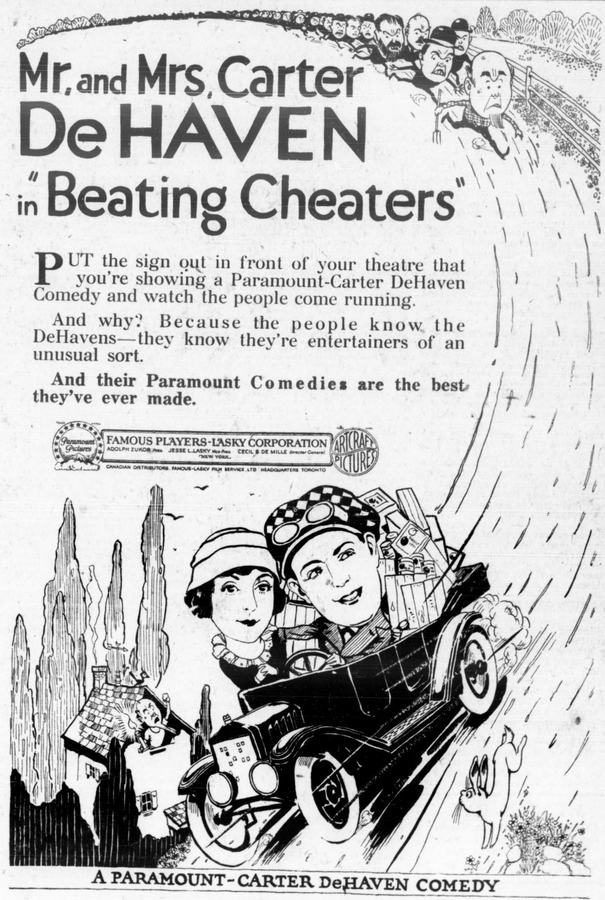
There is a moment, early in Beating Cheaters, when Carter De Haven’s face—thin, fox-like, flickering between hope and suspicion—fills the frame like a cracked mirror aimed at every audience member who ever trusted a scratch-off ticket. The year is 1926, Wall Street is still tipsy but not yet vomiting over the curb, and the automobile sits in the American imagination like a chromium grail. The film, brisk as a Charleston and twice as jittery, skewers the national itch to possess speed, status, and the illusion of chance.
Jones’s grocery is no mere storefront; it is a neon-lit cathedral where sacraments are bought by the pound. The De Havens enter clutching coupons the way medieval peasants gripped pilgrim badges, convinced providence can be budgeted. Their purchasing binge—sugar, lard, tinned peaches—becomes a comic Stations of the Cross: each tin a relic, each receipt a psalm. Director Keene Thompson stages these transactions in iris-shots that shrink the world to the diameter of a coin, implying cosmoses of desire spinning inside every cent.
In the parlor sequence the couple mime driving with parodic solemnity: Carter twists a broom-handle, Flora Parker DeHaven shifts an imaginary stick, and the camera pirouettes 360°, mocking their pantomime of acceleration. The wallpaper behind them—florid, suffocating—turns into a prison of petunias. It is a visual gag worthy of Tati before Tati, but darker: the American living room as padded cell.
Overhearing Jones’s cynical largesse, Carter does not recoil; he accelerates. The portable garage he orders arrives like a dismembered Transformer, boards numbered in Esperanto. Assembly becomes marital farce: husband and neighbor trade insults while bolts roll under furniture like guilty secrets. Mrs. De Haven, exasperated, finishes solo, her hammer strikes syncing with intertitles that read more like manifestos than dialogue: "If men measured twice, they’d apologize less." In 1926 this is suffragette snark wrapped in slapstick, and it lands hard.
When Jones shutters the store and skips town, the film’s tone pivots from carnival to wake. The couple stand outside the darkened shop, tickets clutched like wilted roses. The camera holds on their backs, receding into fog, a visual sigh. Yet the narrative refuses lament; instead it transmutes grief into mercantile revenge. The garage becomes a micro-Wanamaker’s, shelves erected from betrayal’s lumber. Canned peaches return as liquid capital, price tags flapping like victory flags.
Renting a roadster with their grocery profits, the De Havens finally taste velocity. The machine, all rust and braggadocio, bucks like a sacrificial steer. Carter’s circles at intersections—shot from a crane that predates Kubrick’s—turn traffic into dervishes. The collision with a confetti truck is Eisenstein meets Keystone: colored paper explodes into the air, settling on the couple like baptismal confetti. For a heartbeat the film attains pure kinetic poetry, a silent hymn to chaos.
They limp away, buy a battered flivver, and kiss amid the wreckage. The kiss is not romance; it is contract—an oral agreement that delusion, if shared, becomes covenant. The final shot tilts up to an open road, a horizon that might lead anywhere, or nowhere. The camera does not follow; it stays planted, as if to say the fantasy of escape is always more photogenic than escape itself.
Carter De Haven possesses the rubber physiognomy of a man who could sell snake oil to snakes, yet his eyes telegraph the terror of being found out. Flora Parker DeHaven, perennial second fiddle in silent shorts, here conducts the orchestra: her sideways glances at male folly, the way she pockets a hammer like a pistol—every micro-gesture is a feminist eye-roll set to 16 fps. Together they radiate the lived-in chemistry of vaudeville partners who have split profits and socks for decades.
Robert F. McGowan’s script (from a Thompson story) crackles with titles that beg to be sampled in tweets a century later: "Hope is a tin can—if you kick it down the road, it still rattles." Cinematographer Frank Zucker frames suburbia like a diorama under glass: every hedge too neat, every cloud a painted swab. The result is uncanny, as though the world itself were a grocery item waiting to be price-gouged.
Seen today, Beating Cheaters plays like proto-Coen, a tale where the universe is not hostile merely indifferent, and every kindness carries usury. Its DNA snakes through hoodooed capers and bruised romances alike. The automobile, promised and withheld, then purchased and almost wrecked, is America itself: a commodity so luminous it blinds you to the pothole you’re about to kiss.
Restoration prints on Criterion Channel sparkle, but the real revelation is the new score by Mont Alto—a fox-trot that mutates into dissonant rumba as dreams sour. Headphones recommended; you will hear the tick of every ticket, the sigh of every unloved turnip.
Beating Cheaters is not a nostalgia truffle; it is a warning wrapped in tissue paper and tinsel. It whispers that the house always wins, but adds—winkingly—that sometimes the house is made of balsa, and a woman with a hammer can still remodel the world.
Where to watch: Criterion Channel (restored 2K), Kanopy (public domain scan), occasional 16 mm revivals at MoMA. Run, don’t drive—your license may still be collateral.
IMDb 6.1
1932
Community
Log in to comment.