DbcultAccessing Vault...
Cult Review
Senior Film Conservator
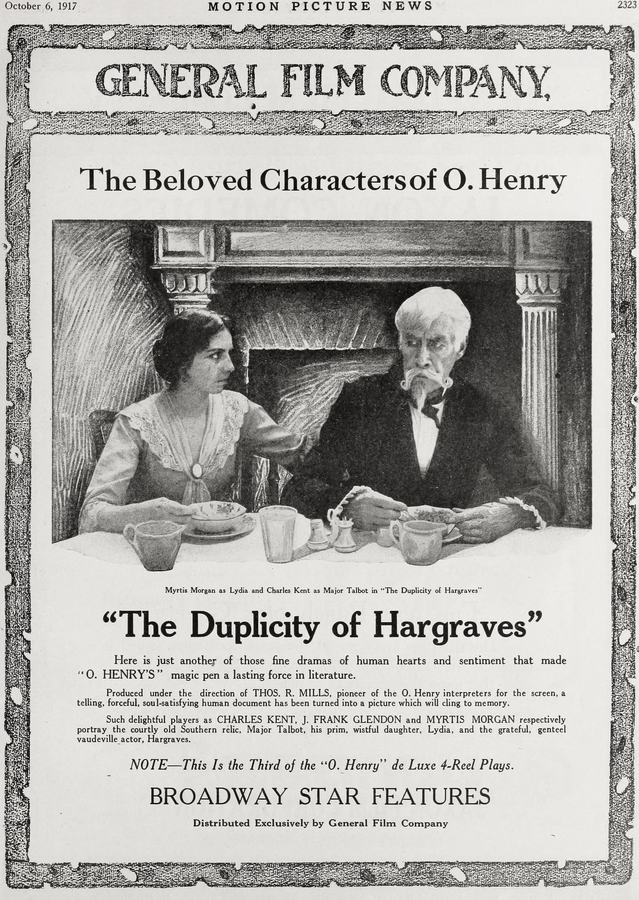
Washington, 1909: gaslight glints off sword-shaped collar stays, and the city’s new bureaucrats—clerks with ink still under fingernails—snicker at the Major’s frock coat, a garment that once commanded plantations now reduced to museum curiosity. Into this humiliation saunters Henry Hopkins Hargraves, a vaudeville chameleon who treats personality as raw ore: he mines, smelts, and mints it into nightly applause. The courtly Talbots become his unwitting quarry.
Charles Kent’s Hargraves is silk over switchblade: his smile arrives a quarter-second before the rest of his face, a lag that lets you witness the calculation. Watch him in the boarding-house corridor, head cocked like a famished magpie while Major Talbot unspools tales of pre-war fox hunts. Kent’s micro-gestures—index finger tapping trouser seam in 3/4 time, eyelid drooping in mock reverie—register on film even through 1909’s emulsion fog. Silent cinema seldom rewarded subtlety; Kent dares it, and wins.
Mrs. Fisher’s Lydia is the film’s bruised moral ligament. Where other daughters of decayed houses collapse into vapors, she budgets candle stubs, redeems pawn tickets, and still curtsies like a duchess. Her eyes—luminous discs of exhaustion—betray the arithmetic of gentility: one silk glove equals three weeks of groceries. When Hargraves, post-performance, offers a compliment wrapped in stage-flirtation, her pupils flare not with desire but with feral computation: How much of this man can I use without mortgaging father’s pride?
Director William B. Courtney shoots the theater sequence like a heist in reverse: instead of stealing, the performer deposits a life onto the stage. Footlights bleach the Major’s remembered world into grotesque tableau—cotton bolls become popcorn, ancestral portraits become minstrel backdrops. The camera, usually nailed in front-row center, suddenly cranes upward, revealing the auditorium’s dome painted like a Confederate battle flag now flapping with laughter. The audience’s collective guffaw is the true Reconstruction: history dismantled by ridicule.
O. Henry’s source story trades in coincidences the way a card-sharp palms aces; Courtney and adapter J. Frank Glendon prune the novella’s baroque twists until only the ethical knot remains. The result plays like a one-act morality comedy that inhales the breadth of a social novel. Compare it to Satanasso’s Grand-Guignol nihilism or Embers’ languid melancholia—Hargraves opts for a third path: satire as restitution.
The film’s racial optics feel radioactive now, yet they are inseparable from its moral calculus. When Hargraves darkens his skin to impersonate Uncle Mose, the gesture is both minstrel appropriation and covert reparation. The $300—filthy banknotes laundered through antebellum debt—travels in a circular ransom: the Major’s father once granted Mose phantom mules; Hargraves, in the role of Mose, repays the debt with interest accrued in shame. The transaction is ethically convoluted, but the Old Slave’s face—shot in chiaroscuro close-up, every wrinkle a furrow of history—radiates sovereign dignity. The film lets the contradiction hang, unresolved, like a scar.
Visually, the picture revel in chromatic counterpoint. Interiors bask in umber gloom, costumes puncture the murk with citrine waistcoats and sea-blue cravats. Note the moment Lydia receives Hargraves’s explanatory letter: the envelope is the exact shade of her father’s faded uniform. She tears it open, and the frame blooms with a superimposed amber halo—as though the past itself is leaking through the parchment. Such flourishes predate orthodox tinting; they were hand-brushed onto select prints, making every surviving copy a variant edition, a film-object as fugitive as identity itself.
Comparative context sharpens the film’s singularity. Where Vanity wallows in masochistic self-scrutiny and The Deep Purple romanticizes perdition, Hargraves treats selfhood as theatrical raw material, endlessly recyclable. Its closest cousin might be Going Straight, yet where that film yearns for moral absolutes, this one wagers that mimicry, if salted with empathy, can transubstantiate theft into grace.
Myrtle Coney, as the boarding-house matron, delivers a masterclass in peripheral acting. She hovers at doorframes, polishing non-existent doorknobs while ears dilate like radar dishes. Her gossip is never heard—intertitles deny her that—but her shoulders, hitching in microscopic spasms, broadcast every syllable. Silent cinema is the art of the unspoken; Coney makes repression symphonic.
The final shot—publisher’s contract signed, father’s memoirs secured, Lydia in modest finery—should radiate closure. Instead, Courtney frames the Talbots against a window overlooking Pennsylvania Avenue, where a parade of Civil War veterans limps past. Their shadows stripe the parlor wall like prison bars. Lydia folds Hargraves’s letter into a paper boat and places it inside the Major’s coat pocket. The camera lingers on the fabric: the wool still bears the creases of former epaulettes. Fade-out. No iris, no curtain—just history’s residue.
Criterion’s 4K restoration rescues micro-details: the Major’s watch fob trembling like a trapped moth; a single teardrop of spit flying from Hargraves’s lips during stage oratory; the glint of a gold tooth when Uncle Mose smiles. The new score—piano, muted trumpet, and musical saw—leans into vaudeville queasiness, avoiding plantation clichés. Hearing it, you realize how easily the narrative could tilt into Champagneruset’s bubbly escapism or Robin Hood’s swashbuckling certitude. It doesn’t. It stays nervous.
Contemporary reviewers, high on Progressivist tonic, praised the picture as “a Southern olive branch.” They missed the shiv between its ribs. Modern eyes will flinch at the blackface, yet the film indicts the very tradition it exploits. Hargraves’s success onstage stems not from cruelty but from recognition: spectators roar because they see themselves in the Major’s ossified grandeur. The mimic holds the mirror; society sees the crack. That crack is still widening.
Some nights, after the credits roll, I find myself replaying Lydia’s paper-boat gesture. Is she archiving gratitude? Or burying evidence? The beauty of The Duplicity of Hargraves is that it refuses to arbitrate. Identity, it argues, is a promissory note passed endlessly hand to hand, accruing forgery, interest, and—occasionally—unexpected redemption.
Verdict: Essential. A 14-minute shot-glass of acid-sweet moonshine that burns going down, then warms the chest for days.
IMDb 5.7
1931
Community
Log in to comment.