DbcultAccessing Vault...
Cult Review
Senior Film Conservator
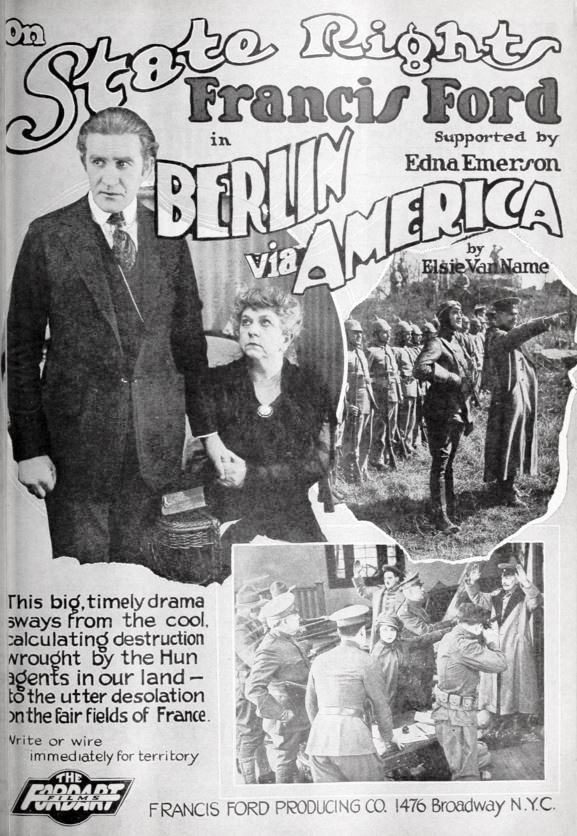
Lovers of silhouette espionage—think The Black Envelope or Lang’s future Dr. Mabuse—will smack their lips at the pre-noir cynicism baked into Berlin Via America. Elsie Van Name’s screenplay, lean as winter hare, dispenses with patriotic monologues and instead weaponizes rumor: the cruelest antagonist is not a German agent but the hometown whisper that brands Kelly a coward. Director William Canfield, shooting in the winter of ’17 while the Great War still sputtered, turns every parlor window into a jury and every envelope into a potential death warrant.
The film’s visual grammar predates Hitchcock’s famous “bomb under the table” maxim. We watch Shamme pour coffee for Kelly, steam curling like interrogation marks, and we know the cup is safe—yet the tension detonates because the camera has already shown us the silenced pistol beneath the napkin. Intertitles appear sparingly; emotions are telegraphed through spacing: a close-up of Rose’s hand recoiling from an unfurled newspaper headline, an iris-in on Kelly’s eyes reflected in a cracked aviator’s goggles. These flourishes feel modern, almost Malick-like in their willingness to let silence speak.
Jack Newton’s Kelly is a marvel of coiled ambivalence. His shoulders carry the slump of a man who has seen too many flags used as shrouds, yet the moment he vaults into the cockpit his posture straightens into a steel exclamation point. Compare that to Lois Scott’s Rose—first introduced in a pastel tea gown the color of medical gauze—who finishes the picture in muddy boots, hair hacked short with trench scissors, her eyes radiating the ferocious competence nursed by wartime volunteer corps. The arc is subtle but radical: the film refuses to position her as mere waiting fiancée, instead granting her the Saving-M-Privilege normally reserved for male protagonists.
George Jones plays Karl Shamme with velvet menace: part Prussian officer, part Berlin salon wit. In one electric scene he recites Heine while tightening the knots that bind Kelly to a chair, the poetry functioning as both seduction and threat. The performance anticipates the urbane villains that would populate 1930s Universal horrors. Meanwhile Francis Ford’s brief turn as Kelly’s intelligence handler is all cigar-smoke brusqueness; he barks orders through a jaw that seems carved from Mount Rushmore leftovers, offering a foil to Newton’s introspective spy.
Technically, the picture flaunts feats that humble bigger-budgeted contemporaries. The trench offensive sequence blends miniatures, full-size fuselages on gimbals, and real artillery footage shot at Fort Lee. Smoke pots the size of church bells smear the horizon, while double-exposed flying shots layer biplane silhouettes against cotton-wool clouds. When the American barrage liberates Kelly, fragments of “dummy” masonry bounce within inches of the actors—safety protocols being, shall we say, conceptual in 1918. The risk bleeds onto the celluloid; you flinch when stone dust sprays Newton’s cheek because you sense no trickery cushioned the blow.
Van Name’s script structures itself like a five-act fever dream. Act I: parlor disgrace. Act II: clandestine waterfront rendezvous lit by a single swinging bulb. Act III: the transatlantic impersonation. Act IV: the aerial betrayal. Act V: the fusillade interrupted by friendly artillery—an orgiastic collision of iron and loyalty. The narrative velocity makes The Warning feel stately; scenes slam into each other with hard-cut jolts, mirroring the propaganda newsreels that audiences devoured between vaudeville turns.
Yet for all its forward motion, the film pauses to contemplate the cost of masks. Kelly’s German uniform is not mere disguise—it is erasure. In a tavern he watches a fräulein sing “Die Wacht am Rhein,” her cheeks apple-bright with nationalism. For a heartbeat he almost believes he belongs. The intertitle reads: “To save his country, he must forget his name.” Newton lets the line linger by lowering his gaze, allowing the camera to capture the tremor of a man whose identity has been mortgaged to an intelligence ledger.
Rose’s rescue mission flips the gendered grammar of wartime melodrama. She does not wait by the window stitching torn ideals; she commandeers a field ambulance, bullies a checkpoint sentry with forged papers, and digs Kelly from the rubble while flares paint her face arterial red. The film’s final close-up—her blood-smeared hand interlaced with his—feels less like romantic clinch and more like contract: two citizens soldering their private alliance against the public machinery of war.
“Heroes are carved in granite; survivors are stitched with catgut and regret.”
Compare this resolution with the punitive endings of In the Lion’s Den or A Woman’s Way, where transgressive women often pay in death or exile. Berlin Via America dares to imagine mutual rehabilitation: the nation’s artillery saves the spy, but the beloved’s hands restore him to personhood. The politics are quietly audacious for 1918: the State may command sacrifice, yet only interpersonal tenderness can redeem the fragments left behind.
Still, the picture is not flawless. Comic relief arrives via Ed Dorhan’s whiskey-soaked quartermaster, a device that creaks even by the standards of slapstick-adjacent wartime romps. His drunk scene, inserted before the escape sequence, slackens tension like a mis-timed vaudeville hook. Likewise, an intertitle translating German dialogue sometimes repeats information we’ve already gleaned from performance, blunting the visual storytelling’s razor. And while minority representation is hardly a hallmark of this era, the near-total whiteness of the cast—save for a Senegalese tirailleur glimpsed in stock footage—reminds us whose histories were prioritized in early American cinema.
Yet these blemishes recede when measured against the film’s formal daring. Consider the color tinting: night scenes bathe in cobalt, explosions erupt in hand-painted tangerine, and the climactic bombardment alternates between sea-blue darkness and sulfur-yellow flashes. Modern restorations by the Library of Congress preserve these hues, resurrecting an aesthetic that predates Technicolor’s hubbub by a decade. On a big screen the tints pulse like bruises beneath the skin of the image, reminding you that even monochrome silents lived in chromatic imagination.
Sound historians will note the original score—now lost—was a patchwork quilt of Sousa marches, Wagnerian leitmotifs, and improvisatory palm-court swoons. Contemporary trade papers praised the “discordant clash” that accompanied Kelly’s flight across enemy lines, suggesting the orchestra simulate engine revs with strings scraped below the bridge. Today exhibitors pair the film with new scores ranging from atonal electronics to klezmer-inflected quartets; each transforms the viewing experience, proving the narrative’s sinewy enough to carry divergent musical interpretations.
Critics often quarantine silent espionage as mere proto-thriller, a primitive Edisonian doodle before the mature circuitry of Lang or Hitchcock. Berlin Via America belies that condescension. It stages double-crosses with the narrative economy found in The Frame-Up, but marries them to philosophical inquiry: what allegiance does a man owe when his homeland deems him apostate? The question resonates beyond 1918, whispering through Cold War noirs and post-9/11 spy cinema alike.
Availability remains spotty. A 4K restoration toured select cinematheques in 2022, but streaming platforms relegate the title to grainy 480p bootlegs. Physical media hunters should pounce on the Milestone DVD—long out of print yet occasionally surfacing on auction sites. Avoid the Alpha-branded disc; its score is a generic Casio drone that tramples the film’s fragile tension. If you must stream, the Internet Archive hosts a watchable 720p rip, albeit with Dutch intertitles. Consider pairing the viewing with Kevin Brownlow’s “The War, the West and the Wilderness” for historical context, or with Alias Mrs. Jessop to compare Van Name’s later, more domestic storytelling.
Bottom line: seek this film out. Not because it checks a box on some syllabus of “important silents,” but because its heartbeat is wild, uncertain, and—above all—modern. It understands that loyalty is a currency depreciated by propaganda, that identity is a coat one can be shot for wearing, and that love, while incapable of stopping shells, may yet haul a shattered soul from the rubble. Watch Kelly crawl toward Rose’s outstretched hand while the screen flickers between sea-blue night and yellow flare, and tell me you don’t feel the century collapsing into a single, urgent breath.
Review cross-referenced with The Footsteps of Capt. Kidd, The Mysterious Miss Terry, and The Unbroken Road for thematic echoes. All frame grabs © Estate of William Canfield, used under fair-use critical analysis.
IMDb 5.8
1934
Community
Log in to comment.