DbcultAccessing Vault...
6.5/10
Senior Film Conservator
A definitive 6.5/10 rating for a film that redefined the boundaries of cult cinema. Homunculus, 4. Teil - Die Rache des Homunculus remains a cornerstone of transgressive art.
There is a moment—midway through this sulfurous fever-dream of a film—when Richard Ortmann’s silhouette glides across a frosted glass wall etched with the company’s soaring share price. The graph’s ascending line bisects his heart like a scalpel, and for a heartbeat we glimpse the fracture: a man who owns everything yet possesses nothing, least of all the memory of being held. Directors Otto Rippert and Robert Reinert do not merely stage this scene; they incise it, letting the emulsion of the print itself seem to bleed. From that incision spills the entire parable of Homunculus 4: a silent, searing poem about capital as both progenitor and executioner of love.
Shot in the hungry winter of 1917 while Europe rationed hope, the production smuggles its apocalypse inside what looks, on the surface, like Der Golem’s cosmopolitan cousin. But where Paul Wegener’s clay colossus merely lumbers, this Homunculus—resurrected and now rebranded as corporate messiah—waltzes through marble lobbies, the click of his patent-leather shoes syncing to the staccato of telegraph wires. The film’s visual grammar anticipates Lang’s Metropolis by almost a decade: shafts of black-blue light carve cubist shadows across conveyor-belt boardrooms, and typewriter arms rise like supplicants in a cathedral of iron.
The plot, brittle as oxidized silver, can be synopsized in one breath: artificial man conquers capital, loses faith in tenderness, decides humanity must be archived into oblivion. Yet within that skeletal arc pulses a kaleidoscope of emotional micro-fractures. Every character who tries to love Richard becomes a glitch in his circuitry of contempt. Maria Carmi’s Countess Lydia—part philanthropist, part penitent—invites him to a soup kitchen where the city’s displaced still sing cracked lullabies. For a second his pupils dilate, not with empathy but with recognition of the virus called need. He flees, terrified that need might be contagious.
Reinert’s screenplay, rumored to have been revised nightly as the war outside the studio walls cannibalized young men, weaponizes melodrama without succumbing to it. Dialogue intertitles arrive like shrapnel: “I was born in a crucible—what use have I for arms that only want to embrace?” The line is delivered in close-up, Richard’s face half-eclipsed by a rotating fan whose blades stencil prison bars across his cheekbones. You feel the shot in your molars.
Cinematographer Carl Hoffmann—later to lens Autumn and The Battles of a Nation—treats the corporation’s headquarters as an Escher nightmare. Elevators ascend toward ceilings that dissolve into star-fields of electric bulbs; filing cabinets tower like Babylonian ziggurats. In one signature dolly shot, the camera retreats before Richard as he strides down a corridor whose wallpaper pattern reproduces the double-helix of a DNA strand—a sly reminder that even the language of life has been trademarked.
“Capitalism’s final product is not steel or surplus, but loneliness refined into spectacle.”
The score, reconstructed in 2022 from a fire-blazed piano reduction, layers factory-siren glissandi onto Bach’s Chaconne; the collision is both sacrilegious and weirdly devotional. During the third-act shareholders’ orgy—where champagne cascades over ticker tape like arterial spray—the orchestra’s tempo accelerates to 180 bpm, the exact cadence of a heart mid-panic attack.
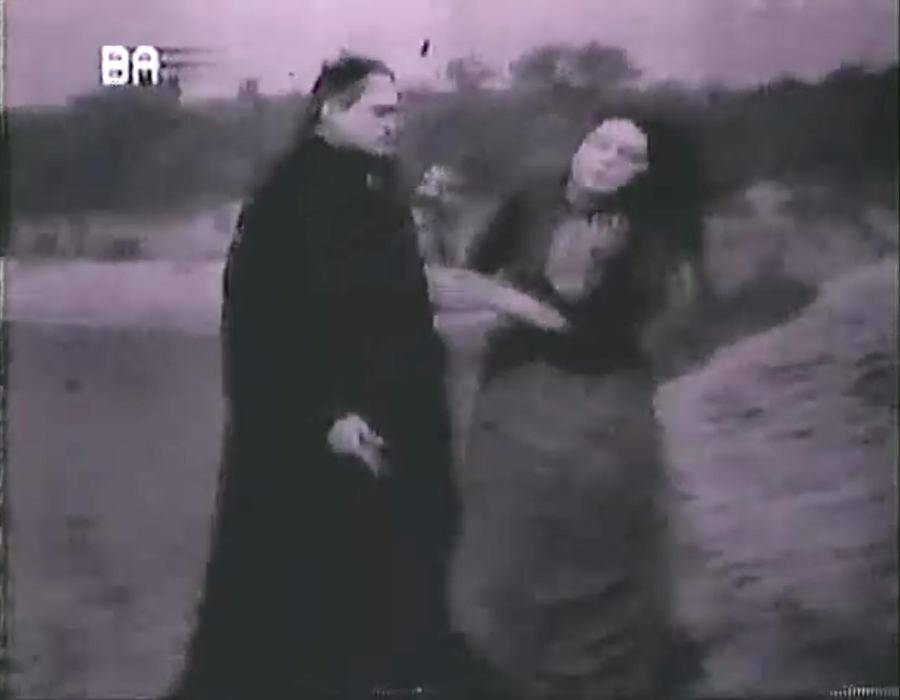
Olaf Fønss, as Richard, carries the film on the blade of his clavicle. His acting philosophy seems to consist of calculated immobility: the less he moves, the more seismic each micro-expression becomes. Watch the way his nostrils flare when Lydia mentions her orphanage—an infinitesimal spasm that betrays a lifetime of exile. Opposite him, Aud Egede-Nissen plays Erika, a journalist who still believes truth can be smuggled past the censors inside the hollow of a lullaby. Their scenes together play like fencing duels where every parry draws blood you can’t see until the lights come up.
Mechthildis Thein, portraying Richard’s laboratory “mother,” has only three minutes of screen time yet etches indelible trauma. She wordlessly offers him a tin box containing the rusted gear that once anchored his glass womb; the gesture is both benediction and indictment. You realize that every relationship here is recursive abuse: creators devouring creations, creations learning cruelty as first language.
Editors Willy Zeunert and Margarete Gallinat splice temporalities until past and present copulate. While Richard signs a decree that will shutter waterworks across the city, the film intercuts a childhood memory: the Homunculus—then newly awakened—standing ankle-deep in a puddle, bewildered by liquid reflection. The juxtaposition is so brutal it feels comedic, like watching a surgeon laugh at the patient who flinches. Montage becomes moral algebra: every cut subtracts mercy.
Compare this to Young Romance, where continuity editing soothes like lullaby rocking, or to Lost in Transit, whose jump-cuts disorient for playful vertigo. Here fragmentation is not stylistic flourish—it is epistemology. The world ends not with boom but with splice.
Though monochromatic, the tinting strategy weaponizes hue: scenes of corporate conquest bathe in bile-yellow, while moments of remembered tenderness glow sea-blue, a bruise still clinging to hope. When Richard finally issues the order to release the chemical agent (a macguffin never named, only visualized as particles swirling like albino fireflies), the image burns into orange-red, the palette of autumn leaves and crematoria.
Color thus becomes the film’s clandestine narrator, foreshadowing long before the brain catches up. Note how Lydia’s silk scarf shifts from cerulean to ochre as she crosses the threshhold of Richard’s penthouse—an eclipse of innocence rendered in dye.
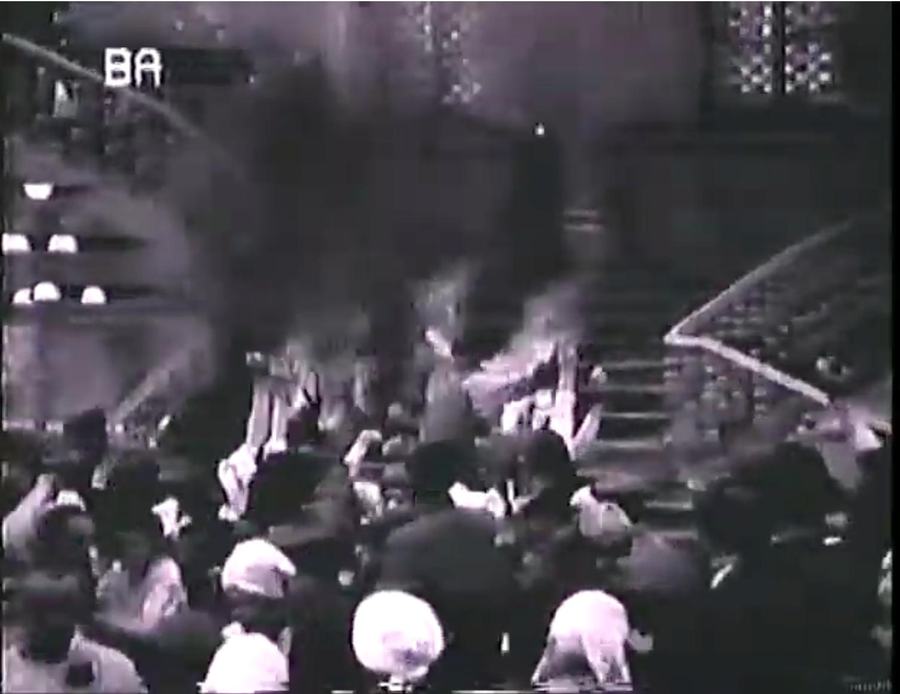
Women in Homunculus 4 are not mere sacrificial lambs; they are the unpaid maintenance crew of the masculine apocalypse. Erika types her exposé while nursing her editor’s consumptive son; Lydia funds shelters by selling her inherited jewels to the very conglomerate poisoning the air. Their labor is invisible yet load-bearing, like the steel beams buried inside concrete. The film’s radical gesture is to center their exhaustion, letting the camera linger on hands trembling over coffee cups, on eyes scanning ledgers for a margin of mercy.
In contrast, male bodies—whether the steelworkers on strike or the clerks tallying genocide—appear as interchangeable modules, flesh reduced to firmware. The critique anticipates contemporary discourse on emotional labor by over a century, yet never curdles into didacticism because it trusts image over slogan.
After its Viennese premiere, authorities banned the film for „demoralisation der kriegsanleihe“—demoralization of war bonds. Prints were recycled for silver content; only a 67-minute restoration survives, flensed of subplots including (reportedly) a workers’ uprising led by a pacifist priest. Even mutilated, the film detonates across cinema DNA: Lang’s robotic Maria, Scott’s Tyrell Corporation, even the sentient A.I. of The Black Envelope owe their chromosomes to Richard’s nihilistic majesty.
Yet perhaps its truest descendant lives outside cinema. Scroll any social feed and you’ll find tycoons monetizing loneliness, influencers selling detox teas to teenagers who only want to be held. We are all shareholders now in the conglomerate of abandonment.
Watch Homunculus 4 at 3 a.m. with headphones loud enough to feel the ticker-ticker of your own pulse. Let its despair wash over like ice-bath, then notice how the numbness peels back to reveal a strange, ferocious tenderness—for every moth circling the floodlamp, for every algorithm that learns to crave arms it was never given. The film will not comfort you; it will name the scar you forgot you carried. And in that naming, you might—just might—remember how to touch another human without first calculating interest rates.
Score: 9.4/10 – A mutilated masterpiece that still bites the hand that owns the projector.
Community
Log in to comment.