Summary
In Lois Weber’s 1915 pastoral drama, 'It's No Laughing Matter,' the narrative revolves around Hi Judd, a postmaster whose soul oscillates between the administrative duties of a rural hub and the lyrical escapism of poetry. Judd is the village’s unofficial 'doctor of happiness,' a man whose benevolence serves as the communal adhesive. However, this altruism is juxtaposed against the domestic friction caused by his perceived indolence, specifically his tendency to neglect physical labor in favor of the written word. The equilibrium of this bucolic life is shattered by the arrival of Jim Skinner, a predatory usurer who seeks to dismantle Judd’s livelihood and home. Parallel to this financial peril is a moral one: Judd’s daughter, Bess, finds herself ensnared by Sam, a sophisticated urbanite who masks a dark domestic past. The plot reaches a crescendo when Judd unearths evidence of Sam’s abandonment of a wife and child—who happen to be the kin of a local widow Judd has long supported. Through a convergence of poetic justice and financial serendipity, Judd’s literary pursuits, once dismissed as frivolous, become the instrument of the family’s salvation, redeeming his legacy and securing the community’s moral fabric.
Synopsis
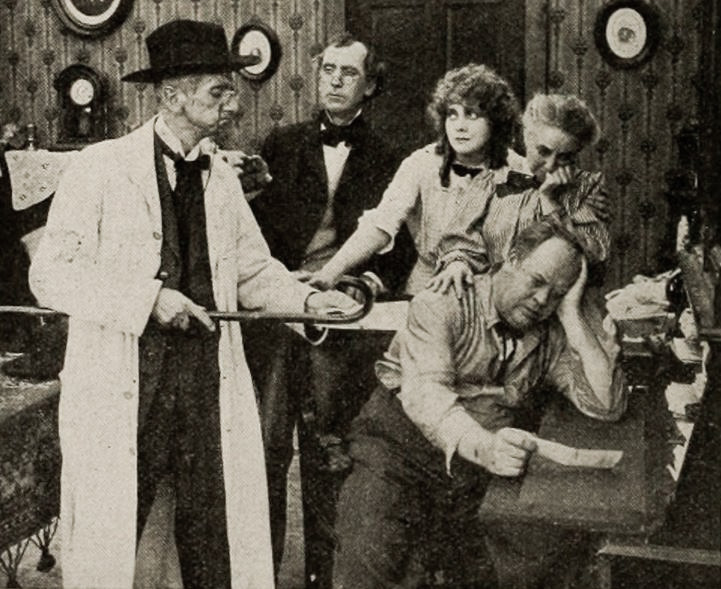
Hi Judd, poet, postmaster and philosopher, is the sunshine of the village, a veritable doctor of happiness. His right arm the little world of the village leans on, the kind words he scatters broadcast reap their harvest of love for the old postmaster and the verses he writes (sometimes when he should be working) proclaims him the wit of the village. And because of the verse writing Mrs. Judd is often discouraged. Hi confides in his daughter, Bess, that he often stands in awe of Mrs. Judd when she catches him pencil in hand, with the woodpile untouched and the chores not done. But Bess is consoling and when Hi is not around she makes a collection of the verses and sends them on to a great newspaper. Theirs is a peaceful life that must have its dramatic climax and it all descends upon them at once. Jim Skinner, an unscrupulous, grasping old miser, holds the mortgage on the house and also has designs upon Hi's position as postmaster. Then the bank fails and shadows hang low. In the meantime drama is stirring within their home. Bess who had thought she cared for Hal, the station master is under the spell of Sam who has come from the city to be the new ticket agent. Hi, dubious of his character and regretting his daughter's change of heart, before it is too late, finds a picture of Sam, his wife and their baby. Hi recognizes in the wife, Belle, the long-missing daughter of Mother Wilkins, a widow of the village whose home has burned and who would have suffered privation had it not been for the generosity of Hi. He sends for Belle, making her believe the money and message come from Sam and when Sam is confronted with the wife and baby he sees there is nothing to be done but face the unexpected situation. The mortgage is due. Heartbroken, they are preparing to leave the little home when word comes from the newspaper: "Verses accepted, send them as fast as you can write them." Thus ends the story. Hi, with his $500 check from the newspaper pays off the mortgage, the future holds its promise; Mother Wilkins is happy with her daughter and the little baby, and Hal and Bess are engaged to be married.
Review Excerpt
"
The Lyrical Resilience of the Rural Soul
To approach the works of Lois Weber is to engage with a cinema of profound moral inquiry and social architecture. In her 1915 effort, It's No Laughing Matter, Weber moves away from the visceral shock of her more controversial works to craft a poignant, layered exploration of community, debt, and the intrinsic value of the artistic spirit. The film serves as a vital bridge between the simplistic melodramas of the early silent era and the complex social ..."