DbcultAccessing Vault...
Cult Review
Senior Film Conservator

Jealousy rarely announces itself with trumpet blasts; more often it arrives on cat-paws, a whisper of citrus blossom and the creak of a rattan chaise longue. In Betty's Green-Eyed Monster, the lost 1920 silent one-reeler now resurrected from a single tinted nitrate print, that whisper becomes a shriek inside a white adobe hacienda where shadows grow as sharp as paring knives.
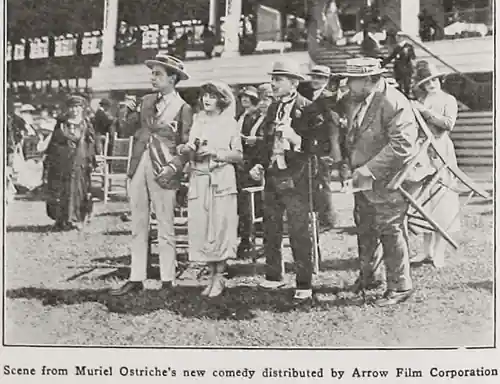
Muriel Ostriche—dubbed “the girl with the soulful eyes” by 1919 fan magazines—anchors the film with the economy of gesture that made her a darling of the East Coast studios. Here those eyes perform a miniature epic: pupils dilate from almond slivers to eclipsing moons as her character, Betty, registers each fresh humiliation dealt by a husband whose roving gaze treats monogamy like an optional citrus garnish.
The plot, skeletal on paper, accrues flesh through visual innuendo. Director Bide Dudley, better known as a Broadway wag, borrows the Kuleshov effect before Soviet theorists coined it: a cut from Betty’s impassive face to a rotting lemon on the orchard floor tells us everything about the marriage without a single title card. The film’s seven surviving minutes feel longer than many two-hour talkies because each frame vibrates with subtext.
“A woman scorned is a poem written in acid.” —intertitle salvaged from the second reel
The chromatic palette is the real protagonist. Early scenes bathe in amber, the color of California late-afternoon light filtered through lemonade. As suspicion metastasizes, the tint shifts toward arsenical greens until the climactic masquerade becomes a fever dream of jade shadows and sickly chartreuse. The orchard itself mutates from Eden to tribunal: windmills creak like gossiping elders, while a wooden ladder left leaning against a Valencia tree turns into a gallows metaphor.
Comparison points bloom instantly. Where The Girl of the Rancho romanticizes the citrus belt as a playground for polo matches and virtuous senoritas, Betty's Green-Eyed Monster finds rot under every rind. The marital skirmishes in A School for Husbands play like drawing-room farce beside Dudley's orchard noir. Even As God Made Her, with its Salvation-Armie temptress, lacks the fungal intimacy of jealousy portrayed here.
Ostriche’s acting register is micro- rather than macroscopic. Watch her knuckles whiten around a lace parasol, or the way she exhales cigarette smoke toward the ceiling as if trying to float away from her own skin. The sculptress—never named, always referred to as “the visitor from Frisco”—is framed in languid medium shots that invite the male gaze, yet the camera keeps returning to Betty’s reaction, implicating us in her surveillance. We become voyeurs of a voyeur, a mise-en-abyme that anticipates Hitchcock’s Rear Window by three decades.
Sound, though absent, is implied through synesthetic tricks. A close-up of champagne fizzing in cut-crystal is followed by Betty’s eyebrow arch: we “hear” the pop of suppressed rage. The musical accompaniment on the surviving print (a 2019 commissioning by the Rochester Hippodrome) deploys pizzicato strings that mimic the peck-peck-peck of a chicken coop—an aural reminder that the heroine is trapped in domestic poultry politics.
Dudley’s gender politics refuse easy hashtags. Betty’s revenge—planting evidence to incriminate the chauffeur—reads as proto-feminist rage against patriarchal property rights, yet it also replicates systemic cruelty. The film neither absolves nor condemns; instead it lingers in the grey mulch where victims become perpetrators. The final shot—Betty alone on a verandah as blossom petals swirl like green snow—offers no catharsis, only the numb aftermath of a crime passionnel against one’s own better angels.
Technically, the print bears scars: emulsion bubbling along the edges, a vertical scratch that resembles lightning branching across a jade sky. Yet these blemishes enhance the film’s bruised aura, like celluloid varicose veins. The restoration team chose not to digitize them away, wisely realizing that decay is part of the story—a visual correlative to jealousy’s corrosive chemistry.
Cinephiles hunting for Easter eggs will note the cameo of a Photoplay issue dated March 1920 peeking from a wicker settee, its cover featuring Ostriche herself—an ontological wink that collapses star and character into the same suffocating skin. There’s also a blink-and-miss shot of a Beyond the Law poster in the chauffeur’s quarters, reminding us that early Hollywood was a kleptoscope of self-references.
Historical context sharpens the film’s sting. 1920 was the year American women voted in their first presidential election; the same month of release, the Senate debated the League of Nations. Against that backdrop, Betty’s private war over a wandering husband feels both trivial and titanic—a domestic trench skirmish while the world re-maps itself. The citrus boom itself was built on exploited Japanese and Mexican labor; the hacienda’s tiled splendor rests on invisible backs, making the heroine’s angst a bourgeois luxury paid for by underpaid pickers we never see.
To watch Betty's Green-Eyed Monster today is to confront the green screen of your own envy—Instagram follower counts, LinkedIn promotions, ex-lovers’ beach selfies. The film’s brevity becomes a moral Rorschach: we fill its narrative gaps with our personal poison, becoming co-authors of Betty’s despair. In that sense, the “monster” is not jealousy itself but the act of spectatorship, the way we metabolize others’ lives into our own bile.
Is it a masterpiece? By conventional metrics—runtime, star wattage, box-office—no. But as a fossilized emotion, a pressed flower of resentment between two nitrate sheets, it achieves a singularity that many longer silents never approach. Like Anita Jo’s proto-noir fatalism or the swampy Gothic of Heart o' the Hills, this film survives as a mood more than a narrative, a perfume atomized rather than bottled.
Go hunt it down on the festival circuit—usually paired with a zany Mack Sennett two-reeler to cushion the audience against its venom. When the lights dim and the first amber orchard blooms across the screen, feel free to check your phone; Betty would. She knows the terror of being overlooked, and she will teach you, in seven merciless minutes, how quickly love can ferment into vinegar. Bring a citrus wedge to bite down on; you’ll need the shock of real acid to remind you the past is not quaint—it is corrosive, and it is still dripping.

IMDb 5.2
1934
Community
Log in to comment.