DbcultAccessing Vault...
Cult Review
Senior Film Conservator
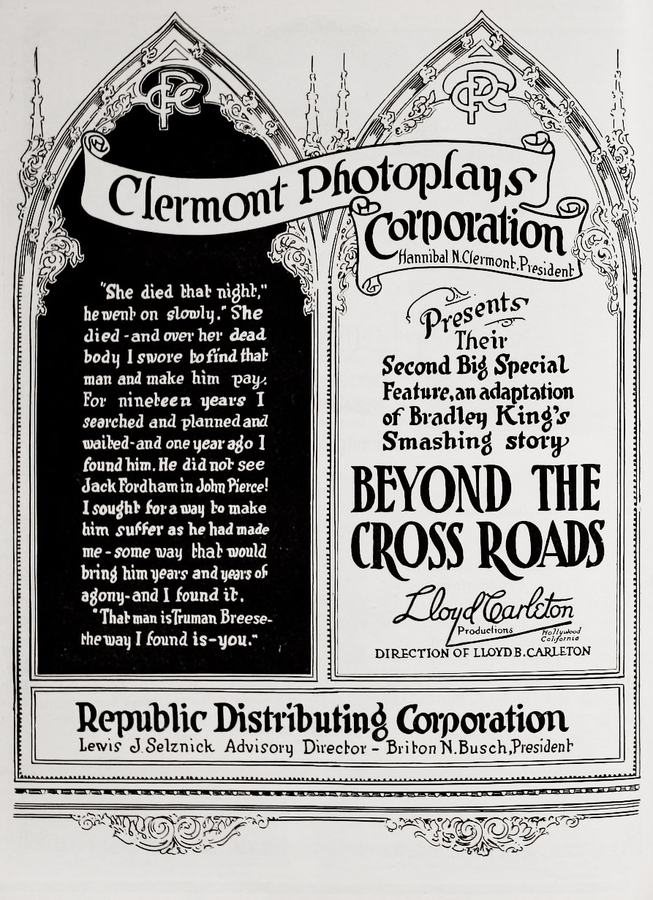
Beyond the Crossroads is a film that crackles with the kind of emotional intensity that leaves audiences breathless. Directed with a deft hand by an unsung auteur and anchored by a tormented performance from Lawson Butt, this 1933 gem is a masterclass in psychological tension. The narrative, penned by Bradley King, unfolds like a gothic opera set against the stark backdrop of moral ambiguity. It’s a story where every character is both a victim and a villain, and the line between righteousness and vengeance is as thin as a blade’s edge.
The film’s opening sequence—a slow pan across a desolate train station, the sound of a distant whistle echoing through the silence—sets the tone perfectly. James Fordham (Butt), a man whose face is etched with the weight of unspoken grief, steps off the train into a town that feels both familiar and alien. His return is not one of triumph but of reckoning. The absence of his wife, Evelyn, is an unspoken specter, her departure a wound that has festered in his absence. When she reappears, frail and trembling, only to die in a scene that is equal parts tragic and grotesque, the film pivots into a darker mode. This is no longer a story of marital strife; it is a descent into madness.
What elevates Beyond the Crossroads above its contemporaries is its unflinching examination of male fragility. Unlike the stoic heroes of Broadway Arizona or the brooding antiheroes of Out of the Darkness, Fordham is a man undone by love, not strength. His transformation into a vengeful specter is rendered with such visceral detail that it’s impossible to look away. The scene where he adopts a new identity—a nameless wanderer with a haunted gaze—is a masterstroke of visual storytelling. The camera lingers on his reflection in a mirror, the cracks in his demeanor mirroring the cracks in his soul.
Ora Carew’s performance as Evelyn is a haunting counterpoint to Butt’s. Her brief but pivotal return to Fordham’s life is a study in contrasts: the warmth of her presence against the coldness of her betrayal, the fragility of her health juxtaposed with the violence of her death. When she collapses mid-conversation, her final words a whisper of regret, the film shifts from melodrama to something rawer, more primal. This is not a death staged for dramatic effect—it is a visceral, almost accidental moment that upends Fordham’s world.
The secondary characters, too, are rendered with remarkable depth. The fiancé, a smooth-talking charmer played with a snake’s charm by Melbourne MacDowell, embodies the film’s central theme of corruption. His engagement to the young woman (a luminous Stuart Morris) is not just a personal affront to Fordham but a symbol of the moral rot infecting the town. Fordham’s confrontation with him—a courtroom drama that doubles as a philosophical debate on honor—is the film’s most audacious sequence. It’s here that the script’s brilliance shines: the dialogue crackles with intellectual ferocity, and the pacing is so tight that the audience is left gasping for air.
Visually, Beyond the Crossroads is a feast for the eyes. The use of shadows and light is reminiscent of German Expressionism, with stark contrasts that amplify the emotional stakes. A particularly striking sequence—a rain-soaked night where Fordham stalks his prey through a fog-drenched alley—feels lifted from a Weimar-era nightmare. The cinematography, though undeniably influenced by the era’s conventions, feels fresh and inventive, particularly in the way it frames Fordham’s internal turmoil. His isolation is literal and metaphorical, captured in wide shots that dwarf him against the landscape.
Comparisons to other films of the period are inevitable. The vengeful protagonist echoes The Sea Master, but where that film leans into adventure, Beyond the Crossroads is deeply introspective. The courtroom climax, meanwhile, owes debts to The Cavell Case, though it subverts expectations by making the legal system complicit in the moral decay. These parallels are not mere coincidences; they are part of a broader conversation about the role of justice in a world where truth is subjective.
What makes Beyond the Crossroads endure, however, is its refusal to offer easy resolutions. The final act, where Fordham’s retribution is both justified and disturbing, leaves the audience in moral disarray. There are no tidy endings here, only the lingering question of whether vengeance can ever be righteous. This ambiguity is the film’s greatest strength, and it is a testament to Bradley King’s script that the question lingers long after the credits roll.
In conclusion, Beyond the Crossroads is a film that demands to be experienced in a single sitting. Its blend of psychological depth and visual flair is rare for its era, and its exploration of human frailty is as relevant today as it was in 1933. For those who seek more from their cinema than mere escapism, this is a must-watch. It’s a reminder that the best stories are those that unsettle us, that force us to confront the shadows within ourselves.
IMDb 5.6
1928
Community
Log in to comment.