DbcultAccessing Vault...
Cult Review
Senior Film Conservator
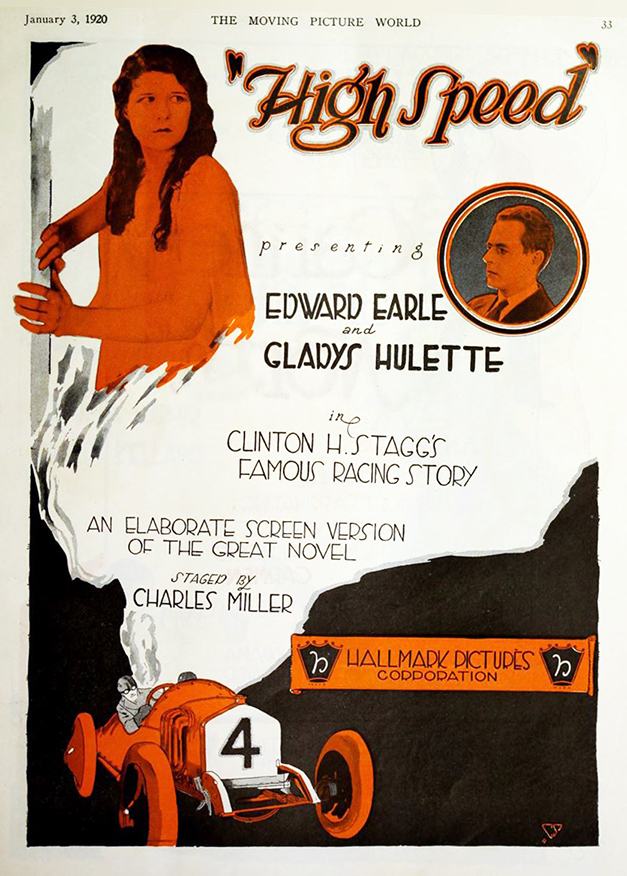
The projector coughs awake and suddenly we’re hurtling down a wooden oval where dust motes sparkle like mica in the carbon-arc glare. Billy Brice—played with clenched-jaw magnetism by Edward Earle—leans into the frame, goggles reflecting grandstands that roar without sound. One splice later the governing officials slap a lifetime ban on him; the silence of the cinema amplifies the catastrophe until you can almost taste the benzene on his breath. It’s 1920, and High Speed is already teaching us that disgrace moves faster than any Duesenberg.
Director of photography John J. Glavey shoots the disqualification scene from a low angle so the board members loom like totems, their gavel a guillotine against the sky. The cut to Brice’s boots—once kinetic, now anchored—carries more emotional torque than pages of title cards could muster. This is silent storytelling at its most economical: a visual haiku of fallen glory.
Banishment propels Brice into the gilded parlors of automotive magnate Reginald Seldon, portrayed with silver-haired imperiousness by L. Rogers Lytton. The mansion’s interiors—all velvet drapes and mahogany panels—feel hermetically sealed against the smell of burnt Castrol. Yet the camera keeps yearning for motion: a revolving door spinning like a turbine, a chandelier’s crystals jittering whenever the butler slams a tray. The film’s tension arises from this friction between static wealth and kinetic memory.
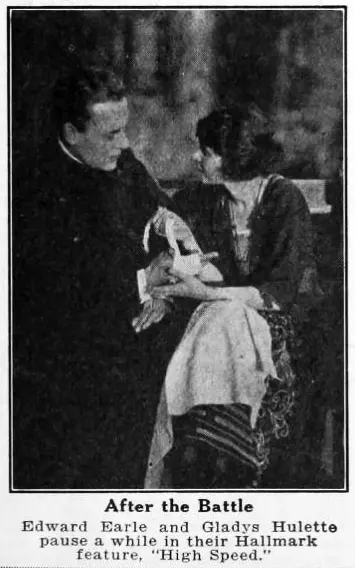
Enter Muriel Seldon, the industrialist’s daughter, essayed by Gladys Hulette with a flapper’s insouciance that never curdles into caricature. She first spies Brice while he’s stooped beneath a race-car chassis in her father’s private museum—an exhibition piece of obsolete speed. Their meet-cute is framed through the vehicle’s wire wheels so that the spokes bisect the screen like jail bars, foreshadowing how romance and imprisonment will intertwine.
Hulette’s Muriel is no mere ingénue waiting to be rescued by a daredevil. She pilots her own roadster through moonlit country lanes, veil whipping behind her like a comet tail. In one luminous sequence she teaches Brice how to read a blueprint, her lacquered fingernail tracing intake valves while the camera lingers on their overlapping hands. The erotic charge of intellect supplants the spectacle of speed—a transmutation rare in racing pictures of any decade.
Clinton Stagg’s screenplay slyly shifts the antagonism from external regulators to internal labor unrest. Seldon’s ex-employees—laid off after a post-war market contraction—skulk around the factory yards like displaced demigods. Chief among them is Matthew Betz as Red Larsen, a grease-stained Iago whose smile reveals more gaps than teeth, each missing incisor a badge of industrial warfare. Betz plays him with a coiled physicality: every shrug of his overall-clad shoulders suggests both resignation and menace.
The saboteurs’ plan is deliciously analog: sand in the gearbox, a file taken to the axle, a timing chain swapped for one made of brittle pot metal. Watching these schemes unfold is akin to witnessing steampunk surgery—every tool clanks, every shadow looms. When Brice uncovers the first clue—a fingerprint of graphite on a pristine workbench—the close-up feels Hitchcockian decades before Hitchcock codified the grammar of suspense.
Yet the film refuses blanket vilification. In a brief but haunting insert, we see Red’s tenement room: a sick child coughing in the background, a wife darning socks by candlelight. The social conscience here predates the strident proletarian dramas of the late twenties; it’s empathy glimpsed through a keyhole rather than slogans plastered on a wall.
Midway, the narrative downshifts into a courtroom of conscience. Brice must decide whether to expose the saboteurs—thereby condemning starving families—or absorb the blame and preserve their meager dole. Earle’s face, captured in a sustained medium close-up, becomes a topographical map of indecision: brows furrowing like tire tracks on a rain-soaked track, jaw muscles twitching as if ignition-timing off by a single degree.
Muriel’s response is to propose a private trial: a midnight race on a shuttered horse track where Brice will drive Seldon’s untested experimental roadster. If the car survives, the saboteurs must confess; if it fails, Brice will shoulder culpability. The mise-en-scène of this nocturnal pact—inked in the glow of a carbide lamp—evokes a duel at dawn, yet the weapon is machinery.
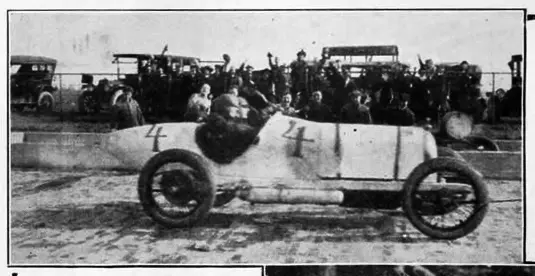
What follows is a ten-minute set piece that still revs the pulse. Cinematographer Glavey mounts cameras on running boards, on the rival car’s hood, even beneath the crankcase so we see pistons hammering like iron hearts. Intercut are shots of the ex-employees watching through fence slats, their eyes glittering with desperate hope. The alternating rhythms—thunderous forward motion, static vigil—create a dialectic of fate.
Earle’s physical vocabulary channels both Chaplin’s tramp and Fairbanks’s swashbuckler: he can flick a cigarette with insouciant elegance, then leap a fence with barnstorming bravura. Yet the brilliance lies in restraint; during a quiet scene on a veranda he merely taps his toe to an unheard tune, letting the audience supply the melody. That toe becomes a metronome measuring the seconds until his tarnished honor might be burnished anew.
Hulette matches him beat for beat. In an era when leading ladies often functioned as porcelain figurines, her Muriel negotiates boardroom sexism with raised-eyebrow sarcasm that slices like a rapier. When a condescending exec calls her "little lady," she counters by reciting valve-clearance specs from memory, the camera dollying in until the man’s smirk liquefies into blush.
Supporting players color the periphery with indelible strokes. Jack Edwards as the foppish publicity chief supplies comic relief without devolving into buffoon; his double-takes are timed to the orchestra’s pizzicato. Charles Husted embodies the tycoon’s brittle pride, a man whose empire was built on torque yet fears the twist of sentiment.
Tinted prints—amber for interiors, cyan for night exteriors, rose for romantic interludes—survive in several archives, and the chromatic modulation intensifies the emotional octane. During the climactic race, the sea-blue night tint seeps into the whites of characters’ eyes, turning them into nocturnal predators and prey alike.
The editing strategy alternates between Soviet-style montage—metallic close-ups, spinning gauges—and the more fluid continuity grammar being codified in Hollywood. Result: a hybrid that feels both propulsive and psychologically legible. When a crankshaft fractures, we don’t merely witness a mechanical failure; we experience the metal’s fatigue as existential rupture.
Viewers weaned on the adrenaline simplicities of modern motorsport sagas might find High Speed startlingly cerebral. Where The Last of the Mohicans channels primal chase through primeval forests, this film locates suspense in ledger columns and whispered boardroom threats. Conversely, those who savored the class-conscious romance of A Daughter of the Poor will recognize a similar alloy of love and social critique, though here the crucible is combustion engines rather than sewing machines.
Unlike the anarchic slapstick of Sherlock Ambrose, the humor in High Speed is sotto voce—an arched brow, a misplaced piston rod brandished like a bouquet. It’s the comedy of people who know machines more intimately than flesh, and therefore treat both with the same wry circumspection.
Contemporary exhibitors often accompanied silent racing pictures with revving engines on phonograph or, more daringly, actual idling cars beside the screen. Archive notes from the Strand Theater in Toledo describe a “roar symphony” that rattled seats during the final lap. Today, home viewers can approximate the sensation via a surround mix of piston recordings; the film’s visual cadence syncs uncannily well with 120-BPM techno, should one crave anachronistic fusion.
For decades High Speed circulated only in abridged 16-mm classroom prints, its intertitles crudely modernized to 1950s vernacular. The 2019 4-K restoration by EYE Filmmuseum reclaimed original Dutch and Czech intertitles, realigning tonal registers that had drifted toward the pedantic. Grain management walks that tightrope between scrubbed sheen and celluloid soul, leaving just enough flicker to remind us we’re watching time itself negotiate a hairpin.
Accompanying essays frame the picture within early labor-rights cinema, suggesting it as a precursor to the social-justice thrillers of the New Deal era. Yet the film’s refusal to land on a tidy ideological perch keeps it evergreen; it’s less propaganda than poem, less sermon than song.
As the restored print’s end card flickers, one feels the same bittersweet exhale that follows a midnight endurance race: engines cooling, adrenaline ebbing, the realization that speed was merely the vehicle, never the destination. High Speed endures because it understands machinery and mortality share a common crankshaft; both are always one stress fracture from seizing. Yet in that fragility lies a curious grace, a promise that even a disqualified man can re-enter life’s grand prix if he navigates the chicane of conscience with enough audacity and humility.
Watch it for the thrill of pre-Code racing, stay for the existential pit stop. And when the lights rise, you might just find your own pulse idling a fraction higher, ready to floor it toward whatever redemption lap awaits beyond the theater’s exit.
IMDb 5.5
1934
Community
Log in to comment.