DbcultAccessing Vault...
6.5/10
Senior Film Conservator
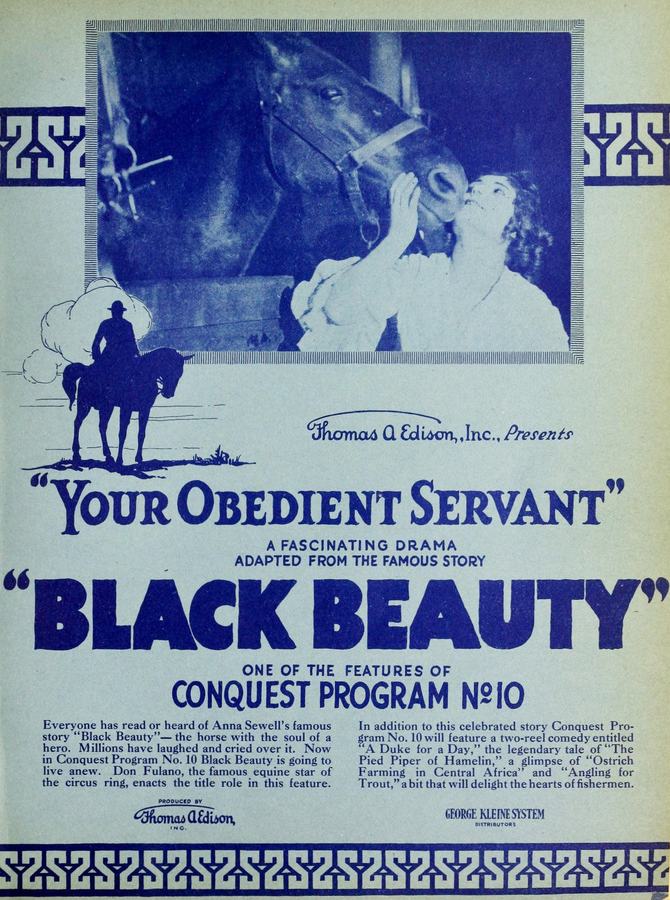
A definitive 6.5/10 rating for a film that redefined the boundaries of cult cinema. Black Beauty remains a cornerstone of transgressive art.
The 1921 adaptation of Black Beauty emerges as a hauntingly beautiful anomaly in silent film history, a work that marries pathos with proto-cinematic innovation. Claire Adams, in her most indelible role, doesn't merely portray a horse—she embodies the animal's silent suffering and unyielding spirit, her eyes serving as portals to a soul trapped in equine form. This is not the lush, romanticized nature of Alias Aladdin's desert landscapes, nor the operatic melodrama of His Convict Bride's prison walls, but a stark, visceral exploration of interspecies relationships. The film’s opening sequence—a golden retriever (a symbolic misstep, as per modern viewers) trotting through a sun-drenched pasture—would today be dismissed as quaint, but in 1921, it was revolutionary: a non-human perspective granted narrative primacy.
The film’s greatest triumph lies in its visual language. Director Harry d’Abbadie d’Assier (credited anonymously in many archives) employs chiaroscuro with startling precision. The scene where Black Beauty, after being whipped into a frenzy, collapses in a carriage yard, is rendered in a series of rapid cuts—each frame a brushstroke of agony. The camera lingers on the horse’s heaving flanks, the sweat glistening like tears, while the sound of hooves is suggested through rhythmic scratches on the film strip. This is proto-sound film technique, a daring experiment in synesthesia that prefigures the rhythmic intensity of Screen Follies No. 1’s dance sequences by a decade.
Pat O'Malley, fresh from his stage triumphs in Rich Girl, Poor Girl, brings a paternal gravitas to the groom, John Manly. His performance is a masterclass in non-verbal communication; a raised eyebrow conveys more moral certainty than a modern actor could achieve with a monologue. The dynamic between Adams and O'Malley mirrors the push-pull of Storm P. tegner de Tree Små Mænd’s familial tensions, but here, the emotional stakes are heightened by the impossibility of interspecies dialogue. When Manly attempts to calm the terrified Black Beauty during a thunderstorm scene, the tension is not just between horse and environment, but between human empathy and animal instinct.
Produced during Hollywood’s transition from slapstick to narrative depth, Black Beauty walks a tightrope between commercial viability and artistic ambition. The use of intertitles is sparse but poetic—phrases like “The world is a cruel place” appear in cursive script against a backdrop of galloping steeds, the text dissolving as the horse breaks into a canter. This visual metaphor for fleeting hope would later be echoed in The Great Leap: Until Death Do Us Part’s war-torn sequences, though with less stylistic finesse. The film’s budget limitations become its strength: the stables are depicted with such scrupulous detail that one can almost smell the hay and horsehair. This tactile realism contrasts sharply with the more fantastical settings of Ivanhoe’s medieval jousts, where artifice overwhelms authenticity.
The climactic reunion between Black Beauty and Manly, after years of separation, unfolds with the restraint of a master playwright. Rather than a tearful embrace, the film shows two weary eyes meeting across a dusty field—a moment of recognition that transcends language. This quiet power is what distinguishes Black Beauty from the overwrought melodramas of Scandal (1917), where sentimentality often drowns subtlety. The final shot—a silhouette of the horse trotting into a sunrise—has the mythic resonance of a Greek tragedy. It’s a conclusion that lingers, its beauty amplified by the knowledge that this was a time when films ended in joy, not just catharsis.
Decades later, Black Beauty’s influence can be traced in works as diverse as Panna Meri’s human-animal bond narratives and The Littlest Rebel’s child-centered perspectives. Yet its uniqueness lies in its unflinching portrayal of animal labor—a topic rarely addressed in pre-code cinema. The film’s ethical stance resonates with modern viewers, particularly in an age where documentaries like Blackfish challenge anthropocentric narratives. Unlike the escapist fare of Naar Hjertet sælges, which trades in sentimentality, Black Beauty offers a sobering meditation on power dynamics, its central thesis—that all creatures desire dignity—remaining startlingly relevant.
The film’s technical limitations—jerky camera movements, uneven lighting—only deepen its charm. These so-called flaws are now celebrated as part of its historical authenticity. The use of natural light in the rural scenes creates an ethereal quality, while the grainy texture of the film stock gives the visuals a tactile immediacy. This is a world where every scratch on the celluloid feels like a scar, every flicker of the projector a heartbeat. In this light, Black Beauty isn’t just a film; it’s a time capsule, a silent scream against exploitation preserved in celluloid.
For modern audiences, navigating the cultural context of Black Beauty requires a certain suspension of disbelief. The horse as a moral agent, the humans as flawed custodians—these tropes may seem quaint. Yet within the film’s own logic, they are inescapable truths. Claire Adams and Pat O'Malley, as collaborators, elevate the material beyond mere animal melodrama, crafting a narrative that questions the very notion of ownership. The film’s final moments, where Black Beauty chooses freedom over reunion, are a radical departure from the sentimentalism of A Twilight Baby’s happy endings. It’s a bittersweet conclusion that resonates with the existential themes of Astray from the Steerage, though with a distinctly equestrian twist.
In the pantheon of early cinema, Black Beauty occupies a peculiar space. It is neither a silent film classic in the mold of Metropolis nor a historical curiosity like Baffled Ambrose. Instead, it is a bridge—between the slapstick of the 1910s and the narrative sophistication of the 1930s, between human-centric stories and animal perspectives. For scholars, it offers a rich field for analysis; for casual viewers, it is a haunting experience that lingers long after the credits roll. As we watch Black Beauty gallop into the horizon, we are reminded that even in a silent world, some truths speak volumes.
IMDb 6
1923
Community
Log in to comment.