DbcultAccessing Vault...
Cult Review
Senior Film Conservator
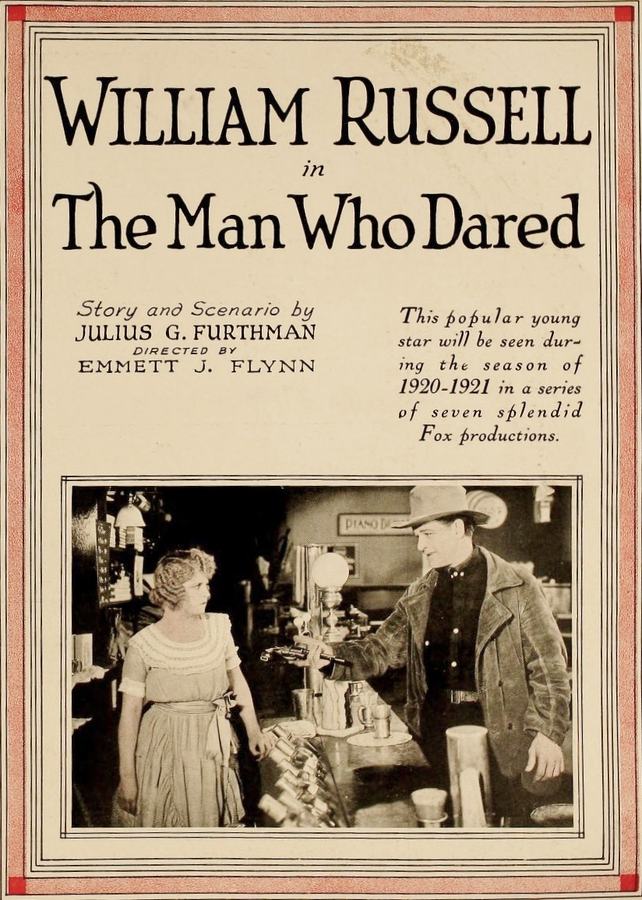
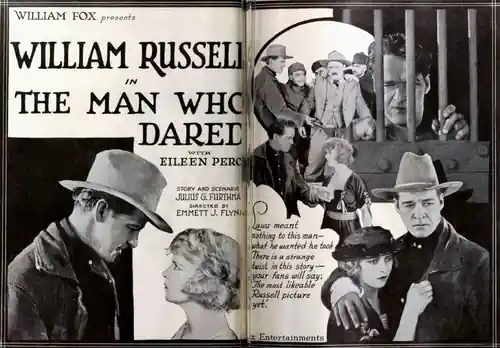
The first time I saw The Man Who Dared it was a battered 16 mm print flickering against a brick wall in a back-alley cine-club; the projector rattled like a bad cough, yet the images—motes of silver swimming through tar—felt like trespassing inside someone’s cathedral of private wounds. Jules Furthman’s script, usually a sly jazz of underworld patter (Mr. Fix-It), here strips itself to a raw nerve: a father’s forged signature becomes a death warrant for innocence, a sheriff’s badge morphs into a bridal price tag, and the jailhouse becomes the chrysalis where cynicism molts into something perilously close to grace.
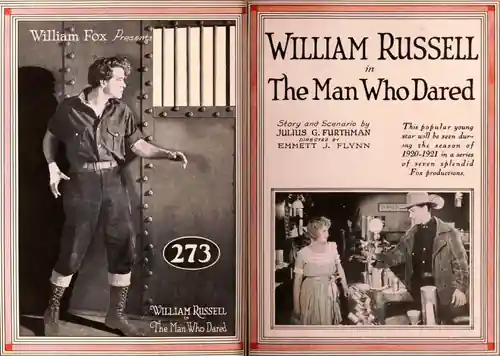
William Russell’s Jim Kane enters the frame all cocked hat and reckless grin, the kind of cowboy who believes revolvers are merely loud metaphors for virility. Watch how Russell’s shoulders telegraph the arc: pre-arrest swagger collapses into a stoop so abrupt you hear vertebrae apologize. The performance is silent, yet the eyes—those dark, incredulous saucers—scream louder than any intertitle when the Italian carver, played by Fred Warren with hands that seem sculpted from the same limestone he chips, begins his nocturnal crucifixion. The jail set is a murk of cross-hatched shadows; cinematographer Frank D. Williams shoots through bars so that the stripes themselves feel like a moral barcode stamped on every soul.
The miracle sequence arrives without fanfare—no irised dissolve, no heavenly choir of orchestra. One moment the stone-cutter slumps, chalk dust ghosting his beard; the next, a figure of uncanny stillness, face obscured by a corona of over-exposure, kneels to wipe the man’s brow. The cut is invisible, the illusion immaculate. In that heartbeat the celluloid itself seems to inhale; the audience I sat with—mostly jaded grad students clutching artisanal lattes—went so quiet I could hear the projector’s sprockets perforating time. It is the rare cinematic theophany that earns its gasp, a moment that sidesteps denominational kitsch and lands instead in the territory of raw, existential shock.
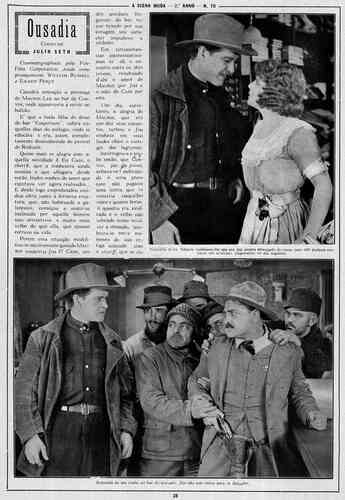
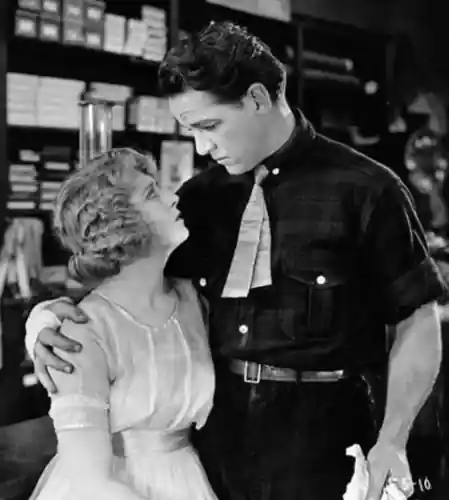
Eileen Percy’s Mamie Lee could have been mere bargaining chip, yet she weaponizes fragility. Notice how her fingers worry the hem of her gingham dress whenever Cass looms—anxious semaphore that betrays the steel underneath. When she finally brandishes the sheriff’s confession, the paper trembles not from fear but from the voltage of retribution. The film refuses a jubilant vindication; her lips part, yet no smile arrives, only the dawning nausea that justice and grief are conjoined twins.
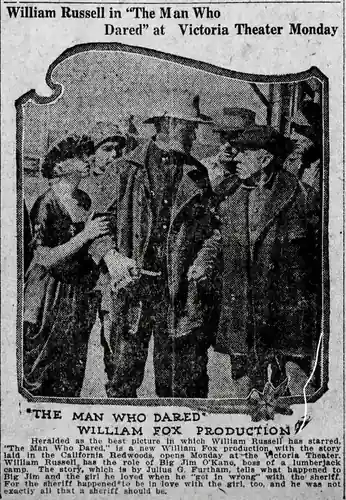
Frank Brownlee’s Sheriff Cass is the kind of villain who polishes his star each morning while rehearsing alibis in the mirror. Brownlee lets a vein pulse just above his collar—metronomic testimony to the man’s self-loathing—so that when the final pistol shot detonates, the suicide feels less like melodrama and more like a ledger balanced in blood. The staging is merciless: camera holds on his boots twitching in a shaft of dust, then tilts up to the wanted posters fluttering like unheeded scripture on the wall.
Compare this moral anatomy to Weltbrand’s continental nihilism or Othello’s jealous miasma, and you realize how uniquely American the film’s redemption arc remains: salvation neither bestowed by church nor state, but hammered out in a privatized hell where a man converses with stone and emerges reborn.
The picture’s detractors—yes, they exist, mostly among the “silent-film-equals-primitive” crowd—argue the conversion subplot arrives deus-ex-machina. I counter: the miracle is seeded early, in the way Jim watches a sparrow hop between jail bars, longing writ large on his face. Furthman’s structure is a stealth parable: every betrayal tightens the screws until transcendence becomes the sole aperture left for oxygen.
Visually, the palette is a bruised triptych: umber prairie, jaundiced lamplight, and the spectral white of the Christ-statue that seems to drink all available moral light. The tinting—original prints used amber nights and cobalt dawns—survives only in fragmentary form, yet even the black-and-white dupe carries a bruised resonance. When the statue’s arm shears off during the artisan’s collapse, the fracture feels like a deliberate iconoclasm, a reminder that divinity often enters through the broken place.
Lon Poff’s turn as the hangman, a beanpole in a stovepipe hat, supplies gothic levity. He measures necks with a tailor’s tape, humming hymns off-key as if salvation were merely a matter of correct proportions. His presence amplifies the absurdity of civic ritual: state-sanctioned murder dressed in Sunday rhetoric.
Joe Ray’s saloon keeper—another cog in Cass’s graft machine—delivers a single, devastating reaction shot when the safe is cracked open: greed, panic, and the faintest shimmer of remorse ripple across his jowls in the span of three flickers. Silent cinema at its apex traffics in such micro-ballets of physiognomy.
The resurrection coda—Jim and Mamie Lee walking into open prairie while the town recedes—avoids the iris-out kiss cliché. Instead, Furthman freezes on their clasped hands, the fingers interlaced like lashed railroad ties attempting to hold the entire rattling continent together. No title card pronounces “The End”; the film simply runs out, as though history itself ran out of tolerance for their story.
Restoration-wise, the surviving elements are spotty: Gosfilmofond holds a 35 mm nitrate with Russian intertitles, while a private collector in Nebraska shelters a 28-minute abridgement with English cards that read like haikus translated back from Japanese. Both versions circulate in murky digital rips on gray-market sites; a proper 2K restoration feels as urgent as reclaiming a lost gospel. Imagine those calcium-bright close-ups scrubbed of emulsion bloom, the prairie horizons re-graded so that every blade of grass resembles a quiver of moral antennae.
Sound, or its absence, is another canvas. I screened it once with a live trio improvising around a doom-folk motif—dulcimer, bowed stand-up bass, whispered field recordings of Oklahoma wind. When the apparition scene hit, the musicians dropped to breath and bow-scrape, letting the projector’s mechanical flutter become the holy drone. The audience wept unashamedly; silence had become the loudest instrument.
Comparative footnote: The Daughter of MacGregor offers a Scottish lilt of familial feud, yet never interrogates the scaffold of belief; Mountain Law flirts with vigilante justice but retreats into pulp sensationalism. Only The Man Who Dared has the gall to stage a miracle inside a republic still inventing its own mythology, and then to leave the miracle unexplained.
Gender politics, admittedly, wobble. Mamie Lee’s body is the original IOU; the narrative’s tension depends on that commodification. Yet the closing image—her leading Jim out of town—suggests a subtle recalibration: she possesses the moral document, the epistemological key, while he carries only fresh-scrubbed faith and the shirt on his back. Power, tethered to paper and choice, quietly swaps genders without a lecture.
Modern viewers allergic to overt religiosity might still find relevance in the film’s core engine: how does one rebuild identity after being hollowed out by injustice? The answer here is neither therapy nor revenge, but an encounter with radical otherness that reframes the question entirely. In an era of algorithmic echo chambers, that proposition feels downright subversive.
Criterion, Kino, BFI—whoever claims the rights—should prioritize this orphaned masterpiece. Market it as the missing link between Moral Suicide’s urban despair and Woman’s proto-feminist assertion. Commission an essay from a prison-reform theologian; commission a second from an atheist philosopher. Let them argue across booklet pages, mirroring the film’s own dialectic between nihilism and beatitude.
Until then, seek out any shard you can find. Squint through the hiss of 96-year-old emulsion, and you may yet glimpse that trembling silhouette—Christ or hallucination, who knows—bending to kiss the brow of a man who spent the night carving divinity out of refuse. In that fraught, flickering contact lies the entire American experiment: condemned men, salvaged by impossible light, staggering toward a horizon still gambling on the idea that anyone, even the damned, can begin again.
IMDb 5.8
1936
Community
Log in to comment.