DbcultAccessing Vault...
Cult Review
Senior Film Conservator
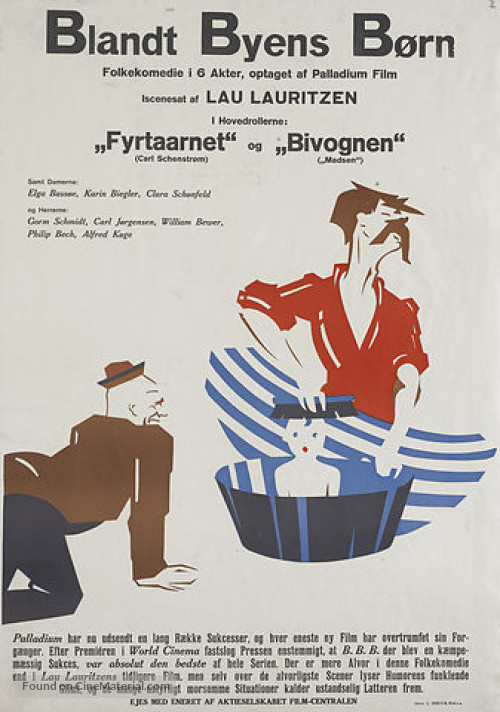
In the annals of silent cinema, where grand epics often overshadow quieter, more introspective narratives, A.V. Olsen's 'Blandt byens børn' (Among the Children of the City) emerges not with a roar, but with a profoundly affecting whisper. This Danish production, a testament to the era's burgeoning social consciousness and its capacity for visual poetry, invites us into a world that is at once starkly realist and imbued with a melancholic lyricism. It's a film that, despite the passage of decades, speaks with an arresting clarity about the human condition, the stark divisions of urban life, and the indomitable spirit of its most vulnerable denizens.
The narrative, penned with a keen eye for human drama by A.V. Olsen, unfolds in the bustling, often indifferent, streets of Copenhagen. Our primary guide through this urban labyrinth is Anya, portrayed with astonishing sensitivity by Else Vermehren. Vermehren's performance is a masterclass in silent acting, her expressive eyes and delicate gestures conveying a world of fear, hope, and fierce protectiveness. She embodies the quintessential 'child of the city' – resilient yet fragile, perpetually on the precipice of despair but clinging to a sliver of optimism. Her younger brother, Erik, brought to life by Gorm Schmidt, is a poignant counterpoint, his innocence a fragile flame threatened by the harsh winds of poverty and illness.
The film's strength lies not only in its central figures but also in the rich tapestry of supporting characters who populate Anya and Erik's world. Harald Madsen, renowned for his comedic partnership with Carl Schenstrøm, delivers a surprisingly nuanced and deeply affecting performance as Lars, the eccentric street peddler. Madsen, usually seen as the taller, more earnest half of a slapstick duo, here channels his inherent warmth into a character burdened by his own quiet struggles, yet whose compassion for the children shines through every weary gesture. It’s a performance that adds significant emotional depth, proving Madsen's range extended far beyond mere japes. One might even draw a parallel to the nuanced humanity found in characters from films like The Halfbreed, where unexpected tenderness emerges from unlikely figures.
The contrast between the children's plight and the city's affluence is starkly drawn through the figures of Mr. Valdemar, played with chilling hauteur by Philip Bech, and his equally aloof wife, essayed by Elga Bassøe. Bech's portrayal of the industrialist is a study in detached power, his every movement exuding an air of self-importance that renders him oblivious to the suffering just beyond his gilded windows. Bassøe, too, captures the essence of a woman cocooned in luxury, her polite indifference more cutting than overt malice. Their performances are crucial in establishing the societal critique that subtly underpins the narrative.
Yet, 'Blandt byens børn' is not without its glimmers of human kindness. Kate Fabian, as Mrs. Jensen, the struggling but benevolent seamstress, offers a much-needed counterpoint to the city's colder elements. Fabian imbues Mrs. Jensen with a quiet dignity and a maternal warmth that resonates profoundly, providing a sanctuary, however temporary, for Anya and Erik. Her character reminds us that even in the bleakest of circumstances, empathy can flourish. William Bewer, as the stern but ultimately observant police officer, and Alice O'Fredericks, as the sympathetic social worker, represent the awakening conscience of the community. Their initial detachment gives way to a dawning understanding, demonstrating the film's belief in the potential for collective action and compassion.
The cinematography of 'Blandt byens børn' is remarkable for its time, employing evocative street scenes that capture the chaotic energy and stark beauty of urban life. The director masterfully uses chiaroscuro lighting to highlight the shadows that cling to the children's lives, contrasting them with the brighter, unattainable world of the wealthy. The camera often lingers on faces, drawing the audience into the emotional core of the characters, a technique that allows the silent performances to speak volumes. The visual language is sophisticated, eschewing overly theatrical gestures for a more grounded, naturalistic approach, while still maintaining the heightened expressiveness characteristic of the era. This visual acuity allows the film to convey its complex themes without relying heavily on intertitles, a hallmark of truly accomplished silent filmmaking. The way the city itself becomes a character, both a source of hardship and a backdrop for human connection, is reminiscent of the urban landscapes depicted in films like The Firing Line, where the environment plays a crucial role in shaping destinies.
A.V. Olsen's screenplay delves into themes that remain alarmingly relevant today: poverty, social inequality, and the moral responsibility of a community towards its most vulnerable members. The film doesn't shy away from depicting the harsh realities faced by children in an indifferent society, yet it never descends into gratuitous melodrama. Instead, it maintains a delicate balance, presenting the struggles with a dignified realism that makes the moments of kindness all the more impactful. The illness of Erik serves as the narrative's central catalyst, propelling Anya into increasingly desperate measures, ultimately leading to a confrontation that forces the privileged to confront the consequences of their detachment. This exploration of desperation and survival echoes the gritty realism found in contemporaneous works like O Crime dos Banhados, though with a distinct Scandinavian sensibility.
What distinguishes 'Blandt byens børn' from many of its contemporaries is its nuanced approach to morality. There are no clear-cut villains or heroes in the traditional sense. Even the 'villainous' Mr. Valdemar is portrayed more as a product of his class and circumstances than an inherently evil individual. His indifference is a systemic failing, a reflection of a society that has normalized vast disparities. The film's resolution, too, eschews a neat, saccharine ending. Instead, it offers a more profound and realistic conclusion: a quiet, collective awakening, a dawning realization within the community that the responsibility for its 'children' rests with everyone. It's a powerful statement that resonates long after the final frame.
The ensemble cast contributes significantly to this intricate portrayal. Clara Schønfeld and Carl Schenstrøm, though perhaps in smaller roles, lend their considerable presence, adding texture to the urban landscape. Karin Biegler, Alfred Kjøge, and Vera Esbøll, too, contribute to the film's rich human tapestry, each portraying their characters with a conviction that grounds the narrative in a palpable reality. Even minor characters feel fully fleshed out, contributing to the overall verisimilitude of the world Olsen has created. This meticulous casting and direction ensure that no performance feels extraneous, each actor serving the overarching thematic goals with dedication.
'Blandt byens børn' is a film that deserves to be rediscovered and celebrated. It's a powerful reminder of silent cinema's capacity for profound social commentary and emotional depth. While it might lack the epic scale of some grander productions, its intimate focus on human struggle and resilience gives it an enduring power. It speaks to the universal experience of childhood vulnerability and the perennial challenge of fostering a compassionate society. Its exploration of urban alienation and the search for connection makes it a timeless piece of art, standing proudly alongside other socially conscious dramas of its era, perhaps even surpassing some in its quiet intensity. The film’s ability to evoke empathy and provoke thought without resorting to heavy-handed exposition is a testament to the skill of its creators.
In an age where cinematic spectacle often prioritizes sensation over substance, 'Blandt byens børn' offers a refreshing counter-narrative. It's a film that trusts its audience to engage with its characters on a deeper level, to feel their joys and sorrows, and to contemplate the larger societal implications of their plight. It's a quiet masterpiece, a jewel of Danish silent cinema that continues to resonate with its deeply human story. Its relevance hasn't faded; if anything, its message about community, empathy, and the well-being of the next generation feels more urgent than ever. The film, much like Little Miss Rebellion, captures the spirit of defiance and vulnerability in youth, but with a more grounded, starkly realistic lens.
For cinephiles and historians alike, 'Blandt byens børn' offers a fascinating glimpse into the social concerns and artistic sensibilities of early 20th-century Denmark. It's a film that, despite its age, feels remarkably contemporary in its themes and its emotional impact. The meticulous restoration efforts, if any have been undertaken, would undoubtedly reveal even more of its subtle visual artistry, allowing new generations to appreciate its profound beauty and timeless message. It's a film that challenges us to look beyond the surface, to see the humanity in every face, and to understand that the strength of a city is truly measured by how it cares for 'its children'. The understated power of the film's conclusion, leaving the audience with a sense of quiet reflection rather than explosive resolution, is a testament to its artistic integrity and lasting impact.
Ultimately, 'Blandt byens børn' is more than just a historical artifact; it's a living, breathing testament to the power of cinema to reflect, critique, and inspire. Its characters, though silent, speak volumes through their expressions and actions, etching themselves into the viewer's memory. It’s a film that reminds us of the profound impact that a well-told story, anchored by compelling performances and thoughtful direction, can have, transcending the barriers of time and language. The poignant journey of Anya and Erik, guided by the nuanced vision of A.V. Olsen and brought to life by a dedicated cast, ensures that this Danish silent film maintains its rightful place as a significant work of cinematic art. It stands as a powerful argument for the enduring value of humanistic storytelling in an ever-changing world.

IMDb 1
1925
Community
Log in to comment.