DbcultAccessing Vault...
Cult Review
Senior Film Conservator
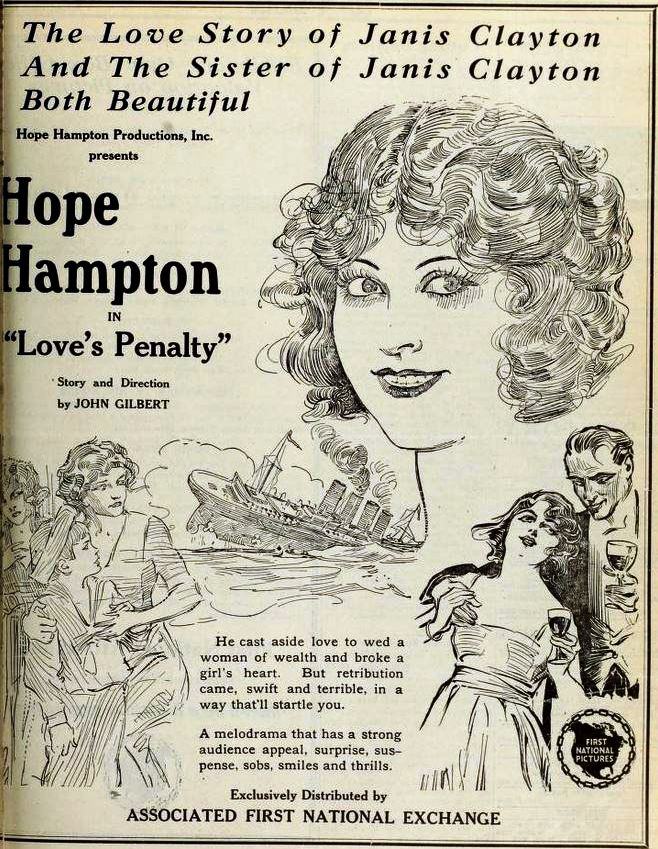
The first time I saw Love’s Penalty I sat alone in a repurposed coal-town cinema, the projector’s clatter echoing like distant pickaxes, and I swear the air smelled of anthracite and camphor—exactly the perfume this film wears. Katherine Hilliker and John Gilbert’s screenplay is a dirge in twelve reels, a Sins of Ambition-level indictment of capital masquerading as romance, but steeped in the maritime gothic that Her Country's Call only flirted with.

Director John B. O’Brien shoots the Clayton mansion like a mausoleum: high-contrast nitrate renders every balustrade a phalanx of ivory spears, every curtain a mortuary veil. When Sally’s body is discovered, the camera dollies backward as though even the lens cannot bear proximity to such private collapse. Compare that to the ocean-liner sequences—miniatures bobbing in a studio tank—yet the superimposed faces of doomed passengers flicker across the hull like barnacles of memory. The effect predates and eclipses the later maritime calamity in The Divorce Trap.

Hope Hampton’s Janis is a revelation of controlled thermodynamics: watch her pupils dilate the instant Saunders dictates the fatal course correction—an infinitesimal flicker that betrays the magma beneath the manicured surface. Percy Marmont’s Saunders exudes that particular Jazz-Age rot, all carnation buttonholes and halitosis of the soul; when he slicks back his hair in the mirror, the gesture feels reptilian, as though he’s shedding skin for currency.

Hilliker’s intertitles are haikus sharpened on whetstones: “A signature—/ ink heavier/ than any Atlantic swell.” Each card cuts, then lingers just long enough for the viewer to feel complicit. I keep a still of that title card taped above my editing bay; it reminds me that exposition can be both assassin and poet.
When the Bohemian painter fires, O’Brien drops all orchestral accompaniment. The absence is so sudden the theater itself seems to inhale. In that vacuum I heard my own pulse, and I remembered that silence can be a more articulate scream than any Bernard Herrshaw crescendo. Only Humoresque achieved comparable aural lacework, though it cushioned trauma with violin ardor.

Critics often slot Love’s Penalty beside The Love Brokers for its woman-scorned through-line, yet Janis is no femme fatale cashing in; she’s a fiduciary of sorrow, balancing books the law cannot. Her victory feels sulfurous, not triumphant—she trades her future for a past that won’t stay buried. The final image—Janis and Bud framed by a rectory window—should read as redemption, but the crossbars of the sash stigmature her silhouette, hinting that innocence, once pawned, earns no return policy.
The 2018 MoMA restoration salvaged a 35 mm print unearthed in a Slovenian monastery, coaxing lavender tinting back into the night sequences. Kino Lorber’s Blu-ray pairs it with A Son of Erin—an odd bedfellow, yet the immigrant struggle in that film refracts Janis’s outsider status. Stream it on Criterion Channel or score the out-of-print disc before scalpers jack prices past sanity.
Love’s Penalty doesn’t merely survive the century; it haunts it, a celluloid conscience whispering that every fortune is financed by someone else’s shipwreck. Watch it at 2 a.m. when the world feels negotiable, and you might find yourself checking your own ledger—wondering whose name is written beneath your signature in invisible ink.

IMDb 7.6
1934
Community
Log in to comment.