DbcultAccessing Vault...
Cult Review
Senior Film Conservator
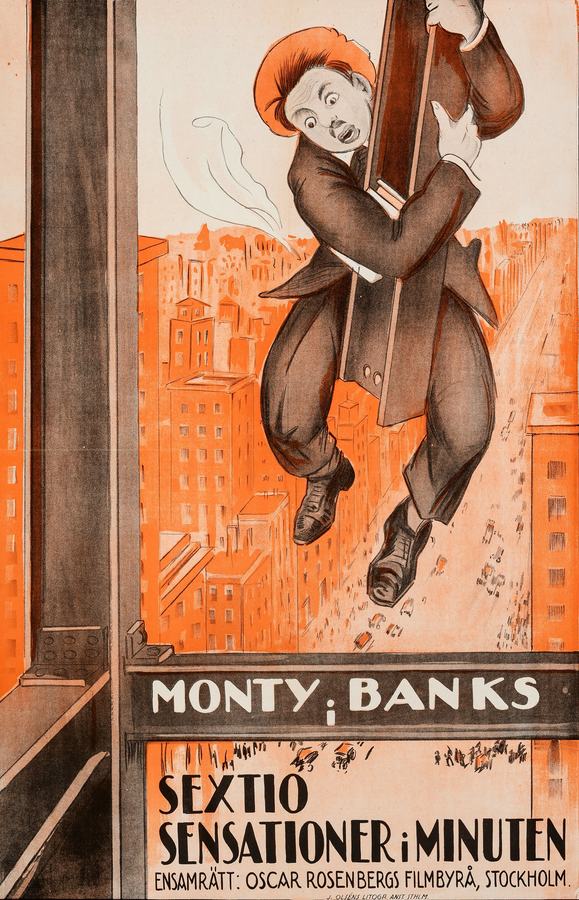
The year 1920 exists in the collective cinematic consciousness as a vibrant threshold, a moment when the grammar of film was shedding its primitive infancy and embracing a sophisticated, albeit silent, maturity. Within this fertile landscape, Monty Banks emerged not merely as a comedian, but as a structural engineer of chaos. His short, His Dizzy Day, is a masterclass in the geometry of the gag, a film that utilizes the burgeoning skyline of the American city as its primary antagonist and playground.
While the broader public often gravitates toward the stoic pathos of Keaton or the everyman optimism of Lloyd, Monty Banks—born Mario Bianchi—cultivated a frantic, almost desperate energy that felt uniquely attuned to the anxieties of the post-war era. Unlike the heavy political undertones found in contemporaries like The Prussian Cur, Banks’ work in His Dizzy Day sidesteps overt propaganda in favor of a visceral, physical existentialism. The film’s obsession with height and the fragility of the human form against the steel and stone of progress reflects a society hurtling toward modernity at breakneck speed.
The narrative structure of His Dizzy Day is deceptively linear. It begins with the mundane, only to systematically dismantle the protagonist's dignity through a series of increasingly improbable physical challenges. Banks possesses a peculiar elasticity; his body seems to respond to gravity not as a law, but as a suggestion. This is particularly evident in the sequences involving unfinished construction—a motif that would become a staple of the era, yet here it feels fresh, raw, and genuinely perilous.
To understand the impact of His Dizzy Day, one must look at the surrounding cinematic ecosystem. While films like The Woman Suffers were exploring the depths of social injustice through heavy melodrama, Banks was finding truth in the absurdity of the physical world. There is a stark contrast between the internal turmoil of a film like The Unveiling Hand and the externalized, explosive energy of Banks’ stunts. Where others sought to reflect the soul, Banks sought to test the limits of the vertebrae.
In the global context, 1920 was a year of profound artistic divergence. While the German industry was producing works of stark national identity like Germania, and the Japanese influence was being felt in titles like Die Japanerin, the American slapstick tradition was perfecting a universal language. His Dizzy Day requires no intertitles to convey the sheer terror of a man dangling from a ledge or the frantic confusion of a botched romantic encounter. It is a cinema of the lizard brain, reacting to movement, height, and the sudden cessation of momentum.
Technically, the film is a marvel of its time. The cinematography captures the dizzying heights with a clarity that must have been genuinely shocking to audiences of 1920. The use of perspective is not merely a gimmick; it is the central theme. We see the city not as a collection of homes and businesses, but as a labyrinth of potential falls. This preoccupation with the vertical is a fascinating counterpoint to the wide-open, horizontal expanses found in The Law of the Yukon, which also debuted that year. While the latter found drama in the vastness of nature, Banks found it in the claustrophobia of the urban heights.
Banks’ performance is characterized by a frantic sort of grace. He does not possess the "Great Stone Face" of Keaton, nor the athletic prowess of Fairbanks. Instead, he has a jittery, high-strung persona that makes the danger feel more immediate. When he stumbles, it feels less like a choreographed dance and more like a genuine accident caught on celluloid. This sense of unpredictability is what elevates His Dizzy Day above the standard two-reeler fare of the period.
Beneath the surface-level comedy, there is a subtle skewering of class and decorum. Banks often plays a character striving for a status that is perpetually out of reach, mirrored by his physical struggle to maintain balance. This thematic thread can be seen in other 1920 releases like Madcap Madge, where social rebellion is treated with a lighter, more feminine touch. In Banks’ world, however, rebellion is not a choice—it is a byproduct of a world that refuses to let him stand still.
The film also touches upon the burgeoning industrialism that was reshaping the American landscape. The construction site is not just a setting; it is a character. The girders, the pulleys, and the cement mixers are all agents of chaos. This mechanical malevolence is a precursor to the more overt social critiques seen in later silent masterpieces, yet here it is presented with a joyous, anarchic spirit. It lacks the cynicism of The Merry-Go-Round, opting instead for a celebratory destruction of order.
Why does His Dizzy Day resonate over a century later? It is perhaps because the sensation of being "dizzy"—of being overwhelmed by the pace of change and the precariousness of one's position—is more relevant now than ever. Banks’ frantic scramble across the face of a building is a perfect metaphor for the modern condition. We are all, in a sense, dangling from a metaphorical girder, hoping the next move doesn't lead to a freefall.
The film’s pacing is relentless. From the opening moments to the final, breathless climax, there is a commitment to escalating stakes. It avoids the narrative lulls that plague many of its contemporaries, such as the somewhat plodding development in Helene of the North. Banks understands that in comedy, momentum is everything. To stop is to fail. This philosophy is evident in every frame, every frantic gesture, and every narrow escape.
Furthermore, the film serves as a vital historical document of Los Angeles in its formative years. The glimpses of the city beneath Banks as he performs his stunts provide a hauntingly beautiful look at a world that has long since vanished. The dusty streets, the nascent skyscrapers, and the fashion of the passersby all add a layer of unintended poignancy to the hilarity. It is a time capsule wrapped in a joke.
One cannot discuss His Dizzy Day without acknowledging the sheer bravery of the performers. In an era before green screens and sophisticated safety harnesses, the stunts seen here were often terrifyingly real. The lack of artifice lends the film a weight that modern action-comedies often lack. When we see Banks lose his footing, there is a primal reaction in the viewer because we know, on some level, that the danger was tangible. This authenticity is what separates the greats from the merely competent.
The editing, too, deserves praise. The rhythmic cutting between the close-ups of Banks’ panicked expressions and the wide shots of his precarious position creates a sense of tension that is almost Hitchcockian. It is a sophisticated use of the medium that shows how quickly filmmakers were learning to manipulate the audience's heart rate. This is a far cry from the more static, stage-like presentations of early cinema, such as the Hungarian production A Gög or the British traditionalism of Tom Brown's Schooldays from the same period.
The cinematic output of 1920 was incredibly diverse, ranging from the Turkish historical drama Alemdar Mustafa Pasa to the Swedish domestic comedy En hustru till låns. Amidst this global explosion of storytelling, His Dizzy Day stands out for its purity of purpose. It doesn't seek to educate or to moralize; it seeks to evoke a physical response. It is as much a workout for the viewer as it is for Banks.
Even when compared to the documentary-style fascination of Rescue of the Stefansson Arctic Expedition, Banks’ film feels strangely more "real" because it captures a universal human experience—the fear of falling. While the Arctic expedition documents a specific, extraordinary event, Banks documents an extraordinary reaction to a common fear. This universality is why silent comedy has traveled so well across borders and through time.
In the end, His Dizzy Day is a celebration of the human spirit's resilience. No matter how many times Banks falls, no matter how many times the world tries to shake him off, he keeps moving. He keeps climbing. There is a profound, albeit hilarious, dignity in his struggle. He is the Everyman as Acrobat, the Fool as Philosopher.
For those looking to understand the roots of physical comedy, or for those who simply wish to marvel at the audacity of early cinema, His Dizzy Day is essential viewing. It is a reminder that before there were superheroes, there were men in straw hats and suits, risking everything for a laugh and a few feet of film.
IMDb 6.9
1928
Community
Log in to comment.