DbcultAccessing Vault...
Cult Review
Senior Film Conservator
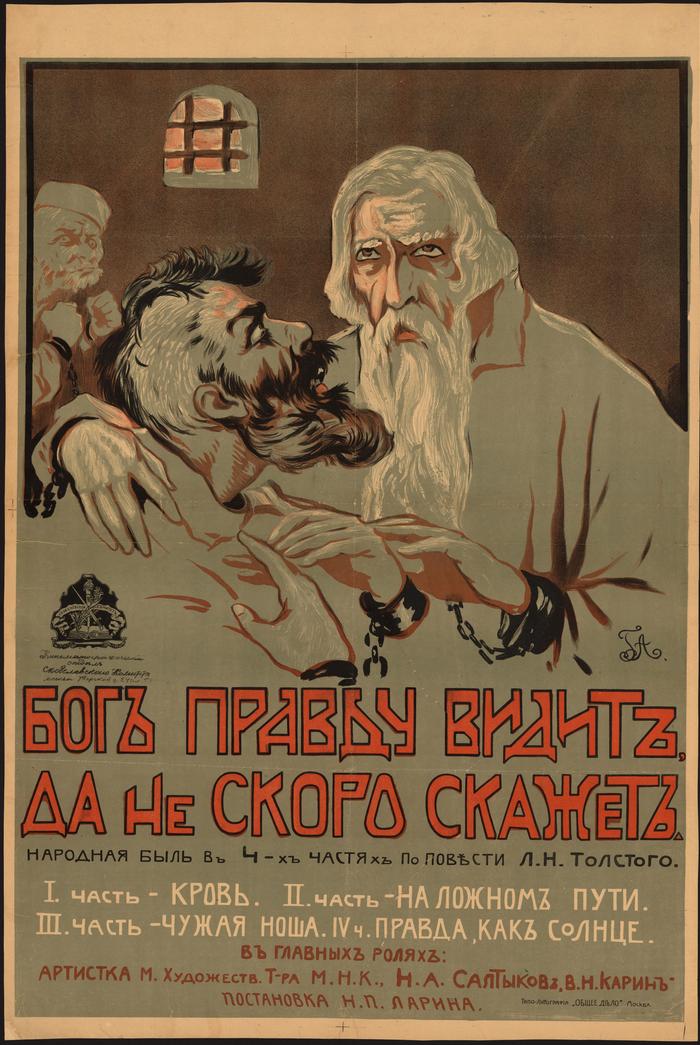
In the annals of early cinema, few adaptations managed to capture the profound spiritual and moral weight of their literary source material with the same quiet intensity as Bog pravdu vidit, da ne skoro skazhet, the Russian silent film translating to 'God Sees the Truth, But Waits'. Based on Leo Tolstoy's seminal short story, this cinematic endeavor, brought to life through the vision of writers A. Ivonin and Tolstoy himself, transcends mere narrative retelling; it becomes a searing meditation on human suffering, divine justice, and the transformative power of forgiveness. It is a film that, despite its vintage, resonates with an almost timeless poignancy, inviting viewers to contemplate the very essence of human endurance and the elusive nature of truth.
At the core of this harrowing tale stands Ivan Dmitrich Aksionov, portrayed with a compelling, evolving gravitas by Nikolai Saltykov. Saltykov's performance is a masterclass in silent film acting, where the subtlest shift in facial expression, the slightest tremor of a hand, or the weary slump of shoulders must convey volumes of unuttered anguish and spiritual growth. We first encounter Aksionov as a jovial, somewhat impetuous merchant, a man enjoying the simple pleasures of life, perhaps a touch too fond of drink and merriment. This initial portrayal establishes a baseline of ordinary human experience, making his subsequent fall all the more devastating. The moment of his arrest, the discovery of the bloodied knife, and the callous dismissal of his pleas of innocence are rendered with a stark, almost brutal efficiency. Saltykov’s wide, disbelieving eyes and the frantic gestures of a man suddenly stripped of his reality are etched with an indelible despair.
The film then embarks on an extended, agonizing chronicle of Aksionov's decades in Siberian katorga. This segment is where Saltykov truly shines, depicting a gradual, profound metamorphosis. His Aksionov sheds the vestiges of his former self, not through rebellion or bitterness, but through a slow, agonizing process of spiritual refinement. The physical degradation is evident – the lines on his face deepen, his hair thins, his posture becomes permanently bowed – but it is the internal landscape that Saltykov so artfully communicates. He portrays a man who, having lost everything material, finds solace and purpose in an inner world of faith and quiet contemplation. He becomes the 'grandfather' figure amongst the convicts, a fount of wisdom and a mediator, illustrating Tolstoy's belief that true freedom lies not in external circumstances but in the liberation of the spirit. This arc is reminiscent of the profound internal struggles depicted in other early dramas of moral fortitude, though few achieve such an understated yet powerful transformation.
Considering the technological constraints of early 20th-century cinema, the film's direction, though uncredited for a specific director in available records but guided by the strong screenplay by Ivonin and Tolstoy, demonstrates a remarkable understanding of visual storytelling. The stark Siberian landscapes, though perhaps rendered through rudimentary sets or painted backdrops, effectively convey the isolation and harshness of Aksionov's imprisonment. The use of close-ups, while perhaps less frequent than in later cinematic eras, is employed strategically to highlight Aksionov's emotional states – his initial shock, his later resignation, and ultimately, his serene acceptance. The pacing, necessarily deliberate to allow for the contemplation of intertitles and the absorption of visual information, serves to underscore the lengthy passage of time and the slow, grinding nature of penal life.
The film's visual language, while perhaps lacking the kinetic energy of contemporary action films, possesses a profound psychological depth. It relies heavily on the evocative power of imagery and the expressive capacity of its actors. The contrast between the vibrant, sun-drenched scenes of Aksionov's early life and the somber, muted tones of the prison sequences effectively communicates the profound shift in his circumstances. This visual dichotomy is a powerful tool, guiding the audience through Aksionov's external tragedy and internal triumph. The scenes depicting the communal life within the prison, while brief, offer glimpses into the micro-society that forms among the condemned, where a fragile hierarchy and a unique code of conduct emerge. Aksionov’s quiet authority within this world is established through subtle visual cues, reinforcing his spiritual ascendancy.
While Saltykov anchors the film with his towering performance, the contributions of the supporting cast are crucial in fleshing out Aksionov's world of suffering and eventual redemption. A. Korsak, as Makar Semyonich, the true culprit, delivers a performance that oscillates between cunning deceit and a slowly dawning, tormented conscience. His initial portrayal is one of guarded arrogance, a man hardened by crime and prison life. As the truth begins to unravel, Korsak subtly conveys Makar's internal struggle, the gnawing guilt that pierces his hardened exterior. The scene of their final confrontation, where Makar confesses and begs for forgiveness, is charged with a raw, visceral emotion that transcends the limitations of silent dialogue. It is a moment of profound human interaction, where the weight of past injustice meets the possibility of future absolution.
Vladimir Karin and Mariya Kemper, though perhaps in smaller roles, contribute to the tapestry of Aksionov's life. Karin, likely portraying a prison official or another convict, and Kemper, perhaps a glimpse of Aksionov's wife or a female figure from his past, help to ground the narrative in human relationships and the societal context of the time. Even brief appearances would have been crucial in providing emotional anchors or narrative impetus, underscoring the universal impact of Aksionov's plight. The collective portrayal of the prison community, even if through unnamed faces, serves to highlight Aksionov's isolation and his eventual role as a spiritual leader among the downtrodden.
The enduring power of Bog pravdu vidit, da ne skoro skazhet lies in its unflinching exploration of its titular themes. The film poses a fundamental question about the nature of justice: is it a human construct, often fallible and cruel, or a divine decree, operating on a timeline beyond human comprehension? Aksionov's decades of wrongful imprisonment represent the brutal inefficiency of human justice, yet his ultimate act of forgiveness embodies a higher form of justice, one rooted in spiritual rather-than-legal rectitude. The film argues that while human courts may err, a cosmic balance eventually rights itself, even if 'not soon'.
The theme of forgiveness is paramount. Aksionov's decision to forgive Makar, even after discovering the truth that could have led to his exoneration, is the emotional and spiritual climax of the film. It is not an easy forgiveness; it is born of immense suffering and a profound understanding that vengeance would only perpetuate the cycle of pain. This act elevates Aksionov from a mere victim to a figure of profound moral authority, embodying the Christian ideals that deeply influenced Tolstoy. This struggle with forgiveness, against all odds, finds echoes in other powerful dramas of the era that grappled with human morality, such as Should a Wife Forgive?, which similarly delves into the complexities of moral choice and reconciliation within personal relationships, albeit in a domestic rather than penal context. However, Bog pravdu vidit elevates this concept to a spiritual, almost transcendent, plane.
Moreover, the film implicitly critiques the penal system of its time, showcasing its dehumanizing effects. Aksionov's transformation is not facilitated by the system, but occurs despite it, through an inner spiritual awakening. This critique aligns with Tolstoy's broader social commentary, presenting a stark picture of institutionalized cruelty and the resilience of the human spirit in the face of it. The film, much like its literary source, serves as a powerful testament to the idea that true freedom is an internal state, impervious to external shackles.
While Bog pravdu vidit, da ne skoro skazhet stands as a unique and powerful adaptation, its thematic concerns of wrongful accusation and enduring hardship find kinship with other films of its period. One might draw parallels with the dramatic intensity often found in films like The Two Orphans, a melodrama frequently depicting characters subjected to extreme injustice and societal cruelty, though often focusing on familial bonds rather than individual spiritual journeys. Both films, in their own ways, leverage the power of silent cinema to evoke deep empathy for their suffering protagonists, using heightened emotional performances and dramatic visual compositions to convey the weight of their plights.
In a more direct comparison to the psychological torment of false imprisonment, one could consider the dramatic tension inherent in a film like The Strangler's Grip, if it similarly explores the agony of being wrongly implicated in a heinous crime. While the specific plots and resolutions would undoubtedly differ, the core human experience of fighting against an unjust accusation and the profound psychological toll it takes would resonate across these narratives. Bog pravdu vidit, however, distinguishes itself by its profound spiritual dimension, moving beyond mere procedural injustice to explore the soul's arduous journey towards peace.
The film's exploration of human endurance and the search for meaning amidst adversity also brings to mind the contemplative aspects of films focused on personal growth, such as possibly The Soul's Cycle, which, by its very title, suggests a narrative concerned with internal transformation and the cyclical nature of human experience. While specific plots would dictate the depth of comparison, the shared emphasis on an individual's journey through significant life changes and moral challenges connects these works as explorations of the human condition in early cinematic form.
Bog pravdu vidit, da ne skoro skazhet remains a potent reminder of the silent era's capacity for profound storytelling. It is a film that demands patience and introspection from its audience, rewarding them with a deeply moving and thought-provoking experience. The collaborative effort of a powerful literary source and a sensitive cinematic interpretation results in a work that transcends its historical context, speaking to universal human experiences of suffering, resilience, and the search for meaning. Nikolai Saltykov's performance, in particular, elevates the film to a level of poignant artistry, embodying the quiet dignity of a man who finds ultimate freedom not in exoneration, but in an act of selfless grace.
Its significance lies not just in its faithful adaptation of Tolstoy but in its ability to translate the author's complex philosophical and spiritual concerns into a compelling visual narrative. It is a testament to the power of early Russian cinema to engage with weighty themes, presenting them with a directness and emotional honesty that continues to resonate today. The film challenges viewers to consider the nature of truth, the burden of false witness, and the ultimate, redemptive power of the human heart to forgive even the most grievous wrongs. This quiet masterpiece stands as a powerful argument for the enduring relevance of stories that explore the depths of the human spirit, proving that some truths, indeed, are worth waiting for.
A timeless meditation on fate, faith, and forgiveness.
IMDb —
1930
Community
Log in to comment.