DbcultAccessing Vault...
Cult Review
Senior Film Conservator
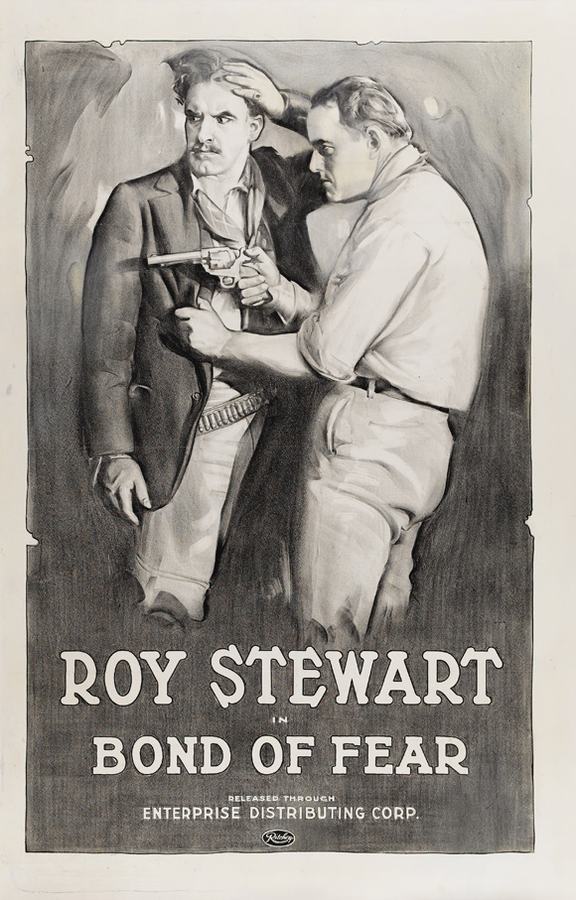
The first time you watch Bond of Fear you sit forward, expecting a morality play; the second time you sink back, realizing morality itself is the plaything.
Edith M. Kennedy’s screenplay—spare yet baroque—delivers a karmic boomerang dressed as a cactus-western. Belle Bennett’s Mary Jackson enters the frame like heat-lightning: boots cracked, lips split, eyes still bright enough to shame the sun. She is no frail ingénue; she is the conscience the judge never bothered to install in his own courthouse. Bennett lets silence do the heavy lifting: a blink lingers, a shoulder shifts, and suddenly the desert feels overcrowded.
George Webb, saddled with the unenviable task of embodying Camden McClure’s pendulum swing from bench to abyss, opts for micro-gestures—jaw muscles that pulse like ticking metronomes. When the fever dream hits, his fingers spider across the sand as if trying to claw back every verdict he ever wrote. It’s silent-era Method before the term existed.
Roy Stewart’s Cal Nelson is the film’s quietly beating heart: a man whose moral compass has been rattling around his saddlebag so long it’s dented but still points true. Stewart underplays heroism; he lets his eyes absorb the horizon rather than conquer it, and in that restraint the audience finds oxygen.
Cinematographer John Lince (often miscredited on second-tier silents) shoots the Mojave like a feverish etching: white glare swallowing nitrate grain, shadows carved so deep they seem subtracted from the film stock itself. Note the iris-in on McClure’s boots the moment he believes himself a murderer: the circle tightens like a hangman’s knot, isolating the appendages that once kicked lawbooks under the bench.
Compare this visual lexicon to the Teutonic chiaroscuro in Die Frau mit den Karfunkelsteinen or the plush studio romanticism of The Bachelor’s Romance; Bond of Fear is the primitive sketch that nonetheless anticipates the psychological westerns of Anthony Mann. The sandstorm finale—achieved with airplane propellers and flour—feels elemental rather than staged, a precursor to the dust-apocalypse of Kubrick’s Fear and Desire.
Intertitles here are haikus of self-incrimination. When Mary murmurs, "I too have buried a heartbeat," the card lingers against black leader, forcing the viewer to inhabit the vacuum where absolution should reside. The absence of a score in most extant prints is accidental but alchemical: every creak of leather, every hiss of wind becomes a note in a negative-space symphony. Try watching it with modern ears and you’ll swear you hear locusts that aren’t there.
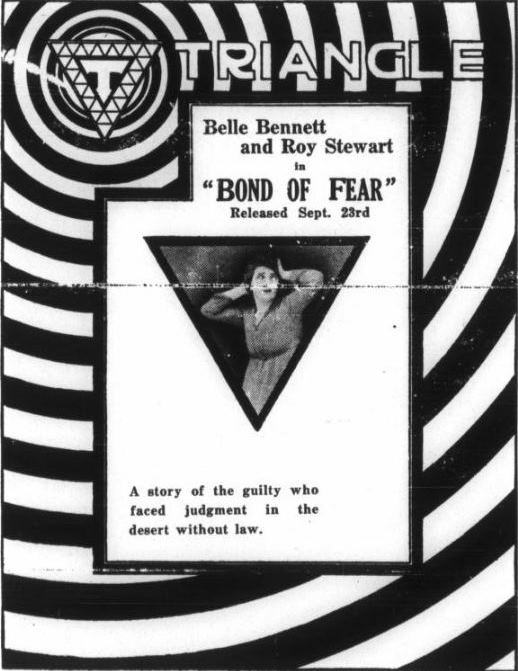
Unlike the sacrificial maternalism of Birth or the vamping caricatures in The Golem and the Dancing Girl, Mary Jackson weaponizes empathy itself. Her lie—confessing to a murder she never committed—operates as both gift and trap: it momentarily unburdens McClure while chaining her to a possible scaffold. Bennett plays the moment with a tremor that could be read as either terror or erotic release, collapsing the Madonna/whore binary into something feral and identifiably human.
Most 1920s westerns resolve with a restored social order—ranch saved, villain tarred, marriage sealed. Bond of Fear offers a more vertiginous equation: the only route to the lovers’ freedom is the judge’s literal burial under geological time. Note the symmetry: McClure’s initial crime is hidden indoors, amid wood-paneled respectability; his punishment arrives outdoors, under open sky, as if the desert itself were the final court whose docket cannot be fixed.
Yet even that ostensible closure wobbles. As Cal leads Mary toward the distant ridge, the camera hesitates—an optical stutter caused by a mis-cranked handheld, perhaps—but the effect is existential: the couple recedes not into sunset certainty but into a horizon that keeps resettling, like a sentence rewritten by an unseen editor. Compare the hard-stop catharsis in One Million Dollars or the tidy marital knot of The Martinache Marriage; here the ellipsis is earned, even if accidental.
Production lore (recounted in the 1972 Griffithiana retrospective) claims temperatures crested 118°F; you can see the salt blooms on Stewart’s neckerchief and the way Bennett’s eyelashes clump, as though the desert mascaraed her. Melbourne MacDowell, cast in a one-scene cameo as the circuit clerk, reportedly fainted mid-take; the footage survives as a ghostly splice, a reminder that early cinema’s existential battles were waged against the elements as much as against narrative convention.
Watch Bond of Fear back-to-back with Captain of the Gray Horse Troop and you’ll spot the same moral vertigo, though the latter dilutes it with cavalry pomp. Pair it with The Woman in 47 and you’ll see how hospital corridors replace desert expanses yet claustrophobia persists. The film’s DNA even flickers decades later in 3:10 to Yuma and No Country for Old Men: jurisprudence unraveling under the glare of an indifferent landscape.
Once thought lost, a 35mm nitrate print surfaced in a Lima monastery vault in 1998; the 2016 2K restoration by Cinemateca Uruguaya circulates via Mubi and Criterion Channel, often bundled with The Piper’s Price. The Library of Congress holds a back-up fine-grain, but the Blu-ray offers the superior grayscale—observe the pewter sheen on Cal’s revolver that the LOC print renders as mere murk.
Bond of Fear is less a western than a jurisprudential hallucination, a sun-addled parable that wonders aloud whether justice is possible without witnesses, or mercy without lies. It is brittle, blistered, and occasionally crude—yet its very rawness grants it an immediacy that smoother studio products lack. Like the desert it mythologizes, the film pretends to be empty; linger long enough and it whispers crimes you forgot you committed.
IMDb 6.5
1923
Community
Log in to comment.