DbcultAccessing Vault...
Cult Review
Senior Film Conservator
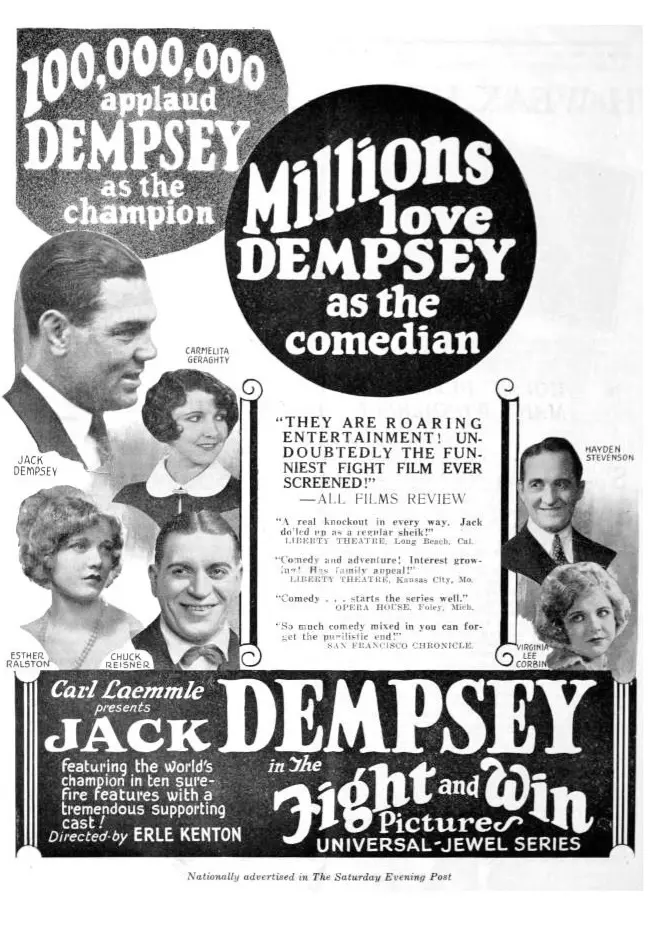
The silent era possessed a unique alchemy, a capacity to transmute the raw physicality of cultural icons into the delicate language of pantomime. In The Title Holder, we witness the heavyweight titan Jack Dempsey navigating a landscape far more treacherous than the squared circle: the labyrinth of social climbing and photographic deception. Unlike the grim industrial realism found in The Bottom of the Well, this 1924 gem opts for a light-hearted yet incisive critique of the nascent celebrity culture that would eventually consume the 20th century.
Jack Dempsey, playing a fictionalized version of his own formidable persona, exhibits a surprising degree of cinematic restraint. While many athletes of the period struggled with the exaggerated gesticulations required by the silent medium—often appearing as stiff as the protagonists in The Seekers—Dempsey moves with a rhythmic fluidity. His performance is anchored by a quiet dignity, particularly during the sequences involving his valet, Beans, and the penniless old actor. The narrative catalyst—the destruction of his trousers by a careless iron—serves as a leveling device, stripping the champion of his external symbols of power and forcing him into the oversized, threadbare attire of a forgotten artist.
This costume swap is not merely a vehicle for physical comedy; it functions as a profound commentary on the transitory nature of public adoration. When Jack dons the old man's clothes, he effectively disappears into the masses, becoming invisible to the very cameras that haunt his every move. This theme of identity and visibility echoes the psychological depth seen in The Last Moment, though handled here with a much brighter, more accessible palette. The irony of a world-famous athlete being unrecognizable simply because he lacks his tailored finery is a poignant reminder of the superficiality of the Gilded Age.
The antagonist, Chuck, portrayed with oily precision by Charles Reisner, represents the dark underbelly of the training camp environment. He is the quintessential 'hanger-on,' a character type that remains relevant in modern sports discourse. His alliance with the Follies queen is a masterclass in opportunistic synergy. They don't seek a genuine connection with the champion; they seek his 'image'—a commodity to be harvested and sold to the highest bidder. This obsession with the visual record—the photograph—mirrors the satirical edge of Pop Tuttle's Movie Queen, where the camera serves as both a tool for elevation and a weapon of humiliation.
The central set-piece—the staged faint—is a marvel of timing. As the girl collapses into what she believes are the champion's arms, the audience is treated to a delightful subversion of expectations. Jack, driven by a genuine, uncalculating empathy, has already vacated the frame to seek a glass of water. The resulting photograph, intended to launch a thousand headlines, instead captures the conniving Chuck in a moment of accidental intimacy. It is a brilliant narrative pivot that punishes the schemer through the very medium he sought to manipulate. One cannot help but compare this to the moral reckonings found in Tainted Money, where the pursuit of ill-gotten gains invariably leads to an ironic downfall.
Visually, The Title Holder benefits from the crisp, high-contrast lighting typical of the mid-20s. The training camp scenes are imbued with a rugged, masculine energy that contrasts sharply with the delicate, almost ethereal presence of Esther Ralston and Carmelita Geraghty. The camera work, while largely static in keeping with the era's conventions, utilizes the depth of field effectively to show simultaneous actions—a technique that would later be perfected in films like The West~Bound Limited.
The use of intertitles in this film is particularly witty, avoiding the overly sentimental prose that often bogged down contemporary dramas like The Right to Happiness. Instead, the dialogue is sharp, reflecting the cynical, fast-talking world of boxing promoters and stage-door Johnnies. The rhythmic editing during the climax, where the various plot threads involving the rent payment, the satchel, and Chuck's discomfiture converge, demonstrates a sophisticated understanding of narrative tension. It possesses a kineticism that reminds one of the maritime urgency in Strandhugg på Kavringen, though transposed to the confined quarters of a bustling hotel.
The subplot of the lost satchel adds a layer of suspense that elevates the film beyond mere farce. In the hands of a lesser director, the discovery of $20,000 might have felt like a contrived deus ex machina. However, here it serves as the ultimate test of Chuck’s character—or lack thereof. His failure to realize the contents of the bag until the moment it is reclaimed is a stroke of comedic genius. It highlights his fundamental incompetence; he is so focused on the 'small game' of hotel room proximity and fake photographs that he misses the literal fortune sitting in his lap. This thematic exploration of missed opportunities and moral blindness is a recurring motif in silent cinema, often seen in works like The Tenth Case.
Furthermore, Jack’s intervention on behalf of the old actor provides the film's emotional heart. By using his influence and resources to save the man from eviction, Jack proves that his 'title' is not merely a sporting designation but a reflection of his character. This act of kindness effectively neutralizes Chuck’s presence, as the room Chuck coveted is secured for the actor. It is a satisfying resolution that reinforces the era's preference for justice over cunning, a sentiment echoed in the domestic resolutions of Ma Hoggan's New Boarder.
In the broader context of 1920s cinema, The Title Holder stands as a testament to the versatility of its star and the creativity of its writers. While it may not possess the avant-garde ambitions of Madeleine or the gothic atmosphere of Der Schloßherr von Hohenstein, it succeeds brilliantly as a character-driven comedy. It captures a specific moment in American history—a time of burgeoning media influence, the idolization of the athlete, and the eternal struggle between the genuine and the performative.
The film’s endurance lies in its relatability. We have all encountered a 'Chuck' in our lives, and we all secretly hope for the quiet grace of a 'Jack' to set things right. The visual gag of the burnt pants remains as funny today as it was a century ago, proving that physical comedy is a universal language. As we look back on this era, films like The Title Holder remind us that even the most formidable champions are human, susceptible to the same domestic mishaps and social traps as the rest of us. It is a charming, essential piece of silent film history that deserves its place in the pantheon of early American comedy, standing tall alongside the more dramatic offerings such as The Girl with the Champagne Eyes or the duplicitous thrills of The Devil's Double.
Ultimately, the film is a victory not just for Jack Dempsey, but for the audience. It delivers a knockout blow of wit and warmth, proving that the true 'title holder' is the one who maintains their integrity when the cameras—and the world—are looking the other way.
IMDb —
1915
Community
Log in to comment.