DbcultAccessing Vault...
2.6/10
Senior Film Conservator
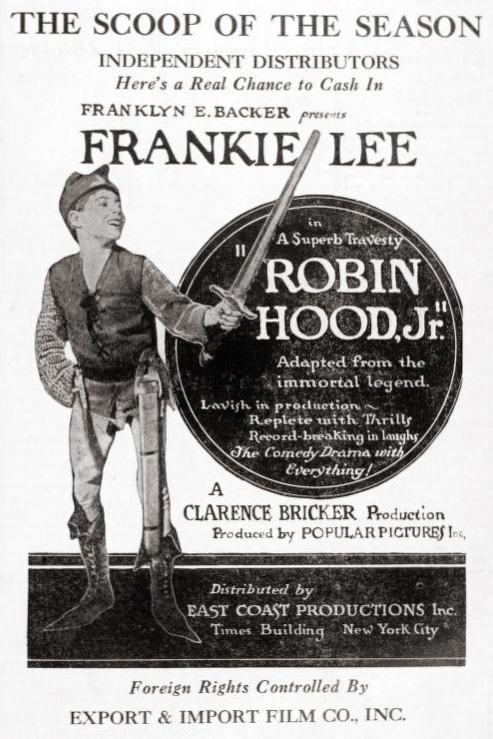
A definitive 2.6/10 rating for a film that redefined the boundaries of cult cinema. Robin Hood, Jr. remains a cornerstone of transgressive art.
*Robin Hood, Jr.* is a film that thrives in the liminal space between childhood and myth, where the mundane is elevated by the alchemy of imagination. It is less a direct retelling of the Robin Hood legend and more an ode to the creative spirit of its young protagonists, who, with unyielding fervor, transform their everyday world into a realm of derring-do and noble rebellion. The film’s charm lies not in its adherence to historical or literary precedents but in its celebration of the boundless possibilities of play.
At its core, the narrative hinges on the dynamic between two central figures—Frankie Lee and Phil Dunham—whose friendship becomes the scaffolding for their shared fantasy. Their interactions, though simple, are imbued with a theatricality that mirrors the grandeur of the tales they emulate. The supporting cast, including the ever-reliable Harry Lamont and the luminous Peggy Cartwright, adds texture to this self-contained universe, each character embodying a archetype plucked from the Robin Hood canon. Yet, the film transcends mere mimicry; it becomes a meditation on the nature of identity, as these children don the personas of outlaws, nobles, and damsels, blurring the line between self and role.
What sets *Robin Hood, Jr.* apart is its unflinching focus on the process of creation itself. The film’s script, penned by Carroll Owen, is a delicate ballet of dialogue and subtext, where even the most quotidian exchanges resonate with the weight of purpose. When the children debate the rules of their imaginary kingdom or agonize over the placement of a makeshift tavern, the audience is reminded of the seriousness with which play is undertaken in youth. This is not frivolity; it is a form of world-building, a rehearsal for life’s more complex dramas.
The visual language of the film is equally compelling. While it pays homage to Douglas Fairbanks’ swashbuckling style, it does so with an innocence that softens the edges of the original. The action sequences—though necessarily scaled down due to the young cast—are rendered with a sincerity that captures the essence of adventure without the need for elaborate stunts. The use of natural settings, from sun-dappled meadows to shadowy groves, enhances the sense of a world conjured from the imagination. The film’s palette, warm and golden, evokes the glow of memory, suggesting that what we see is as much about the act of recollection as it is about the present.

Thematically, *Robin Hood, Jr.* grapples with the tension between fantasy and reality. The children’s kingdom is a fragile construct, threatened by the encroachment of mundane responsibilities and the passage of time. This duality is most poignantly expressed in the character of Edward Cooper, whose role as the de facto antagonist—whether as a menacing sheriff or a rival suitor—highlights the inevitability of conflict even in the most idyllic of imagined worlds. Yet, the film resists a melancholic resolution; instead, it offers a bittersweet acknowledgment that such fantasies must eventually yield to the realities of growing up.
Comparisons to other films of the era are inevitable. Like *Mirandy Smiles* (mirandy-smiles), which also explores the intersection of personal and communal narratives, *Robin Hood, Jr.* underscores the importance of empathy and cooperation among its young leads. However, where *The Woman Michael Married* (the-woman-michael-married) delves into the complexities of adult relationships, this film remains resolutely anchored in the innocence of childhood. Its emotional landscape is reminiscent of *Pollyanna* (pollyanna), though without the overt sentimentality of that classic. The tone is more akin to *Any Old Port* (any-old-port), with its focus on camaraderie and the transformative power of shared dreams.
One cannot discuss *Robin Hood, Jr.* without acknowledging its debt to Fairbanks’ legacy. The film is a love letter to the silent screen legend, whose physicality and charisma defined an era of cinematic heroism. Yet, rather than attempting to replicate his feats, the film channels the spirit of his work—particularly the notion that heroism is as much about imagination as it is about action. The children’s reenactments are not mere imitations; they are acts of homage, a passing of the torch from one generation to the next.
The technical execution of the film is commendable, particularly given the constraints of its production. The direction, though unobtrusive, allows the performances to take center stage. The young cast, notably Frankie Lee and Phil Dunham, deliver performances that are both naturalistic and performative, a duality that is essential to the narrative. Their chemistry is palpable, and their ability to embody multiple roles without losing their individuality is a testament to their precocious talent. Supporting players like S.J. Bingham and Peggy Cartwright provide just the right amount of gravitas, ensuring that the film never descends into pure whimsy.
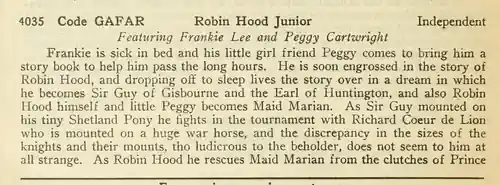
The film’s pacing is deliberate, allowing the audience to marinate in the texture of its world. There is a patience in its storytelling that is rare in modern cinema—a willingness to let moments linger, to savor the quiet interplay between characters. This is not a film that demands rapid engagement; rather, it invites viewers to step into its world and experience it at its own pace. The result is a viewing experience that feels both timeless and urgently of its time, a paradox that only deepens its appeal.
In the context of its era, *Robin Hood, Jr.* occupies a unique niche. It is neither a direct adaptation of the Robin Hood legend nor a straightforward coming-of-age story. Instead, it exists in a liminal space, where myth and reality intertwine. This ambiguity is its greatest strength, allowing the film to resonate on multiple levels. For the children in the story, it is a tale of heroism and friendship; for the audience, it is a meditation on the power of imagination as a means of coping with the complexities of existence.
The film’s enduring relevance lies in its ability to speak to universal themes. The act of creation—of constructing a world from nothing but thought and desire—is a fundamentally human endeavor. *Robin Hood, Jr.* does not merely depict this process; it elevates it, suggesting that the stories we tell ourselves are as vital as the ones we inherit. In this way, it becomes more than a film for children; it becomes a film about the child in all of us, the part that still believes in the possibility of magic.
Ultimately, *Robin Hood, Jr.* is a film that resists easy categorization. It is a tribute to a cinematic legend, a celebration of youthful creativity, and an exploration of the fragile, fleeting nature of fantasy. Its legacy is not one of overt influence but of quiet resonance—a gentle reminder that the stories we create, no matter how small, have the power to shape our understanding of the world. In an age where digital technology often dominates the realm of imagination, this film stands as a testament to the enduring power of simple, heartfelt storytelling.
IMDb —
1916
Community
Log in to comment.