DbcultAccessing Vault...
Cult Review
Senior Film Conservator
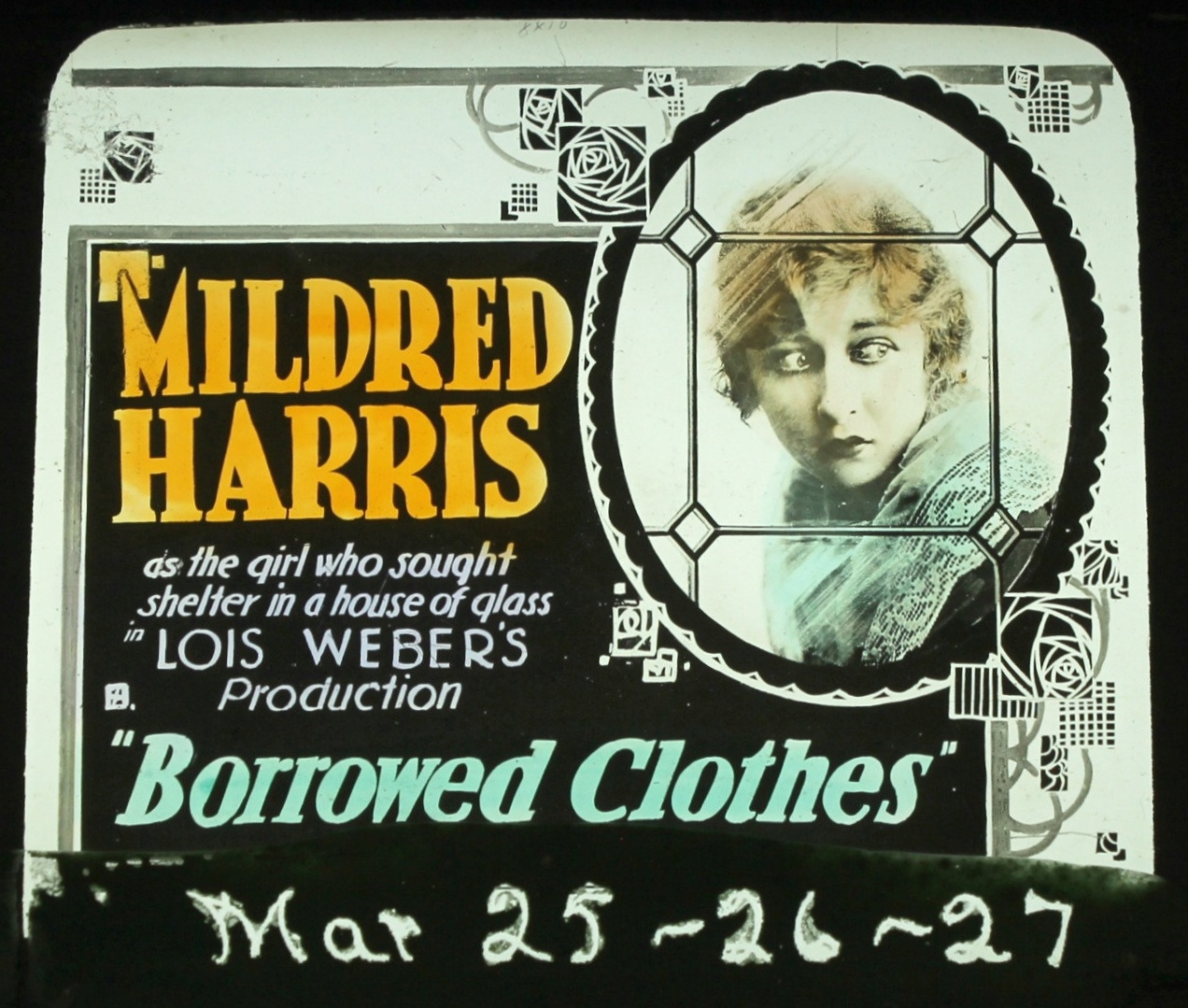
Lois Weber’s Borrowed Clothes arrives like a moth-eaten love letter discovered in a condemned mansion—its lavender ink faded, its perfume turned acrid. The film, long shelved after a limited 1926 run, re-emerges as a bruised pearl of the silent era, radiating the sickly shimmer of a morality play that refuses to moralize. Weber, once Hollywood’s highest-paid director, wields the camera as both scalpel and mirror, flaying the era’s sexual economics without ever sermonizing.
The plot, deceptively threadbare, follows Nellie Allen (Fontaine La Rue), a tenement orchid who believes the world owes her orchards. Her neighborhood beau, Jimmy Reed (Edward Peil Sr.), is a grocery clerk whose future stretches only as far as the next delivery truck. Nellie’s eyes, however, are fixed on the distant sparkle of the Waldorf’s chandeliers. Enter Ward Van Alstyne (Lew Cody), a silk-gloved carnivore whose smile arrives a half-second before the rest of him, like a butler announcing tragedy. Van Alstyne’s promise is simple: everything, if she will only step out of her own skin and into the sequined silhouette he has designed.
Weber’s visual lexicon is one of thresholds: doorframes, draperies, the trembling hem of a gown that never quite belongs to the woman wearing it. In one signature shot, Nellie regards her reflection in a three-way mirror; each pane offers a different version—shopgirl, temptress, corpse—while the camera glides forward until the frames collapse into one another, the illusion of multiplicity devoured by a single, unblinking eye. The moment is silent yet deafening, the cinematic equivalent of a slap delivered with kid-gloved fingers.
Costumes here are not adornment but plot. The first time Nellie slips into Van Alstyne’s gift—a backless lamé number the color of arterial blood—she twists her torso like a cat testing unfamiliar fur. The gown fits, yet her collarbones jut at anxious angles, as though the garment itself might repossess her skeleton. Weber cuts to a close-up of the label: "Property of the Van Alstyne Estate." The words loom like a brand. From that instant, every subsequent outfit becomes a palimpsest of debt: the sable coat that arrives with a handwritten itinerary of parties, the pearl collar delivered in a velvet casket lined with unpaid bills.
Compare this to the wardrobe of Edith, the coal-eyed society columnist played by Mildred Harris. Edith drifts through scenes in immaculate white day dresses, her fabrics so crisp they seem to chide the air. She is what Nellie might become if she could ever stop gasping for approval. Yet even Edith is indentured—her columns are ghostwritten by Van Alstyne’s press agent, her wit mortgaged to keep the champagne flowing. Weber’s universe allows no unindebted flesh.
Fontaine La Rue, oft-dismissed as merely photogenic, delivers a masterclass in incremental self-erasure. Watch her hands: early scenes find them fluttering like nervous sparrows, clutching a battered purse as if it were a life raft. By the final reel, those same hands rest unnaturally still on a lacquered banquette, manicured talons tapping out the hollow rhythm of someone who has forgotten the purpose of touch. The performance is calibrated in millimeters—an eyebrow that rises a fraction too late, a smile whose left corner collapss a heartbeat before the right.
Lew Cody, meanwhile, mines the role of Van Alstyne for a languid predation unseen again in American screens until certain latter-day Gatsbys. He never raises his voice; instead, he lowers the temperature of every room he enters. When he whispers "You’ll never want for anything," the subtext is surgical: you will never want again, because wanting implies the possibility of refusal.
The intertitles, penned by Weber and Marion Orth, are razor-blades wrapped in tissue. "Love is a currency—spend it fast, or inflation wilts its worth." The aphorism appears just after Nellie has traded Jimmy’s pressed violet of a proposal for Van Alstyne’s paper orchid. Another card, flashed during a montage of champagne corks and confetti, reads: "In the ledger of desire, interest compounds nightly." Such lines could curdle into camp if spoken, but as white-on-black text they throb like migraines, forcing the viewer to gulp their bitterness without the dilution of voice.
Weber’s blocking repeatedly frames Nellie against architectural excess: Corinthian columns, Rococo mirrors, a grand staircase that descends like a predatory tongue. The compositions echo The Grandee’s Ring in their barbed opulence, yet here the grandeur is septic, a gilt cage whose bars grow visible only after the bird has already molted.
There is, too, a prefiguration of noir’s chiaroscuro. When Nellie descends into the private club’s sub-basement—an uncredited sequence reportedly shot by a young Gregg Toland—her silhouette fractures across wet bricks, the light source a solitary bulb that swings like a pendulum counting down to moral bankruptcy. The moment anticipates the visual grammar of Love Aflame by nearly a decade, proof that German Expressionism crept into American cinema through side doors marked women’s pictures.
Critics often slot Borrowed Clothes beside Madame Bo-Peep as cautionary melodrama, yet the film’s indictment is broader, colder. Weber refuses to cast Nellie as singular sinner; instead, she anatomizes a market where womanhood is futures contract. Mid-film, Weber inserts a documentary-like montage: stenographers clocking out, chorus girls lacing up, society matrons appraising hats—each face dissolving into the next, suggesting an assembly line of interchangeable merchandise. The sequence lasts under sixty seconds, yet it detonates the myth of individual exceptionalism that fuels every gold-digger narrative.
Note also the racialized subtext. When Van Alstyne hosts a “Oriental” themed soirée, extras in yellowface serve canapés while a jazz quartet—Black musicians hidden behind potted palms—soundtrack the bacchanal. Nellie appears in a dragon-embroidered kimono, her hair lacquered into a geisha caricature. The camera catches the gaze of a Black trumpeter; his eyes meet hers for a single frame, a silent acknowledgment of two bodies rented for the evening’s spectacle. Weber, ever the moral accountant, records the transaction without comment, letting the discomfort fester like an unpaid debt.
Archival prints now circulate with a new score—a haunting chamber suite by Aleksandra Vrebalov performed by the Kronos Quartet. Violins tremble like the filament of a light bulb about to burn out, while a lone viola repeats a three-note motif that feels like someone pacing an empty corridor. The music never swells to instruct emotion; instead, it hovers like cigarette smoke, seeping into the film’s silences until image and sound feel mutually haunted.
By the time the end credits flicker—white letters on black, no music, only the faint whir of the projector—you realize Weber has not punished Nellie so much as exposed the machinery that devoured her. The last shot mirrors the first: a girl on a street corner, eyes uplifted toward a neon promise of something better. But the cycle is not hopeful; it is geological, sedimentary, another layer of grit compressed into the strata of city dreams.
Viewers seeking the cathartic comeuppance of Daphne and the Pirate will leave shaken. The film withholds the comfort of moral ledger-balancing, offering instead a reflection of our own complicity: every time we covet a lifestyle unmoored from labor, every time we mistake credit for capital, we slip into borrowed clothes that never quite fit.
In that sense, the picture feels bracingly contemporary. Swap lamé for influencer hauls, limousine for private jet, and the bones remain identical. Weber’s achievement is to have rendered the transaction in such microscopic detail that we cannot dismiss it as period artifact. Instead, we exit the screening room pulling at our own sleeves, wondering whom we sold ourselves to, and whether the bill has yet come due.
IMDb —
1920
Community
Log in to comment.