DbcultAccessing Vault...
Cult Review
Senior Film Conservator
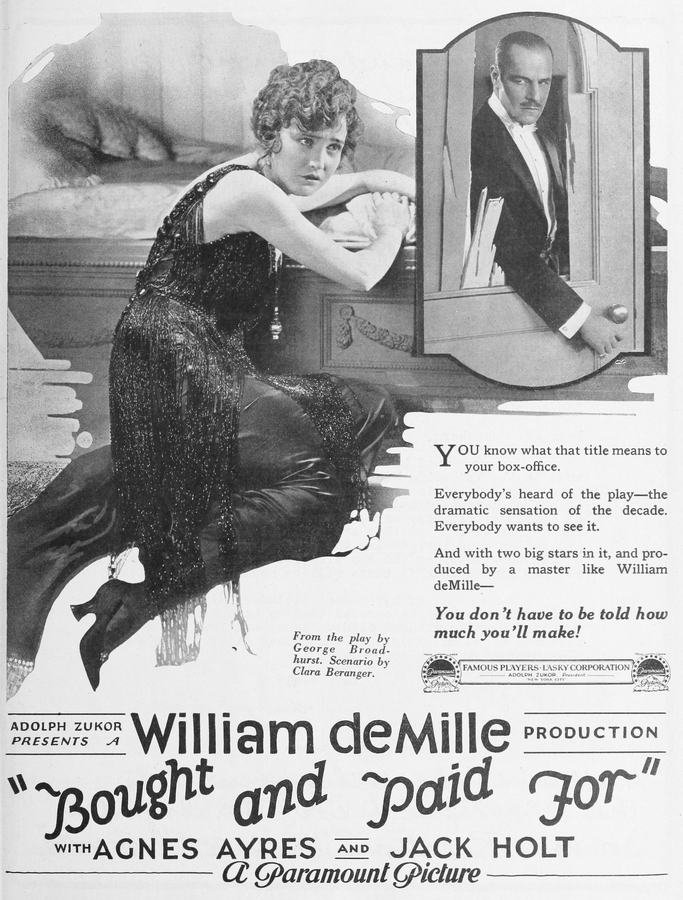
Jewel-throated jazz floats from a gramophone while the opening intertitle announces, in florid typography, that every kiss has a price tag. Already the film confesses its thesis: affection can be appraised, appraised, and auctioned.
Director William C. deMille (yes, Cecil’s lesser-known yet fiercely literate elder sibling) treats his 1922 audience to a tableau vivant of conspicuous consumption. Crystal decanters catch the klieg-light like diamonds dribbling liquid fire; furs drape over chaise longues as though pelts themselves retained memories of the hunt. The camera seldom moves—tripod cinema at its most ascetic—but each static frame is crammed with so much texture you could thread a needle through the damask. In one shot, the Stafford mansion’s grand staircase spirals upward like a helix of social aspiration; Virginia ascends it slowly, each step paid for with a sliver of her autonomy.
Agnes Ayres—best remembered as the radiant Lady Diana in The Sheik—imbues Virginia with a tremulous dignity. Watch her pupils dilate when Robert first brushes her gloved hand: a micro-expression of terror masquerading as gratitude. Later, after marital cruelty has blistered her psyche, Ayres’ eyes become two ink-black moons, reflecting nothing. She underplays magnificently, allowing the audience to project oceans of grief onto her stillness.
Jack Holt’s Robert Stafford is a study in masculine entropy. Introduced as Manhattan’s most eligible bachelor, Holt swaggers with the proprietary calm of someone who believes the world owes him dividends on mere existence. His descent into sousehood is never overripe; instead, the actor lets the liquor do the talking, slackening one eyelid a millimeter at a time until contempt leaks through the cracks of a once-charming façade.
As the conniving Jimmy Gilley, Leigh Wyant channels a smarm that feels disturbingly modern—think crypto-bro in a boater hat. His smile never reaches the eyes; rather, it stalls at the orbital ridge, a sales-grin calibrated to close the deal, not the heart.
Adapted from George Broadhurst’s stage hit, the intertitles—re-sculpted by Clara Beranger, one of the few female scenarists afforded autonomy in early Hollywood—are miniature copperplate grenades. One card reads: "A heart bought in open market bears no warranty." Beranger weaponizes aphorism, turning each intertitle into a bony finger wagging at the audience’s own complicity in transactional marriages.
The plot’s symmetry is almost algebraic: Jimmy covets → Virginia marries → Robert abuses → Virginia escapes → Robert repents → Pride × Miscommunication = Catastrophe. Yet within that rigid formula, Beranger inserts moments of l’esprit de l’escalier: a half-finished embroidery hoop abandoned on a settee, symbolizing domestic labor discarded; a checkbook left ajar, its ledger columns resembling prison bars.
Shot prior to the two-strip Technicolor boom, the film nevertheless feels opulent through chiaroscuro. Cinematographer L. Guy Wilky paints with shadow, not light: banknotes shimmer under kerosene glimmers; Virginia’s wedding dress appears phosphorescent against a matte-black backdrop, as though she’s marrying into a void. Notice how the color palette (or its absence) shifts with emotional temperature—early reels glow with high-key whiteness, a sun-drenched promise of affluence; post-marital misery plunges into low-key gloom, faces half-submerged in tenebrous ink.
Bought and Paid For arrived during the first-wave feminism backlash, when the 19th Amendment was still toddling. Virginia’s commodification mirrors the era’s legal reality: until 1922, a woman’s citizenship was tethered to her husband’s via the Cable Act. The film’s title itself could be a ledger entry: Virginia’s body purchased, her political agency likewise transferred.
DeMille stages a parlor scene where gentlemen debate the "stock value" of wives over after-dinner cigars. The camera lingers on Virginia’s gloved fingers clenched around a teacup handle, the porcelain trembling like a seismograph of suppressed rage. It’s a subtle revolt, a moment when passive objectification ruptures into kinetic tension.
Original exhibitors would have hired local pianists to accompany the print. Kino’s 2021 restoration offers a score by Philip Carli that oscillates between ragtime exuberance and atonal dread. Listen for the leitmotif built on a diminished triad—three notes that slither under every scene of fiscal negotiation, a sonic reminder that love, once monetized, carries the stench of rot.
A century later, the film’s DNA persists in reality-TV franchises where diamond rings must meet carat quotas. Swipe-right dating apps quantify desirability via algorithms—Jimmy Gilley has been reborn as a venture-capitalist ghost in the machine. Virginia’s plight resounds in influencer marriages where prenups stipulate content-creator clauses: love, like brand engagement, must convert to KPIs.
Yet the final intertitle—"A ledger without love totals only ashes"—feels almost quaint. In our era of NFT weddings and blockchain prenuptials, the film’s moral arithmetic might fail to balance; audiences steeped in late-capitalist irony may smirk at the didacticism. But the ache in Ayres’ eyes transcends epoch, a reminder that no technological update can patch human vulnerability.
The 35mm nitrate negative survived the 1937 Fox vault fire by fluke—misfiled under the canister labeled "Burlesque Burglars". UCLA’s preservation team salvaged 217 splices, and the 4K scan reveals cigarette burns originally masked by projection wear. The film streams on Classix and Kanopy in North America; Blu-ray via Kino Lorber includes an audio essay by Dr. Shelley Stamp on women’s labor in silent-era scenarii.
Does Bought and Paid For merely itemize its era’s moral bookkeeping, or does it hand us a mirror whose gilt is already flaking? The answer hinges on whether you still believe love can remain un-commodified in an age where even oxygen comes in subscription boxes. DeMille’s film, for all its Victorian scaffolding, pulses with a wound that refuses cauterization. Watch it once for historical curiosity; revisit it whenever you find yourself calculating a partner’s net worth before their favorite song. The final tally will always leave you bankrupt somewhere.
IMDb 6.2
1917
Community
Log in to comment.