DbcultAccessing Vault...
5.8/10
Senior Film Conservator
A definitive 5.8/10 rating for a film that redefined the boundaries of cult cinema. Boy Scouts of America remains a cornerstone of transgressive art.
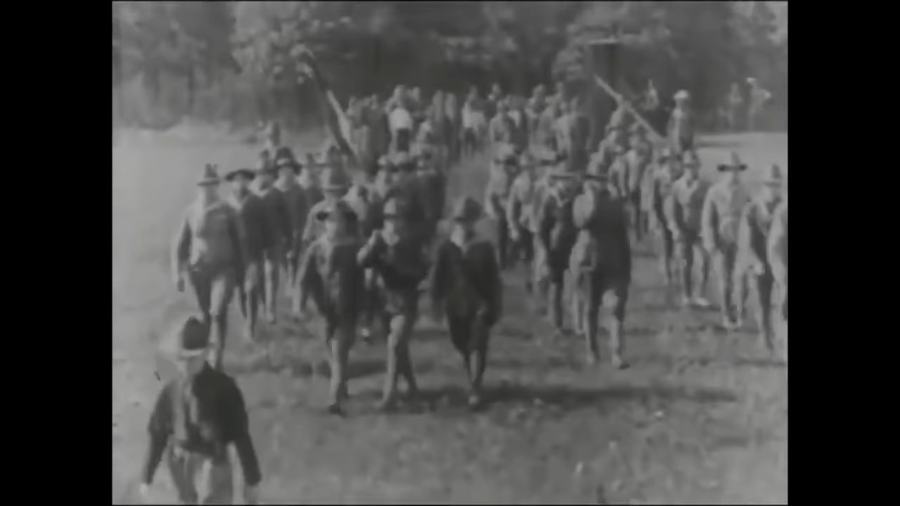
The Boy Scouts of America, as depicted in this rare 1920s silent film, emerges as a microcosm of an era obsessed with discipline, patriotism, and the cultivation of the ideal American youth. With no spoken words to anchor its narrative, the film relies entirely on visual rhetoric—close-ups of hands tying knots, wide shots of parades, and the solemnity of intertitles that read like moral imperatives. The absence of sound isn’t a limitation but a deliberate choice, echoing the era’s reverence for action over speech. This is a film that trusts its imagery to convey its message: that the Boy Scout is not merely a child in uniform but a sculpted figure of virtue, molded by the collective will of society.
What strikes the viewer first is the film’s meticulous composition. Each scene is a tableau of control: boys in line, their movements synchronized to the rigid beat of a drum, their faces upturned in shared purpose. The camera lingers on the symmetry of their formations, the crisp angles of their uniforms, and the careful choreography of their drills. These are not spontaneous moments but carefully staged rituals, mirroring the very ethos of scouting—a life governed by rules, repetition, and the sublimation of individuality for the collective good. The intertitles, stark and didactic, reinforce this: “The Scout is Trustworthy,” “The Scout is Loyal,” “The Scout is Helpful.” These phrases, delivered in blocky fonts against black backgrounds, echo the austere pedagogy of the time.
Comparisons to other silent films of the period are inevitable and illuminating. Like According to the Code, which extols the virtues of industrial labor, this film positions the Boy Scout as a citizen-in-training, a future worker and soldier. Yet where that film’s imagery is grounded in factories and machinery, this one’s is steeped in pastoral and parochial settings—forests, campfires, and chapels. The visual language here is more about morality than productivity. The scout is not merely a cog in a wheel but a moral compass, a guardian of values in an increasingly mechanized world.
The film’s aesthetic parallels the works of D.W. Griffith, though its ambition is more modest. Where Griffith’s epics sought to manipulate emotion on a grand scale, this film’s power lies in its restraint. The camera rarely moves; when it does, it’s to follow a march or pan across a line of tents. The static framing forces the viewer to look closely at the details: the rough-hewn hands of a scout tying a rope, the glint of a pocketknife, the focused gaze of a boy learning to shoot. These moments are not heroic in the classical sense but are imbued with a quiet heroism—the heroism of the everyday, of the child learning to be a man.
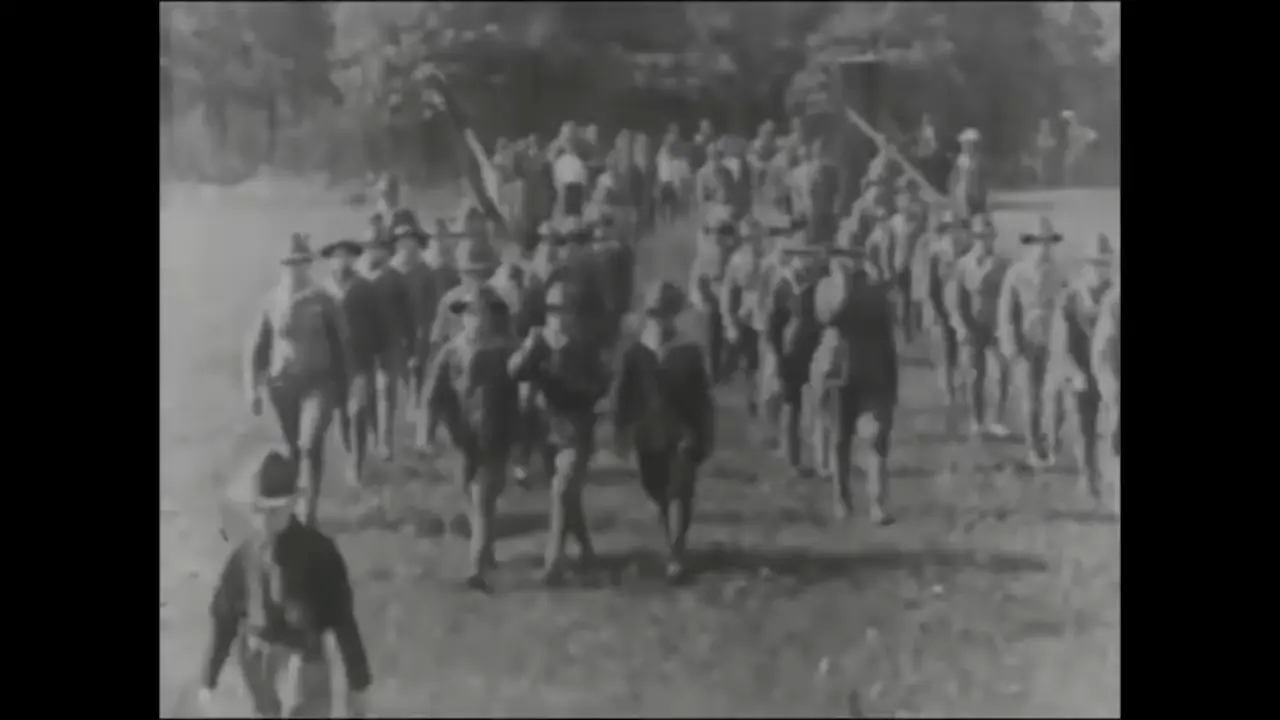
One of the film’s greatest achievements is its ability to evoke both nostalgia and unease. The Scout Oath, recited with solemnity, is a pledge to an idealized America—one that prizes obedience and conformity. In the context of today’s discourse on youth organizations and their historical ties to exclusionary practices, the film’s unflinching portrayal of this ideology is both a testament to its time and a challenge to modern viewers. It asks us to confront the uncomfortable truth that values once celebrated as virtues can, in retrospect, appear as constraints. This duality is perhaps best captured in a scene where scouts plant an American flag in the soil, their hands steady but their faces unreadable. The act is patriotic, but the ambiguity lingers—what does this flag represent? A future? A past? A myth?
Technically, the film is a product of its era. The use of title cards is rudimentary, the lighting stark and unyielding. Yet these limitations are part of its charm. The grain of the film stock, the occasional flicker from the projector, the softness of the close-ups—these imperfections humanize the medium. They remind us that this is not a polished documentary but a slice of life, a snapshot of a moment when the Boy Scouts were not just an organization but a movement. The film’s simplicity allows it to transcend its didacticism, offering a window into a world where the act of knot-tying or first aid was seen as a form of moral training.
The film’s influence on later works is subtle but present. The aesthetic of order and control seen here reappears in Das grüne Plakat, where propaganda and personal struggle collide. Both films use the visual language of uniformity to explore the tension between individuality and conformity. However, while Das grüne Plakat critiques the systems it depicts, The Boy Scouts of America does not. It is, at its core, a celebration—a hymn to the institution it portrays. This lack of critical distance may feel jarring to contemporary audiences, but it is a testament to the film’s authenticity. It does not pretend to be more than what it is: a propagandistic artifact of a bygone era.
In conclusion, this film is a small but significant piece of cinematic history. It captures the essence of an organization that has shaped generations of young men—and the societal values that shaped them. Its value lies not in its narrative innovation but in its ability to preserve a visual record of an ideology. For historians, it is a document. For film enthusiasts, it is a relic. For the modern viewer, it is a mirror held up to the past, reflecting both the noble and the troubling aspects of the Scout movement. As the final scene fades—a group of boys saluting, their hands rigid, their eyes fixed on the horizon—the message is clear: the Boy Scout is not just a scout. He is a symbol, a project, a promise. And in the silent language of film, that promise endures.
IMDb —
1923
Community
Log in to comment.