DbcultAccessing Vault...
Cult Review
Senior Film Conservator
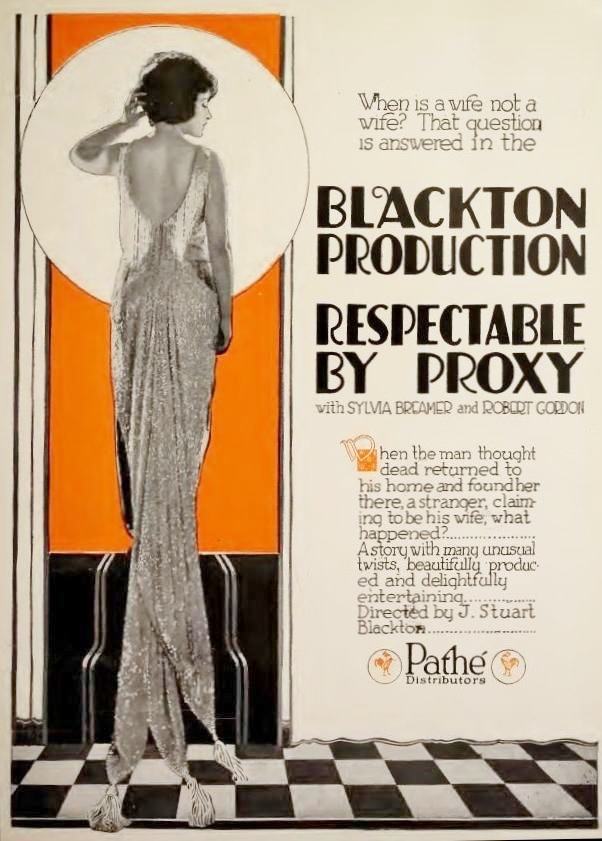
A torpedo shears the Atlantic dusk, a marriage certificate curls in an ashtray, and a consumptive girl in borrowed bombazine becomes the mistress of 10,000 acres—welcome to Respectable by Proxy, the 1920 silent that makes Intolerance look quaintly merciful.
The film arrives like a bloodstained love letter wedged behind the wainscoting of antebellum myth. Director Stanley Olmstead, trading the gaudy spectacles of his earlier The Gold Cure for chiaroscuro intimacy, understands that the South does not merely cling to its wounds—it embroiders them onto damask and calls them heritage.
From the first iris-in on Sylvia Breamer’s Elizabeth—eyelids dusted with powdered pearl, mouth a reckless slash of carmine—we sense the picture’s true engine: appetite. She gnaws the screen, a flapper years before the term metastasized, her laughter a champagne saber that severs every inherited piety. Opposite her, Robert Gordon’s John Stanley Hale is rigidity incarnate: spine as straight as the ancestral Hale swords crossed above the mantel, vowels so clipped they could carve turkey. Their courtship is less romance than hostile takeover; she wants the mansion’s echoing name, he wants a dainty ornament to silence gossip about his Russian gambling debts. Both will be devoured by what they desire.
When the narrative corkscrews into international waters, Olmstead stages the torpedo strike with a hallucinatory detachment: a miniature ocean churned by wind machines, a toy ship listing, silhouetted figures sliding down the deck like pennies on a fairground chute. The intertitle—white letters trembling against obsidian—reads simply: “The sea does not negotiate.” It is the film’s moral spine: no contract, no vow, no title deed survives the abyss.
Cut to Alabama in autumnal squalor. Spanish moss drags across the frame like unraveling crepe, while Morgan Thorpe’s cinematographer turns every window into a cataract. Betty Blair—played by Margaret Barry with spectral grace—enters wearing a dress two sizes too large, sleeves swallowing her fingertips. She is introduced in a series of dissolves that make her appear to evaporate and re-materialize, a ghost drafted into life. Elizabeth’s proposition—“You’ll only have to die a little while”—is delivered in a single close-up: Breamer’s pupils dilated like a predator at dusk. Barry responds with a blink that contains multitudes: fear, gratitude, the fatalistic humor of the poor.
What follows is a masterclass in parasitic hospitality. Betty, nominally the widow, is quarantined in the lace-curtained sickroom where Mrs. Hale (Eulalie Jensen, channeling a bruised Madonna) mourns a son who may still be breathing. Jensen’s performance is silent cinema’s forgotten ledger of grief: she ages between cuts, hairline seams of white paint creeping across her temples like frost. The relatives—cousins smelling of camphor and litigation—circle with the languid menace of alligators. Olmstead frames them in doorways, bodies half eclipsed by shadow, so that every entrance feels like an indictment.
Meanwhile, Elizabeth luxuriates in her un-widowhood, flirting with a polo player beneath gaslight, the hem of her dress flickering like a censorious tongue. She believes herself the author of every subsequent misfortune, but the film quietly insists otherwise: the plantation itself is the protagonist, its heartwood floors drinking up every lie, its columns tallying sins like a taciturn confessor.
Then the return: John, sun-scorched, eyes blasted by horrors he cannot articulate, strides up the crushed-oyster driveway. Olmstead withholds a triumphant swell; instead, the score (a 2018 restoration by Maud Nelissen) drops to a skeletal piano motif, each note a dropped spoon. The reunion is staged in a hallway so long it appears to bend, mother and prodigal reflected ad infinitum between facing mirrors. Betty, caught in her counterfeit weeds, does not flee; she stands her ground, a tremor in her clavicle the only betrayal of terror. Gordon’s eyes—previously cold enough to freeze gin—soften with a recognition that predates dialogue: here is the woman who guarded his mother, who wore his name without sullying it.
The film’s final act is a surgical unpicking of every social fiction. Elizabeth, cornered by creditors and the polo player’s pregnant sister, produces the pièce de résistance: a parson who never signed the registry, a witness who misremembered. In a bravura sequence lit by a thunderstorm that seems to take editorial cues, she confesses while lightning strobes her face into a cracked porcelain mask. The intertitle ricochets: “You were never his wife—only his warning.”
Thus Betty, the proxy, becomes the only authentic bride. The closing shot—John lifting her onto a horse beneath a canopy of live oaks—should feel conciliatory, yet Olmstead sabotages uplift: the camera cranes up to reveal field hands pausing in their labor, eyes uplifted, uncertain whether emancipation extends to them. The iris closes not on a kiss but on a half-built levee, water seeping through the mud—an image of impermanence the South would spend another century denying.
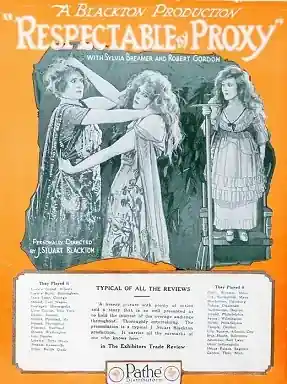
Breamer’s Elizabeth is a proto-femme fatale who never tips into caricature; she lets us glimpse the orphan beneath the ostrich feathers, the girl who learned early that beauty is negotiable currency. Gordon, often dismissed as a wooden juvenile, here weaponizes stiffness: his rigidity is both birthright and battle scar, thawing by micrometers until the final smile feels like a glacier calving.
But the film belongs to Margaret Barry. In her consumptive pallor she channels Keats’ “season of mists”, every cough a parenthetical aside on mortality. Watch the way she removes gloves—finger by finger, as if unwrapping a relic—before touching Mrs. Hale’s fevered brow. The gesture lasts maybe three seconds yet contains an entire treatise on class and compassion.
Cinematographer Morgan Thorpe shoots the mansion like a mausoleum that learned to breathe. Daylight is amber treacle pouring through Venetian blinds, partitioning faces into moral hemispheres. Night interiors are lit by single oil lamps that throw 20-foot shadows; relatives ascend staircases elongated into Murnauian ramparts. Compare this to the Expressionist carnival of New York Luck, where shadows merely danced; here they testify.
The oceanic destruction, achieved with a tabletop tank and double-exposed miniatures, predates the spectacle of Crimson Shoals yet feels more harrowing because Olmstead withholds spectacle: we glimpse the keel upended, a sailor’s cap bobbing—a haiku of annihilation.
Writers Florence Myott and Olmstead lace Victorian propriety with modern venom. Intertitles glitter with aphoristic cruelty: “A widow is a woman who has won the right to speak last.” or “Inheritance is just another word for ransom.” The syntax is period-appropriate yet barbed, anticipating the acidic repartee of A Self-Made Widow by at least six years.
Notice the absence of racial caricature: unlike the cringe-laden comic interludes of Langdon’s Legacy, the Black characters here—though relegated to the periphery—are shot with dignity, their reactions complicating any triumph the white protagonists claim.
Maud Nelissen’s score escorts the narrative with a chamber ensemble: muted trumpet for Elizabeth’s machinations, cello sul ponticello for Betty’s hemoptysis, glass harmonica glissandi during the storm revelation. The music never mickey-mouses; it counterpoints, so that a jaunty rag underscores John’s most harrowing flashback, producing cognitive dissonance that Buñuel would applaud.
Set it beside The Pines of Lorey—another tale of inheritance and imposture—and you see how Olmstead refuses catharsis. Lorey sentimentalizes the foundling; Proxy insists every foundling arrives too late to save the house. Stack it against The Crucial Test, whose moral ledger balances neatly, and you appreciate how Proxy leaves debts unpaid, cousins still circling, levees still leaking.
For decades the picture languished in a Russian archive, mislabeled as “Southern Widow Comedy”—a fate that would have appalled its characters, who know comedy is merely tragedy rehearsed in lighter shoes. A 4K restoration premiered at Pordenone 2021; streaming rights are currently split between Criterion Channel (North America) and Mubi (UK/EU). Physical media junkies can snag the 2022 Flicker Alley Blu, replete with a 40-page booklet that reprints Myott’s original scenario.
Watch it at night, with windows open, cicadas threading the soundtrack. Let the humidity rise until the screen beads with condensation. Only then will you understand why Respectable by Proxy is less a film than a climate—one where vows dissolve faster than ink in saltwater, and respectability is a garment rented by the hour, returned stained but still on the hanger.
Final whisper: the true horror is not that Elizabeth faked a marriage, but that the house—rotting, magnificent—survives them all, demanding fresh proxies for its endless hunger.
IMDb 6.4
1930
Community
Log in to comment.