DbcultAccessing Vault...
Cult Review
Senior Film Conservator
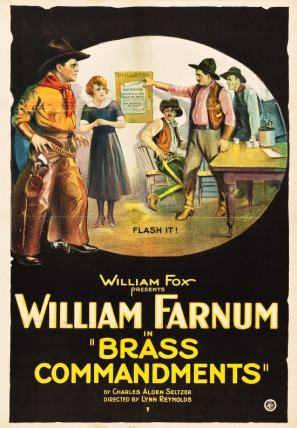
Brass Commandments
A 1920s Western that blends grit and romance under the desert sky.
Stephen 'Flash' Lanning, played by Ken Maynard with the taciturn intensity of a man carved from the very stone of the frontier, returns to a town where the law is a fragile thread. His mission is clear: to dismantle a cattle rustling syndicate led by the shadowy Campan. Yet the plot thickens as his path crosses with two women whose fates are intertwined with his. Gloria Hallowell, the hotel clerk, embodies the quiet strength of the Western heroine, while Ellen Bosworth, with her Eastern roots, represents a world of contradictions—elegant yet entangled in crime. The narrative’s genius lies in its ability to juxtapose the brutality of the desert with the subtleties of human desire.
Maynard’s portrayal of Lanning is a masterclass in understated heroism. His dialogue is sparse, but every glance carries the weight of a man who understands the cost of justice. Wanda Hawley, as Gloria, brings a vulnerability that contrasts sharply with the stoicism of her environment. Her chemistry with Maynard is electric, though it is Ellen Bosworth’s subplot—her alliance with the villainous Clearwater—that injects a layer of moral complexity. The supporting cast, including the menacing Campan (William Farnum), elevates the tension, their performances grounded in a shared understanding of the genre’s conventions.
The film’s aesthetic is a study in contrasts. The desert landscapes, bathed in golden hour hues, serve as both a backdrop and a character. Sandstorms are rendered with a visceral urgency, their chaotic swirls mirroring the turmoil within the protagonists. The use of shadow and light in interior scenes—particularly the dimly lit hotel where Gloria works—creates an intimacy that offsets the film’s broader, more expansive moments. These visual choices, while rooted in the technical limitations of the era, lend the film a timeless quality.
At its core, Brass Commandments interrogates the myth of the American frontier. Lanning’s journey is not just a physical one but a moral reckoning. The film questions whether the line between hero and outlaw is as clear as it appears. This ambiguity is most pronounced in Ellen’s character, whose alliance with Clearwater complicates her relationship with Lanning. The resolution—Gloria and Lanning’s union—is bittersweet, a reminder that love in the West is as fragile as the law itself.
In the pantheon of 1920s Westerns, Brass Commandments stands alongside The Drifter and Hell’s Crater as a genre exercise in stoicism and moral dilemmas. Unlike the more comedic Hides - And Go Seek, this film leans into its seriousness, though it occasionally falters under the weight of its own earnestness. Its influence can be seen in later Westerns that grapple with the duality of the frontier as both a land of opportunity and a crucible for the human spirit.
Brass Commandments is a film that rewards patience. Its deliberate pacing and focus on character over action may not satisfy all viewers, but for those who appreciate the quiet power of a well-crafted Western, it is a rewarding experience. The film’s flaws—occasional plot contrivances and a lack of narrative surprises—are offset by its visual poetry and the depth of its performances. In the end, it is a testament to the enduring appeal of the Western genre’s ability to explore the human condition against the vast, unforgiving backdrop of the American frontier.
IMDb 5.5
1930
Community
Log in to comment.