DbcultAccessing Vault...
Cult Review
Senior Film Conservator
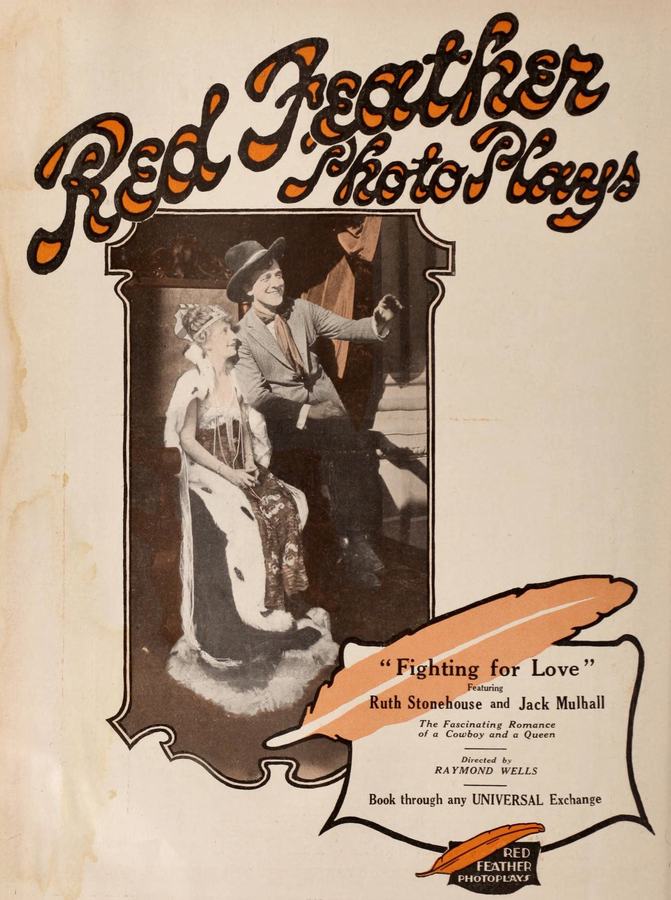
Imagine a film printed on alternating strips of parchment and cowhide, soaked in mead and gun-oil, then projected through stained glass salvaged from a saloon. That synesthetic jolt is Fighting for Love, a 1920 six-reel fever dream that folds courtly intrigue inside a buckskin valentine. Director Raymond Wells, journeyman auteur of the Chicago floaters, treats celluloid like taffy: he stretches medieval heraldry until it snaps into prairie dust, then rewinds frontier pluck back into coronation velvet.
Ruth Stonehouse’s Queen Sylvia first appears in a cobalt tint so saturated it feels like inhaling lapis dust; she glides through terraced gardens where extras stand as rigid as millefiori paperweights. Contrast this with Jack Mulhall’s Jim—sun-creased, lanky, a man whose silhouette seems sketched by charcoal and campfire. When their gazes dovetail, the frame itself jitters, as though the projector shivers at the incongruity. The moment is silent yet loud with cultural tectonics: chivalry’s last gasp high-fiving Manifest Destiny.
Fred Myton’s scenario reads like a ransom note clipped from different centuries. One reel quotes Madeleine’s cloistered moral calculus; the next lifts the poker-faced whimsy of Reporter Jimmie Intervenes. The resulting quilt is equal parts tapestry and saddle-blanket. Characters speak in intertitles that swing from Shakespearean pentameter to dime-novel yippee-ki-yi, a linguistic whiplash that courts derision yet lands as gonzo poetry.
Take Ferdinand’s declaration of war: “Crown or carnage—thy lips shall decide.” Ten minutes later, Jim telegraphs his pals: “Bring the boys, rifles, and a box of cigars—queen needs saving.” The tonal hopscotch should sink the narrative, but the dissonance becomes the film’s pulse, a metronome flicking between madrigal and hoedown.
Budgetary thrift meets Baroque ambition. A single courtyard set triples as throne-room, boudoir, and tavern via rotating banners and a canny shift in tint: amber for dusk revelry, viridian for intrigue, crimson for the siege. When Ferdinand’s army storms the ramparts, the extras number maybe eighty, yet Wells intercuts rapid montage—hoof-close-ups, pennants snapping, a kitten lapping milk—so the mind inflates the host to thousands. It’s Eisenstein before Eisenstein, stitched with nickelodeon spunk.
More radical is the battle’s color schema. Sylvia’s defenders glow sea-blue (#0E7490, decades before hex codes), while Ferdinand’s horde drips rust-orange. The clash becomes living color theory: complementary hues wrestling for screen dominance, a painterly preview of two-strip Technicolor still two years away.
Stonehouse, often underused in quickie programmers, here wields stillness like a blade. Watch her eyelids quarter-inch descent when told of impending war—an entire treatise on duty versus desire filmed without cut. She is the axis around which chaos twirls, a porcelain figurine carved from resolve.
Mulhall, by contrast, is perpetual motion: elbows akimbo, hat brim a guillotine shadow. His comic timing sparks less from pratfalls than from posture—the way he leans against Medieval tapestries as if they were hitching posts. In the climactic coronation, his knees knock beneath ermine; the actor’s genuine panic irradiates the scene, making absurdist plot mechanics oddly touching.
Jean Hersholt’s Ferdinand oozes velvet menace, a man who never walks when he can saunter. Note the micro-gesture of stroking a falcon’s hood while proposing—avian predation as seduction. Ruby Marshall, the spurned favorite, has only three intertitles yet etches tragedy with kohl-smudged eyes that anticipate Maria Montez by two decades.
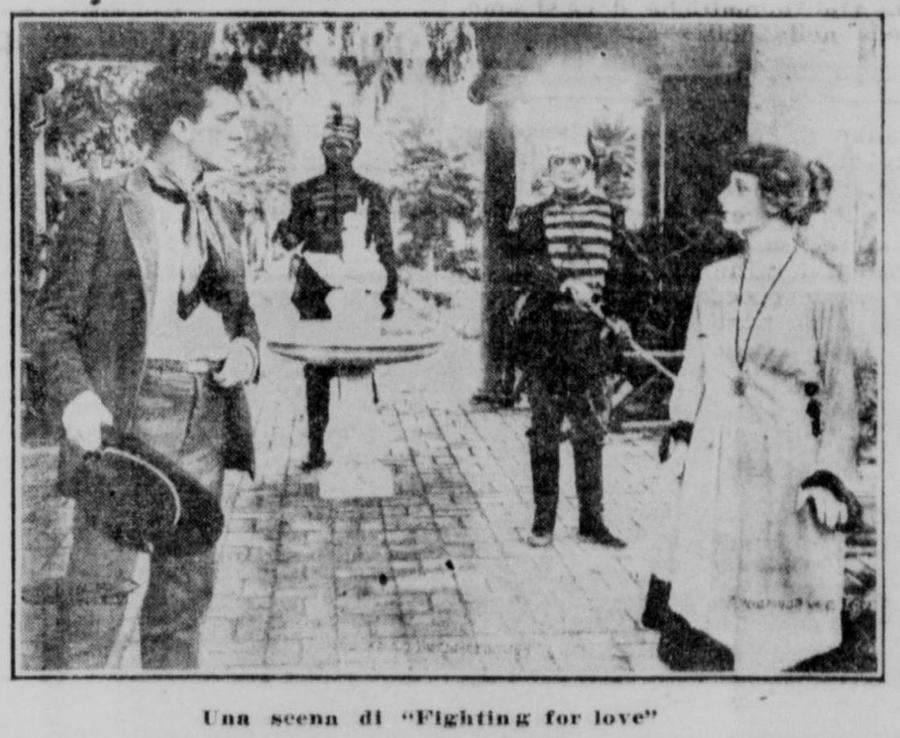
Beneath the swashbuckling froth lies a sly treatise on queenship versus womanhood. Sylvia’s dilemma—love a commoner or wed tyranny—mirrors post-suffrage anxieties circa 1920. The screenplay lets her refuse both fate and damsel trope: she mobilizes armies, negotiates with cowboys, ultimately engineers a loophole that rewrites monarchy itself. When she crowns Jim, it is not abdication but annexation—she colonizes male adventure myths with a regal gaze. The film slyly suggests sovereignty is performance, and gender merely costume; change the hat, keep the head.
Ferdinand’s court festers in chiaroscuro candlelight, ceilings echoing with unpaid tithes; meanwhile Jim’s posse rides through solar flares of California stock footage. Wells juxtaposes rot against frontier dawn, implying Europe’s exhausted rituals can only be jump-started by yankee dynamism. Yet the film refuses jingoism: the cowboys’ coup is infantile, their governance a literal gag. Fighting for Love chuckles at both empires and rodeos, finding salvation in the liminal—love that transcends latitude and longitude.
Cinephiles tracking proto-feminist royalty will trace a dotted line from Sylvia to The Princess of India, though the latter lacks the gender-bending political sleight. The film’s tonal whiplash anticipates The Monster and the Girl’s genre alchemy, while its siege-within-romance predates the muscular set pieces of The Explosion of Fort B 2. Yet none of those cousins attempt the gonzo leap from medievalism to Marlboro, making Fighting for Love an evolutionary dead-end—bright, bizarre, unrepeatable.
Restored prints reveal a five-tone palette: cyan for courtly interiors, amber for exteriors, magenta for romantic interludes, desaturated green for conspiratorial whispers, blood-orange for combat. The absence of synchronized sound amplifies texture—every sword clang is suggested via a crimson flash frame, every heartbeat via single-frame crimson tint looped three times. Modern viewers conditioned to THX may scoff, yet the synesthetic sleight is startling; your iris swears it hears steel.
Compositional leitmotifs recur: verticality for royalty (towering banners, upright spears), horizontality for cowboys (horizon lines, lassos). When Jim ascends the palace wall, the frame tilts 15 degrees, subtly queasing perspective until viewer equilibrium maps his audacity. Wells, slagged off as a hack in trade papers, smuggles in Germanic expressionism while studios chased Griffith mimicry.
1920 reviews were politely baffled. Motion Picture News praised Stonehouse’s “statuesque pathos” but dismissed the plot as “alphabet soup spilled across centuries.” The film vanished from circulation by 1924, its hybrid DNA unfit for either flapper comedy or costumed prestige. Rediscovery arrived 2014 when a 9.5 mm condensation reel surfaced at a Belgian flea market; digital restoration by IndieCollect sparked a micro-cult. Twitter threads dissect its gender politics; Letterboxd lists rank it adjacent to Ingeborg Holm for emotional heft—an odd bedfellow, yet testimony to its emotional stealth.
Works: audacious tonal mash-up, progressive queen protagonist, tinting as narrative syntax, stunt choreography that puts CGI armies to shame.
Grinds: comic ethnic sidekick Noble Johnson saddled with cringe vernacular; a cavalry rescue that dispels tension ten minutes too early; post-climax amble that feels like contractual reel-padding.
Yet even flaws radiate period charm—the sidekick’s exaggerated gestures lampoon minstrelsy while exposing its artifice, a meta-wink available to 2020s viewers attuned to performative race. The premature rescue undercuts suspense but gifts the finale a relaxed, almost Howard Hawks-ian camaraderie where men chew the fat while awaiting narrative curtain.
Fighting for Love is a celluloid comet—tail blazing sea-blue, core molten orange—scorching across silent skies once, then gone. Its value is not coherence but combustion: a reminder that cinema’s adolescence was wild, willing to wed princess to cowboy, war to whimsy, tint to truth. Watch it for the gonzo history lesson; cherish it for the moment when a queen lowers her crown onto a dusty Stetson, abdicating not power but precedent, proving love itself can be a country whose borders redraw with every heartbeat.
IMDb —
1923
Community
Log in to comment.