DbcultAccessing Vault...
Cult Review
Senior Film Conservator
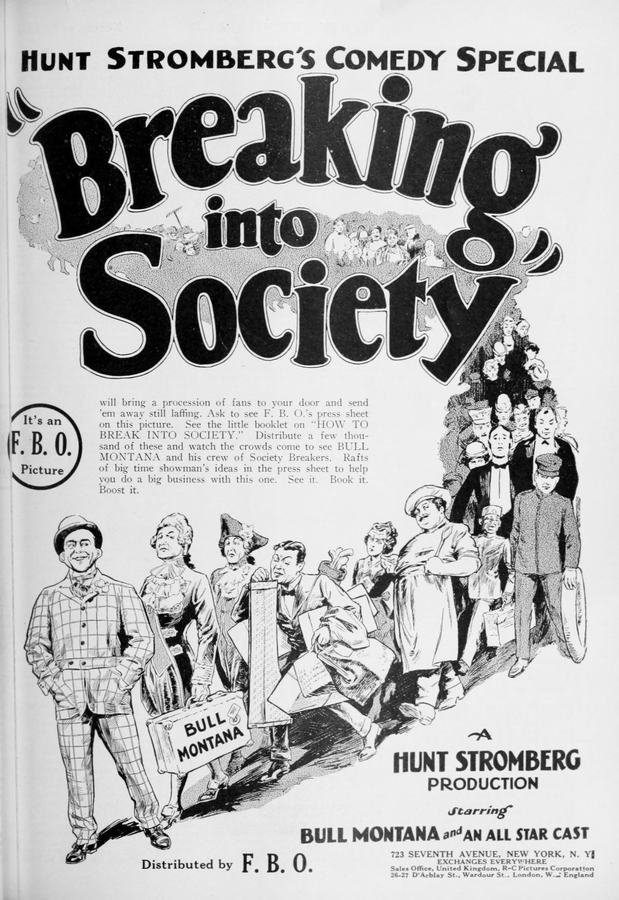
The silent comedy Breaking Into Society arrives as a curious artifact of early‑twentieth‑century American cinema, a film that simultaneously lampoons and reveres the frantic pursuit of social acceptance. Directed by the industrious Hunt Stromberg, the picture follows the O'Tooles—an unassuming family suddenly flush with wealth—who relocate to the fashionable enclave of Pasadena with a singular ambition: to be welcomed into the upper‑echelon circles that dominate the city’s social calendar.
The narrative unfolds with the precision of a well‑rehearsed ballroom waltz. The O'Tooles, portrayed by a roster of seasoned character actors—Carrie Clark Ward as the matriarch, Bull Montana as the boisterous patriarch, and Gertrude Short as their bright‑eyed daughter—embark on a campaign of ostentatious hospitality. Their inaugural dinner party, set in a sun‑lit patio overlooking the Pacific, is a tableau of immaculate silver service, crystalline glassware, and a menu that reads like a culinary manifesto. The guests, a constellation of Pasadena’s self‑styled aristocracy, initially react with a mixture of awe and polite curiosity, their murmurs echoing the film’s title: they are, after all, witnessing an earnest attempt to “break into” a world that has long been closed to outsiders.
Stromberg’s script, though sparse in dialogue—relying heavily on intertitles—exploits visual comedy to its fullest. The O'Tooles’ meticulous manners, exaggerated for effect, become a satirical mirror reflecting the absurdity of performative civility. The film’s climax erupts when the so‑called “Pittsburgh Kid” (Bull Montana) and his Bowery wife Yvonne (Florence Gilbert) crash the soirée uninvited. Their arrival is not signaled by a polite knock but by a sudden clatter of boots and a raucous laugh that reverberates through the manicured garden. The juxtaposition of the Kid’s raw, industrial swagger against the O'Tooles’ cultivated veneer creates a visual and thematic rupture, exposing the fragility of the social façade the family has painstakingly constructed.
Bull Montana, a former circus strongman, brings a kinetic physicality to the role of the Pittsburgh Kid. His movements are deliberately unrefined, a stark counterpoint to the O'Tooles’ measured grace. When he bursts through the garden gate, the camera lingers on his muscular silhouette, emphasizing the collision of two worlds—industrial grit versus suburban polish. Florence Gilbert’s Yvonne, with a cigarette perpetually perched between her lips, embodies the archetype of the liberated, street‑wise woman, her eyes flashing mischief as she surveys the bewildered guests.
In contrast, Carrie Clark Ward delivers a performance steeped in dignified restraint. Her eyes, often narrowed in a practiced display of aristocratic poise, betray a flicker of insecurity that becomes more pronounced as the Kid’s intrusion escalates. Stanhope Wheatcroft, cast as the O'Tooles’ son, oscillates between earnest admiration for his parents’ ambition and a palpable discomfort when the party’s decorum collapses. The supporting cast—Leo White, Tiny Sandford, and Charles Reisner—populate the film with a chorus of society’s peripheral figures, each contributing a nuanced layer to the social tapestry.
Cinematographer Charles J. Stumar (uncredited) employs a palette that, while constrained by the monochrome medium, hints at the opulence of the setting through meticulous set design. The contrast between the bright, sun‑lit patio and the shadowed interior rooms underscores the duality of public display versus private anxiety. The film’s use of deep focus—particularly in the climactic scene where the Kid and Yvonne occupy the foreground while the O'Tooles’ guests scramble in the background—creates a visual hierarchy that mirrors the social hierarchy being critiqued.
The intertitles, rendered in a stylized Art Deco font, serve not merely as narrative bridges but as visual punctuation, each framed by a thin border of dark orange (#C2410C) that subtly reinforces the film’s thematic coloration. The occasional splash of yellow (#EAB308) in the decorative motifs of the banquet table—such as gilded napkin rings—provides a visual cue to the audience, highlighting the artificiality of the O'Tooles’ attempts at grandeur.
While Breaking Into Society stands as a singular comedic venture, it shares a thematic kinship with other silent-era satires that probe the American obsession with class mobility. For instance, The Price of Folly similarly explores the perils of aspirational excess, albeit through a more melodramatic lens. Both films employ the device of an uninvited outsider to destabilize the protagonist’s constructed world, yet Breaking Into Society leans more heavily on slapstick physicality, a hallmark of Bull Montana’s screen persona.
In contrast, The Tango Cavalier utilizes dance as a metaphor for cultural integration, whereas Breaking Into Society opts for the dinner party—a more static, ritualistic setting—to dramatize the clash of cultures. The film’s brevity (approximately 70 minutes) forces a compressed narrative rhythm, making every visual gag and intertitle count.
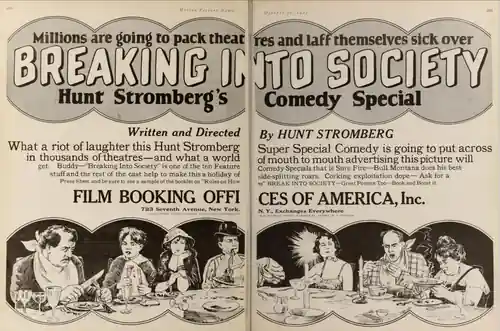
The production design team, though uncredited, deserves commendation for crafting an environment that feels simultaneously authentic and exaggerated. The O'Tooles’ mansion, a modest bungalow transformed through strategic camera angles and lavish set dressing, appears as a palatial estate to the untrained eye. The dinnerware—delicate porcelain with intricate patterns—acts as a visual metaphor for the fragile veneer of the family’s newfound status.
Rags the Dog, the film’s canine cameo, provides a moment of levity amidst the tension. His brief appearance, trotting across the polished floor with a silk collar, underscores the absurdity of the O'Tooles’ attempts to emulate aristocratic customs, even extending to pet accessories.
The pacing of Breaking Into Society adheres to the classic three‑act structure: exposition (the O'Tooles’ arrival and preparation), complication (the dinner party and initial success), and resolution (the Kid’s intrusion and the subsequent chaos). However, Stromberg subverts expectations by allowing the third act to dissolve into a series of rapid, almost chaotic visual jokes, rather than a tidy moral resolution. This choice reflects the film’s underlying skepticism toward the notion that wealth alone can secure social legitimacy.
The film’s conclusion—an ambiguous tableau of the O'Tooles standing amid the wreckage of broken china and scattered guests—leaves the audience pondering whether the family will retreat to anonymity or double down on their social aspirations. The final intertitle, rendered in a bold, sea‑blue (#0E7490) font, reads, “Society, like a fragile crystal, shatters under the weight of pretension,” encapsulating the film’s central thesis.
While the film itself is silent, contemporary screenings often paired it with a piano score that oscillated between light‑hearted ragtime during the dinner scenes and a more discordant, percussive motif when the Kid and Yvonne entered. This musical dichotomy reinforces the visual contrast, guiding the audience’s emotional response without the need for spoken dialogue.
Although Breaking Into Society did not achieve the commercial success of contemporaneous comedies starring Charlie Chaplin or Buster Keaton, its exploration of class anxiety resonates in today’s social media‑driven culture. The O'Tooles’ meticulously curated image, designed to impress an audience of unseen observers, mirrors modern influencers’ perpetual quest for validation through curated feeds.
The film also anticipates later cinematic examinations of social mobility, such as the 1930s screwball classic Red Crossed, where characters navigate the treacherous waters of wealth and reputation. In this sense, Breaking Into Society can be viewed as a proto‑screwball, employing rapid-fire visual comedy to dissect the absurdities of class aspiration.
Bull Montana’s career, though largely defined by his imposing physicality, finds a rare moment of nuance in this film. His ability to transition from a menacing figure to a comedic catalyst showcases a versatility often overlooked in silent‑era scholarship. Similarly, Gertrude Short’s brief yet memorable appearance as the O'Tooles’ neighbor foreshadows her later work in early talkies, where her expressive face translated seamlessly to sound cinema.
Hunt Stromberg, who later became a prominent producer at MGM, demonstrates an early aptitude for balancing commercial appeal with thematic depth. His later productions, such as The Call of the East, would further explore cultural intersections, suggesting that the social commentary in Breaking Into Society was not an isolated experiment but part of a broader artistic trajectory.
In sum, Breaking Into Society stands as a compelling study of pretension, ambition, and the inevitable collision between authenticity and affectation. Its visual humor, anchored by strong performances and thoughtful production design, offers a window into the social dynamics of 1920s America while maintaining a timeless relevance. For scholars of silent cinema, the film provides a fertile case study in how comedy can serve as a vehicle for incisive social critique. For contemporary audiences, it offers both laughter and a mirror reflecting the perennial desire to belong.
IMDb 6.6
1935
Community
Log in to comment.