DbcultAccessing Vault...
Cult Review
Senior Film Conservator
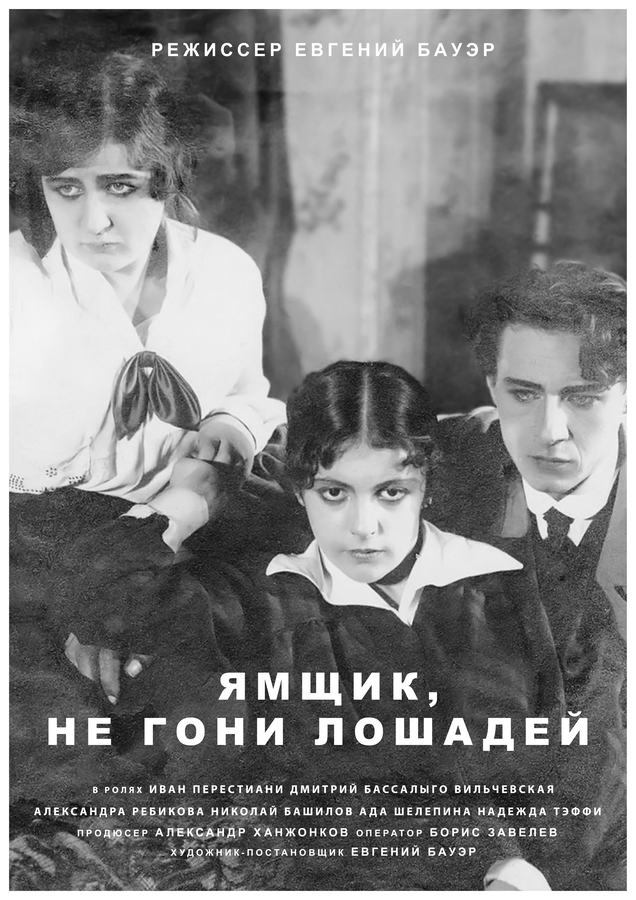
In the annals of early Russian cinema, a name that resonates with profound artistic integrity and an almost melancholic aesthetic brilliance is that of Yevgeny Bauer. His filmography, tragically cut short by his untimely demise, remains a testament to a visionary whose command over visual storytelling transcended the nascent limitations of the medium. Among his most poignant works stands Jamshhik, ne goni loshadej (The Coachman, Don't Drive Your Horses), a 1916 silent drama that delves into the profound desolation of unrequited affection and the crushing weight of time's relentless march. This isn't merely a film; it is a meticulously crafted elegy, a somber poem rendered in celluloid, exploring the human condition with an unflinching gaze.
The narrative, deceptively simple in its premise, unfolds with a psychological depth that belies its era. We are introduced to a provincial landowner, a man whose youth has long since receded into the mists of memory, leaving behind a landscape of quiet resignation. His existence, presumably one of routine and an ever-present, gnawing emptiness, is abruptly disturbed by the sudden, overwhelming onset of an attraction to a young girl. She is a beacon of vibrant youth, an embodiment of everything he has lost or perhaps never truly possessed. This magnetic pull, however, is not a gateway to rekindled joy but rather a cruel mirror reflecting his own advanced years and the chasm of difference between them.
Bauer masterfully uses the setting sun as more than just a backdrop; it is a profound metaphor for the twilight of the protagonist's own life, a visual echo of his fading hopes. The golden hues, initially promising warmth, gradually give way to the encroaching shadows, symbolizing the inevitable descent into despair. The film doesn't shy away from depicting the raw, almost painful futility of his affections. There is no grand romantic gesture, no heroic pursuit; instead, there is a quiet, internal struggle, a man grappling with the harsh realities of age, societal expectations, and the unyielding nature of desire when confronted with its impossibility.
The performances in Jamshhik, ne goni loshadej are a clinic in silent film acting, relying heavily on exaggerated yet nuanced facial expressions and body language to convey complex emotional states. Nikolay Bashilov, as the landowner, delivers a performance steeped in quiet agony. His eyes, often downcast or gazing into the distance, speak volumes of his inner turmoil. One can almost feel the weight of his unexpressed longing, the burden of a heart that yearns against all reason. His gestures, often hesitant or resigned, paint a vivid picture of a man trapped by his circumstances and his own desires.
Aleksandra Rebikova, portraying the young object of his affection, embodies an effortless grace and vivacity that starkly contrasts with Bashilov's melancholic gravitas. Her youth is not merely an age but a force of nature, a vibrant energy that inadvertently highlights the landowner's decrepitude. The interplay between these two central figures, despite the lack of dialogue, creates a palpable tension, a silent dialogue of unspoken desires and stark realities. Nadezhda Teffi, Ada Shelepina, and Ivane Perestiani, though perhaps with less screen time, contribute to the film's rich tapestry of provincial life, each face adding another brushstroke to Bauer's intricate portrait of a society on the cusp of profound change.
Yevgeny Bauer's directorial genius truly shines through in his unparalleled command of mise-en-scène. He transforms every frame into a carefully composed painting, where objects, lighting, and spatial arrangement are imbued with symbolic meaning. The 'empty house' to which the protagonist ultimately returns is not just a dwelling; it is an extension of his soul, a physical manifestation of his internal void. Its silent corridors and desolate rooms echo the hollowness of his hopes, the crushing realization that his dreams have collapsed into an inescapable solitude. This architectural symbolism is a recurring motif in Bauer's work, often reflecting the psychological states of his characters, much like the opulent yet suffocating interiors seen in other contemporary dramas.
His use of chiaroscuro, the dramatic interplay of light and shadow, is particularly striking. Shadows are not merely an absence of light but active participants in the storytelling, often engulfing characters, symbolizing their despair or the hidden aspects of their psyche. The sunset scenes, as mentioned, are not just beautiful; they are a visual metaphor for endings, for the closing chapters of life and love. The deliberate pace, the lingering shots, and the careful framing all contribute to an atmosphere of profound introspection and melancholy, drawing the viewer into the protagonist's subjective experience of despair.
The central theme of Jamshhik, ne goni loshadej—the futility of clinging to youthful dreams in old age, the collapse of hopes—finds echoes in several other films of the era, both Russian and international. One might draw parallels to the emotional desolation explored in Bauer's own Slave of Sin, where characters are often entrapped by societal conventions or their own destructive passions, leading to tragic outcomes. While Slave of Sin might focus more on the external pressures of social transgression, 'Jamshhik' delves deeper into the internal, existential crisis of the individual.
The 'collapse of hopes' is a motif that resonates with the very title and plot of The House Built Upon Sand, suggesting a shared cinematic language of precarious dreams and inevitable downfall. Both films, in their own unique ways, articulate the fragility of human aspirations when confronted with harsh realities. Similarly, the theme of forbidden or unattainable love, often fraught with moral quandaries and societal disapproval, can be seen in films like The Path Forbidden, though 'Jamshhik' distinguishes itself by emphasizing the internal, self-imposed futility rather than external obstacles.
Bauer's films, including this one, often explored the intricate psychological landscapes of their characters, a characteristic that set them apart from many of their Western contemporaries who might have focused more on overt action or melodramatic plotlines. While films like The Battle of Life might present grander struggles, Bauer's battles are fought within the confines of the human heart, making them no less impactful. The quiet desperation of the landowner, his ultimate retreat into an empty house, is a powerful statement on the human condition, a premonition of the existential angst that would define much of 20th-century art.
The enduring power of Jamshhik, ne goni loshadej lies in its universal appeal, its ability to transcend its historical context and speak to fundamental human experiences. Who among us has not, at some point, yearned for the unattainable, felt the sting of regret, or confronted the harsh realities of aging and lost opportunities? Bauer doesn't offer easy answers or saccharine resolutions; instead, he presents a raw, unvarnished depiction of emotional suffering, allowing the viewer to sit with the discomfort of human vulnerability.
His influence on subsequent filmmakers, particularly in the realm of psychological drama and visual symbolism, cannot be overstated. He was a master of creating mood and atmosphere, of using the cinematic apparatus to explore the inner workings of the mind. Even when compared to the more overtly dramatic narratives of films like The Crime of the Camora or the fantastical elements of The Brass Bottle, Bauer's work retains a distinct gravitas, a grounded exploration of human emotion that feels remarkably modern.
In an era dominated by nascent techniques and often simplistic narratives, Bauer's films, including this poignant masterpiece, stand as beacons of artistic ambition and profound insight. They remind us that cinema, even in its infancy, was capable of exploring the deepest recesses of the human heart, of crafting stories that resonate with timeless truths. To watch Jamshhik, ne goni loshadej today is to witness not just a historical artifact, but a vibrant, living piece of art that continues to provoke thought and stir the soul, a testament to Bauer's enduring genius and the power of silent cinema to communicate volumes without a single spoken word.
The final image of the landowner retreating to his empty house, the last vestiges of hope dissipating with the fading light, is an indelible one. It’s a powerful, almost unbearable depiction of despair, yet it’s rendered with such artistic grace that it becomes a meditation on the human condition itself. Bauer's ability to evoke such profound emotion with purely visual means solidifies his place as one of the true pioneers of cinematic art, a master storyteller whose tales of human frailty and longing continue to captivate and move audiences over a century later.
IMDb 6.6
1935
Community
Log in to comment.