DbcultAccessing Vault...
Cult Review
Senior Film Conservator
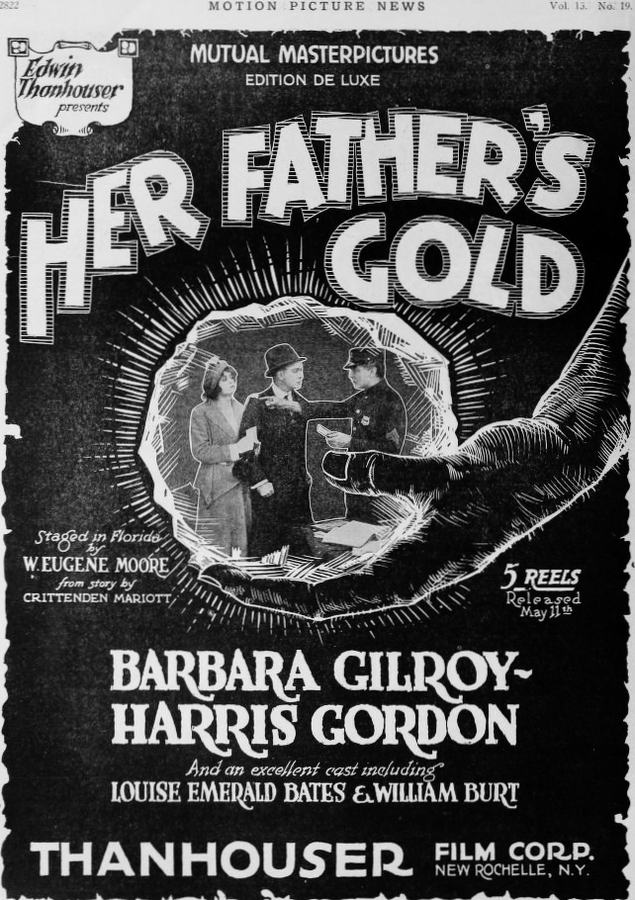
Ah, the grand tapestry of early cinema, a realm where narratives unfurled with a glorious, often breathless, ambition. And within this rich archive, we discover a true gem: Her Father's Gold. This isn't merely a film; it's a rollicking expedition into a bygone era of storytelling, where every twist of fate feels both preposterous and utterly compelling. From the moment the curtain rises on this intricate saga, we are whisked away into a world brimming with illicit treasure, shadowy betrayals, burgeoning romance, and the tantalizing whisper of the supernatural. It’s a film that dares to ask: what price gold, and what depths will humanity plumb to possess it?
Our journey commences not with a quiet meditation, but with the robust skepticism of a star reporter, a man whose cynicism is as sharp as his journalistic instincts. He’s dispatched to the sun-drenched, yet strangely ominous, shores of Crystal Lake, Florida, tasked with debunking the local superstitions surrounding a fearsome "water devil." Yet, beneath this veneer of professional duty lies a far more personal, indeed, a more passionate, quest. This intrepid newsman is on a dual mission: to locate his sweetheart and, more pressingly, to unearth a vast fortune in gold bullion, cruelly pilfered from her father's Mexican mine. The narrative, even in its initial exposition, establishes a captivating tension between the rational and the mythical, a conflict that permeates every frame of this cinematic adventure. It’s a delicate dance between the tangible glint of gold and the intangible dread of an unseen leviathan, setting the stage for a grand, almost operatic, drama.
The gold itself, the very fulcrum of this elaborate plot, possesses a history as convoluted as a tangled fishing net. It begins in Mexico, where a quartet of avaricious crooks conspire to seize the mine owner's wealth. But as is often the case with such ill-gotten gains, honor among thieves is a fleeting concept. One of the villains, a master of duplicity, orchestrates a cunning double-cross, marooning his unsuspecting confederates on a desolate island within Crystal Lake. He then meticulously buries the treasure, absconding North with the grand design of returning later, once the dust has settled and the heat has dissipated. However, fate, ever the mischievous playwright, intervenes. His marooned partners, displaying an unexpected resilience, escape their watery prison far sooner than anticipated. Their trail leads them North, a relentless pursuit culminating in the besieged sanctuary of the double-crosser's own home. This rapid escalation of events, this relentless cat-and-mouse game, injects a palpable sense of urgency into the narrative, keeping audiences on the edge of their seats, much like the breathless suspense found in films such as Tangled Fates, where character destinies are inextricably intertwined by betrayal and ambition.
Cornered, with the hounds of vengeance baying at his heels, the beleaguered crook performs an act of desperate ingenuity. He encodes the gold's precise location within a seemingly innocuous blue watercolor painting, hanging it prominently on his wall – a masterpiece of deception hidden in plain sight. This artistic subterfuge is a stroke of narrative brilliance, transforming a simple domestic object into a pivotal plot device. Moments later, a violent confrontation erupts, leaving him tragically blinded and mortally wounded. His final, cryptic utterance from his hospital bed – "The blue picture; the blue picture" – delivered to his true wife who arrives tragically late, serves as the ultimate enigmatic clue. This scene, laden with pathos and a profound sense of last-gasp urgency, resonates with the desperate final pleas and coded messages often seen in pulp fiction thrillers, where secrets are whispered on the very edge of oblivion. The dramatic irony here is exquisite: the secret is revealed, but its meaning remains tantalizingly out of reach, a puzzle wrapped in a riddle, shrouded in blue.
The narrative, never one to linger, propels us forward into the aftermath. The widow, now penniless and utterly baffled by the cryptic "blue picture," attempts to enlist the aid of the original mine owner, proposing a division of the treasure if he can help decipher its location. Before the owner's daughter, our intrepid heroine, can even respond to this desperate plea, the vengeful crooks strike again. They brutally murder the widow, seizing the blue painting which they rightly suspect holds the key to the fortune. This act of cold-blooded violence underscores the sheer ruthlessness of the antagonists, painting them as truly formidable adversaries. It is amidst the grim tableau of this very crime scene that our star reporter, investigating the murder, first encounters the mine owner's daughter. In a classic cinematic flourish, a spark of romance ignites amidst the ashes of tragedy, a tender bloom in the desolate landscape of greed and death. Their connection, forged in the crucible of shared purpose and burgeoning affection, becomes the emotional anchor of the film, providing a much-needed counterpoint to the relentless pursuit of wealth.
It is here, too, that the reporter makes a crucial discovery: a mere fragment of the enigmatic blue painting. Its importance is immediately, almost viscerally, underscored by the relentless and increasingly desperate efforts of a surviving crook's wife to steal it from him. Her avarice, her single-minded determination, serves as a beacon, guiding the reporter towards the truth. In a clever strategic maneuver, he allows her to "steal" the fragment, knowing full well that she will lead him directly to her Florida shack. This shack, a den of villainy, is situated on the very banks of Crystal Lake, the ominous domain of the fabled water devil. The stage is now perfectly set for the film's climactic sequence, with all the key players converging on this solitary, foreboding location. This deliberate cat-and-mouse game, the calculated release of information to lure a villain, is a narrative technique that builds exquisite suspense, reminiscent of the intricate plotting found in films like The Scarlet Woman, where deception and pursuit often drive the core of the story.
Our resourceful reporter, hesitant to simply abscond with the entire painting, opts for a more clandestine approach: photography. He believes that capturing an image of the blue picture will allow him to decipher its hidden secrets at his leisure. However, in a stroke of deliciously frustrating dramatic irony, he discovers a fundamental flaw in his plan: blue, being non-actinic, does not photograph. The resulting film is blank, a symbol of his momentary failure, a void where answers should have been. His sweetheart, who develops the film for him, offers solace and comfort in this moment of shared disappointment. Together, they discard the seemingly useless film, their hopes dashed, believing that the pictured scene would have provided the elusive location of the gold. This setback, though disheartening, only serves to deepen the audience's investment in their struggle, highlighting the formidable obstacles they face.
But the narrative, much like the currents of Crystal Lake itself, harbors hidden depths and unexpected turns. The discarded, seemingly worthless film, in a twist of fate that only classic cinema can deliver with such panache, falls into the hands of the very woman who now possesses the original blue painting. And here, the genius of the plot truly reveals itself. With the aid of a magnifying glass, she makes an astonishing discovery: the hidden writing and the intricate plan, obscured by the blue watercolor, *did* photograph through, rendering the secret perfectly legible! The blue, rather than being an impediment, became a filter, allowing the truth to emerge for those with the right tools and perspective. This revelation is a moment of pure, unadulterated narrative exhilaration, a testament to the film's inventive spirit. It reminds us that often, what appears to be a failure can, in the right circumstances, become the very key to success. This ingenious plot device, where a seemingly useless object suddenly holds immense power, creates a powerful surge of tension, as the audience knows the secret is now within reach of the wrong hands.
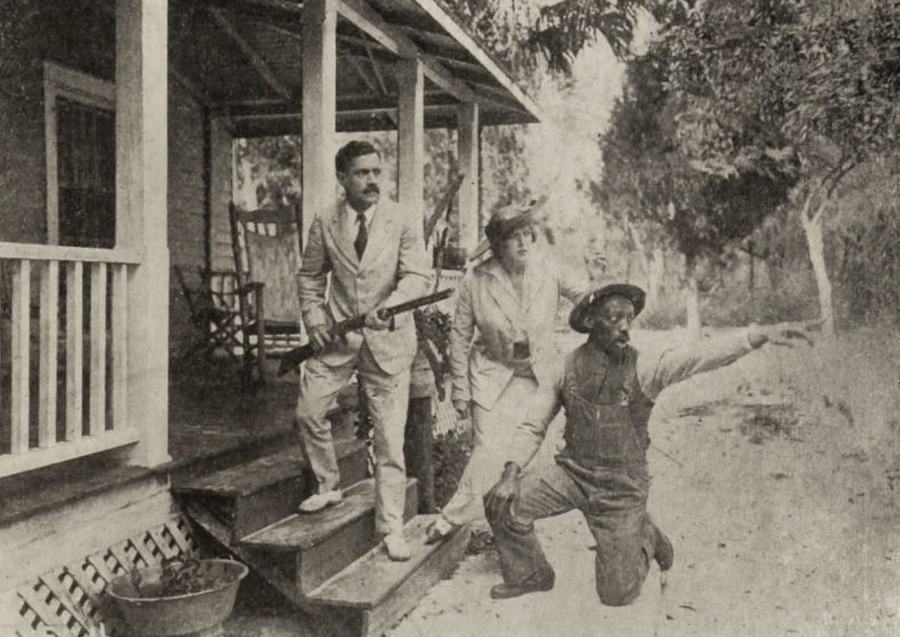
With the secret of the gold now within her grasp, the villainess prepares to relay her findings to her husband, anticipating their triumphant escape with the treasure. But just as the nefarious plan approaches fruition, the mine owner's daughter, demonstrating remarkable agency and courage, intervenes. In a swift, decisive act, she reclaims the film, locks up the crook's wife, and races to inform the reporter of their breakthrough. The gold, at long last, seems within the rightful owner's reach. Yet, the film has one more cruel twist in store, one more turn of the screw to tighten the suspense. Unbeknownst to our triumphant duo, the imprisoned woman's husband, the sole surviving male crook, is *with* the reporter when the good news arrives. His presence transforms a moment of victory into one of profound peril. Feigning helpfulness, he cunningly offers to ferry the pair to the island where the gold is buried, using his boat, and even assists them in the arduous task of digging it up. His deceptive charm is a chilling reminder of the insidious nature of evil, capable of masquerading as benevolence.
The scene on the island is a masterclass in tension. The gold, shimmering in the light, is finally unearthed and loaded onto the boat. The heroes, momentarily triumphant, are now at the mercy of their cunning foe. With a chilling smile, the villain reveals his true, murderous intent: the gold is his, and they, the rightful claimants, are to die and be buried in the very hole from which the treasure was exhumed. It’s a moment of stark, brutal irony, a sudden plunge from the pinnacle of success to the abyss of despair. As the ruffian, standing triumphantly amidst the gold-laden boat, raises his rifle, poised to deliver the fatal blow, the narrative reaches its absolute zenith. Just when all hope seems lost, when the rational world has exhausted its solutions, the film unleashes its most audacious, most mythical element.
From the murky depths of Crystal Lake, a place long whispered about in local legends, rises the fabled water devil. This isn't a subtle manifestation; it's a dramatic, awe-inspiring eruption from the water, a creature of myth made flesh, or perhaps, scale. The monster, whose existence few had truly believed, seizes the would-be murderer in a spectacular, almost divine, act of retribution. It's a breathtaking deus ex machina, a sudden, powerful intervention that transcends the logical confines of the narrative, yet feels entirely earned within the film's established universe of folklore and high stakes. This moment, where the supernatural intervenes to mete out justice, elevates Her Father's Gold beyond a mere crime thriller, imbuing it with an almost folkloric grandeur. It’s a bold narrative choice, one that might feel jarring in a more grounded film, but here, it perfectly caps the escalating tension and thematic interplay between belief and skepticism.
The aftermath is one of profound relief and burgeoning joy. The daughter, having endured so much, is overjoyed to restore her father's lost fortune, a tangible symbol of justice served. But a far greater treasure awaits her. In the loving gaze of the young reporter, whose courage and unwavering devotion have been her constant companions, she finds a happiness that eclipses even the glittering gold. She consents to be his bride, sealing their future together in a moment of pure, unadulterated cinematic bliss. The film concludes not just with the resolution of a treasure hunt, but with the triumph of love, courage, and the poetic justice delivered by an ancient, watchful entity. It’s a testament to the enduring power of classic narratives to intertwine grand adventure with heartfelt romance, all while hinting at forces beyond human comprehension.
The strength of Her Father's Gold lies not just in its intricate plot, but in its audacious blend of genres. It seamlessly navigates the treacherous waters of a crime caper, the thrilling currents of a treasure hunt, the tender eddies of a burgeoning romance, and the mysterious depths of a monster movie. The pacing is relentless, a rapid-fire succession of betrayals, discoveries, and narrow escapes that keeps the audience utterly captivated. Crittenden Marriott’s writing is a masterclass in weaving complex threads into a coherent, exhilarating whole. The characters, though archetypal, possess enough distinctiveness to drive the emotional core of the story. Louise Bates, Barbara Gilroy, and Edward Lawrence, among others, bring a vibrant energy to their roles, embodying the dramatic stakes with conviction and flair. While the specific nuances of their performances might be lost to time without viewing the actual film, the plot itself suggests roles rich with opportunity for expressive acting, typical of the era.
Comparing Her Father's Gold to other films of its period further illuminates its unique charm. Its relentless pursuit of a hidden object, coupled with the romantic subplot, echoes the adventurous spirit found in films like The Primal Lure, where characters are often driven by fundamental desires and the quest for survival or wealth. The complex web of deceit and the double-crosses are reminiscent of the more intricate narrative structures seen in melodramas or early thrillers, where moral ambiguities often form the bedrock of conflict. The sudden, almost supernatural intervention of the water devil, a creature of local folklore, sets it apart from purely human-centric dramas, adding a layer of fantastical escapism that few films dared to embrace so overtly. It’s a narrative device that could be seen as a precursor to creature features, but here, it serves a distinctly moral purpose, a force of nature restoring balance.
The "blue picture" itself, a seemingly simple object, transcends its physical form to become a potent symbol. It represents hidden truths, the deceptive nature of appearances, and the idea that clarity often requires a different perspective—literally, a magnifying glass. The non-actinic blue, initially a narrative roadblock, becomes an ingenious plot mechanism, demonstrating how obstacles can reveal new pathways. This kind of symbolic richness elevates the film beyond a simple adventure story, inviting deeper reflection on the nature of secrets and revelation. The setting of Crystal Lake, too, is more than just a backdrop; it’s a character in itself, embodying both serene beauty and lurking danger, a duality that mirrors the human drama unfolding on its shores. The water devil, therefore, isn't just a monster; it's the embodiment of the lake's mysterious, untamed power, a guardian of justice in a world of human avarice.
The film’s conclusion, while perhaps leaning into the fantastical with the water devil’s appearance, delivers a deeply satisfying resolution. Justice is served, love triumphs, and the natural order, disrupted by human greed, is restored. It’s a narrative arc that speaks to universal desires for fairness and happiness, even if the means to achieve it are extraordinary. In an era where cinematic storytelling was still finding its footing, Her Father's Gold showcases a remarkable confidence in its own narrative ambition. It doesn't shy away from complexity, nor does it compromise on delivering thrilling entertainment. The film’s thematic explorations of loyalty, betrayal, and the corrupting influence of wealth are timeless, offering insights that remain relevant even today. The intertwined fates of the characters, the way their lives are pulled into the orbit of the gold, makes it a compelling study of human nature under duress, much like the intricate moral dilemmas presented in Dzieje grzechu, albeit with a more overt adventurous spirit.
In conclusion, Her Father's Gold stands as a captivating relic of its time, a testament to the inventive spirit of early cinema. It’s a film that demands engagement, rewarding its audience with a narrative that is as intricate as it is exhilarating. The blend of mystery, romance, adventure, and a dash of the supernatural creates a unique flavor that is both nostalgic and surprisingly fresh. It reminds us that sometimes, the greatest treasures are not found in glittering gold, but in the unwavering bonds of love and the triumph of justice, even if that justice is delivered by a mythical creature from the deep. This film is a delightful journey, a vibrant illustration of how compelling storytelling can transcend the limitations of its era, leaving an indelible mark on the cinematic landscape. It’s a must-see for anyone interested in the evolution of genre cinema, a shining example of how to craft a truly unforgettable adventure. The "double event" of finding both the gold and true love, amplified by the water devil's dramatic intervention, makes it a uniquely satisfying experience, on par with the satisfying resolutions found in films like The Double Event, where multiple narrative threads converge for a powerful climax.
IMDb —
1925
Community
Log in to comment.