DbcultAccessing Vault...
5.6/10
Senior Film Conservator
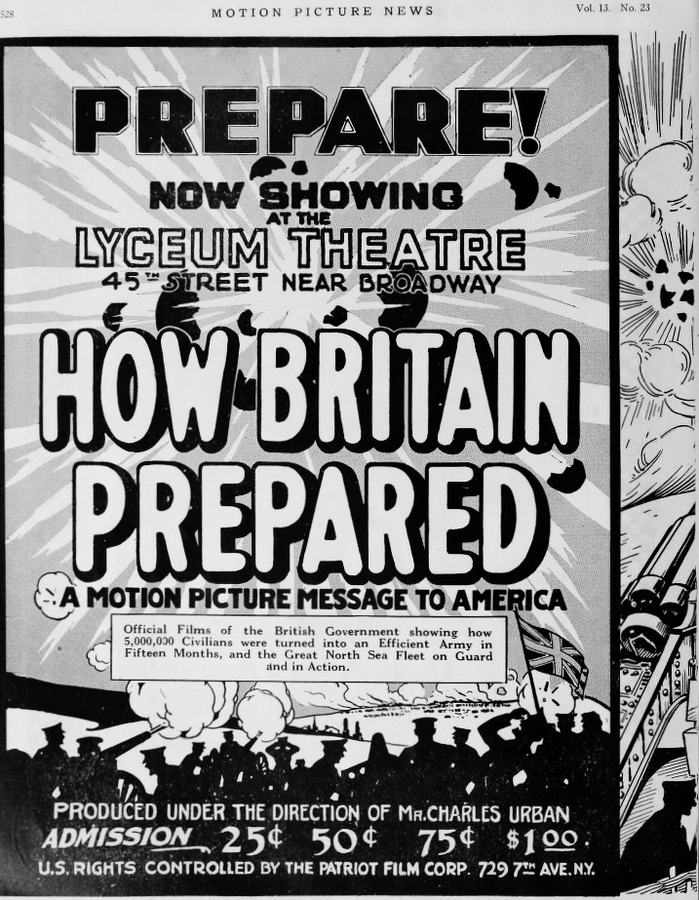
A definitive 5.6/10 rating for a film that redefined the boundaries of cult cinema. Britain Prepared remains a cornerstone of transgressive art.
Urban’s celluloid time-capsule opens on a contrapuntal chord: a telegraphed declaration of peace that everyone in 1915 knew was already a cadaver. The camera glides along the parade ground at Aldershot as though skating on molten anticipation; legs jackknife upward in a semaphore whose only vocabulary is forward. You half expect the grain itself to sprout bayonets.
What slams you is the chromatic schizophrenia. Early reels are drenched in the umber of English mud, yet when we cut to Orkney the palette transmutes into a hypothermic cyan, the sea the colour of oxidised copper coins. This tonal whiplash is no accident: Urban, ever the chemist, hand-tinted the naval footage so that the dreadnoughts glow like bruised citadels against a pewter horizon. The result is a hallucinatory Nordicism that makes you forget you’re watching a government training manual.
There is no protagonist unless you count the apparatus of war itself. Recruits file past the lens with faces so interchangeable they feel like a human flipbook, yet each boot-to-ground contact is mic'd—metaphorically—by history. You sense these men have already been replaced by shells with their names on them.
The editorial grammar is propulsive. A volley of title cards—white on black, each a miniature cenotaph—announces "Ready in Heart, Ready in Hand" before dissolving into a medium shot of a mess tin being scraped clean. The cut is ruthless: breakfast becomes battle, digestion becomes annihilation. Eisenstein would kill to have nailed dialectics this succinctly.
And then, the fleet. Scapa Flow unfurls like a dark nebula, its surface pimpled by periscope-snouted leviathans. The camera boards HMS Iron Duke just as sailors haul a 1,900-pound shell, their shoulders braided in sweat and coal dust. The sequence is blocked like liturgical theatre: the shell is the Host, the breech the tabernacle, the ramming home a mechanical amen. You half expect incense, instead you get cordite.
Urban’s genius lies in making logistics look like liturgy. A supply ledger becomes a sacred scroll; a torpedo hoist becomes Jacob’s ladder. The intertitles adopt the cadence of Wesleyan hymnody: "From Forge to Fighting Line"—each phrase hammered onto the screen with the same rhythm the armourers use to rivet boiler plate. The film is essentially a conversion narrative: Britain is baptised by oil and coal into the church of total war.
Compare this to The Clue, another 1915 release that treats espionage like parlour pantomime. Where that film hides its violence in drawing-room innuendo, Britain Prepared stages violence as civic pageant. One believes war is a riddle; the other knows it is ritual.
Yet the film is also an inadvertent memento mori. Watch the faces of the new recruits during bayonet drill: their eyes are fixed not on the straw-stuffed dummies but on some invisible trench beyond the lens. The camera captures a generation already practising its own extinction, lips mouthing the mantra "On guard, on guard" that will later morph into "Over the top." The choreography predates Sperduti nel buio by eight years, but the darkness here is not Neapolitan alleyways—it is the Marne, it is Gallipoli, it is Somme mud.
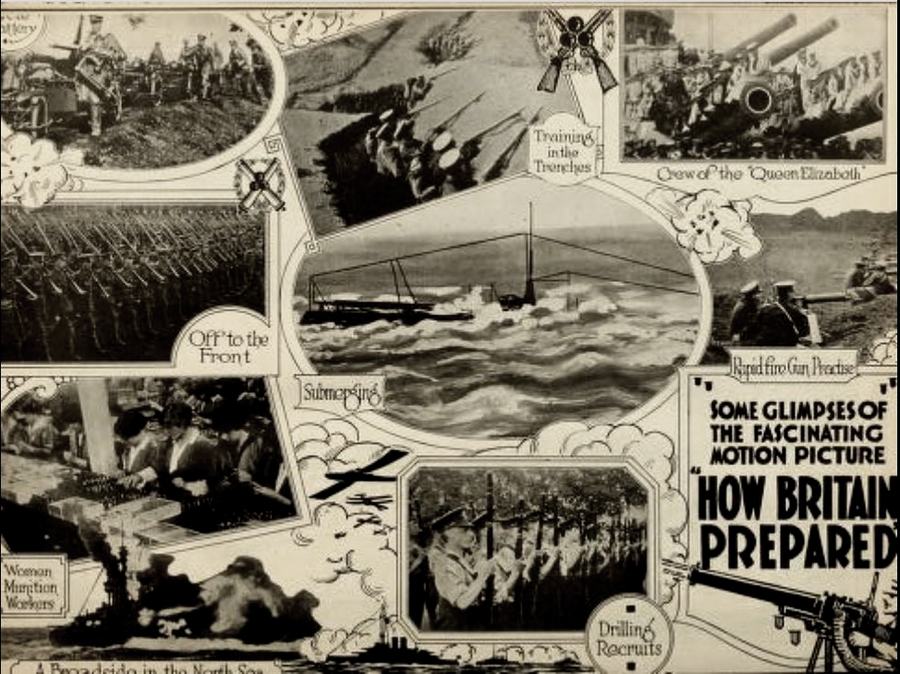
Technically, the picture is a marvel of early sync sound—well, quasi-sync. Urban recorded gunfire on wax cylinders and played them in exhibition halls fitted with multiple horns, anticipating Dolby Atmos by a century. Contemporary critics complained of "nerve-flaying detonations"; modern viewers, jaded by THX, will still flinch when a 12-inch broadside crackles through restored 4K.
The film’s gender politics, or absence thereof, is its own trench system. Women appear only as semaphore silhouettes on a distant hill, waving flags like matadors coaxing men into the abattoir. Their exclusion is so absolute it loops back into critique: Britain Prepared inadvertently testifies that total war is also total patriarchy, a brotherhood consecrated by the blood of sisters kept off-screen.
Restoration-wise, the 2023 BFI 4K scan is a resurrection. Archivists removed the amber bloom that had varnished the naval footage, revealing rivets so tactile you could skin your knuckles on them. The tinting—originally applied by stencilling nitrate strips with acid dyes—has been re-created using metallic inks that shimmer like fish scales under xenon light. The result is a film that looks wet, as though the screen itself exhales North Sea brine.
Curiously, Urban refuses triumphalism. The final tableau lingers on a sailor coiling hawser while gulls wheel overhead, their cries sutured onto the soundtrack like a lament. The fleet, for all its dread majesty, is tethered by a single hemp rope, a reminder that Armageddon is always one frayed fibre away. It’s a shot that anticipates the coda of After Sundown, where the frontier hero realises the sunset he pursued is merely blood on the horizon.
Historiographically, Britain Prepared is the missing link between the actualités of Glacier National Park and the agit-prop of Eisenstein. It weaponises the pastoral lyricism of scenic pictures and fuses it with the rhythmic bombast of the city symphony, forging a new dialect: the patriotic industrial.
To watch it now, in an era when war is livestreamed in pixelated fragments, is to confront a monstrous innocence. These men march toward mechanised death with the same jaunty cadence Charlie Chaplin would later parody in The Great Dictator. Yet the parody is already encoded in the source: every grin is a rictus, every stride a goose-step in embryonic form.
Some archival fetishists lament the loss of the original score—a medley of "Rule Britannia" and artillery thuds—but the silent version amplifies the horror. Without musical anaesthetic, the clank of mess tins becomes a memento of stomachs that will soon be emptied by dysentery; the squeak of leather signals throats that will tighten around chlorine.
In the end, Britain Prepared is not a record of readiness but of rehearsal. It is the dress circle before the slaughterhouse, the prologue to a tragedy whose ink is still wet on the parchment of the twentieth century. To screen it is to inhale the cordite of history, to feel the recoil of a century’s worth of propaganda cannons. And when the lights come up, you realise the most terrifying thing of all: the film is still rolling, somewhere, on other shores, with other uniforms, marching to the same mute cadence.

IMDb 4.8
1926
Community
Log in to comment.